Author

admin

Browsing

House Republicans are channeling Edward Hopper this week as they try to pass President Trump’s big, ‘beautiful bill.’

Hopper is known for ‘Nighthawks,’ one of the most iconic paintings in American history. The 1942 painting depicts four people in a diner in the middle of the night. A deserted streetscape commands the foreground. Two men – heads festooned with fedoras – sit separately at the counter, nursing coffee. One of the men has a cigarette tucked between his index and middle fingers. He’s positioned next to a woman with scarlet hair and a red dress. She appears to holding a bite of a doughnut or sandwich, studying it as though it were a rare artifact. She seems to debate whether she should eat it. A young counterman – attired in white with a crisp envelope hat – leans downward in search of glassware or dishes hidden underneath.

It’s the dead of night. Everyone is distant and detached. Even the couple – even though they sit side-by-side – don’t look at each other.

In Nighthawks, everyone appears as though they’re just trying to make it through the night to dawn.

It’s kind of what House Republicans are going through this week.

The House Budget Committee convened at 10:26 p.m. ET Sunday night to advance the tax cut and spending reduction package after a hiccup stalled the measure Friday afternoon. At 10:39 p.m. ET, the committee approved the bill 17-16 – with four House Republicans voting ‘present.’

The next stop is the House Rules Committee, the final parliamentary way station before depositing a piece of legislation on the floor.

At 12:31 a.m. ET Monday, the Rules Committee announced it would prep the bill for the floor – with a meeting at 1 a.m. Wednesday morning. That session could last all day Wednesday. Literally. The Energy and Commerce panel met for 26 consecutive hours last week to prepare its section of the budget reconciliation measure. The Ways and Means Committee huddled all night long.

The group of House Republicans pushing to state and local tax for high-tax states (known as SALT) scheduled a meeting with House Speaker Mike Johnson, R-La., for 9 p.m. ET Monday. And it’s entirely possible that the House could be debating or even voting on the measure late Thursday, the wee hours of Friday morning or even Friday night.

This is how Capitol Hill rolls when there’s a big piece of legislation on the clock. The hours are late. The meetings are long. Lawmakers convene different sessions whenever they need to – just to get the measure across the finish line.

The only difference between the halls of Congress now and ‘Nighthawks’ is that the coffee fueled the figures in the painting until dawn. It was 1942. But this is 2025. Edward Hopper would know nothing of Celsius or Red Bull.

There’s an actual parliamentary reason as to why the Budget Committee met so late on Sunday night after its stumble on Friday afternoon. And there’s a method to the Rules Committee’s 1 a.m. madness on Wednesday.

Let’s rewind.

The Budget Committee tried to blend the various provisions from nearly a dozen House committees into one unified legislative product midday Friday. That effort came up short. A total of five Budget Committee Republicans voted nay. They groused about spending cuts, green energy tax credits and the timeframe of work requirements for those on Medicaid.

Four of the five GOP noes were truly opposed. Rep. Lloyd Smucker, R-Penn., voted nay so he could order a re-vote. Rules allow a member on the winning side of an issue (in this case, the nays), to ask for another vote later. Smucker supported the plan. But he then switched his vote to nay to be on the winning side. That teed up a possible re-vote.

‘Calling a vote moves the process forward. I think it’s a catalyst,’ said Budget Committee Chairman Jodey Arrington, R-Tex., after the failed vote Friday.

The Budget Committee then announced it would convene at 10 p.m. ET Sunday.

This is where things get interesting:

The key here was for the Budget Committee to finish its work before midnight Friday. Once it got rolling, the process would only consume 15 or 20 minutes. The Budget Committee approved the plan 17-16 with four Republicans voting ‘present.’

‘We’re excited about what we did,’ said Rep. Ralph Norman, R-S.C., who was one of the GOPers who voted nay Friday.

But Norman still wasn’t excited enough to vote yes on Sunday night. He voted present.

‘There’s so much more that we have to do to rein in government and rein in the costs and the deficits,’ said Norman on FOX Business Monday.

But regardless, the measure was out of the Budget Committee before the witching hour on Sunday. And then came the Rules Committee announcement – just after midnight on Monday – about a session at 1 a.m. Wednesday to ready the ‘big, beautiful bill’ for the House floor.

There are several reasons House Rules Committee Republicans decided to huddle at 1 a.m. et Wednesday. Let’s begin with the parliamentary one.

The Budget Committee wrapped up just before midnight Sunday. The rules allow Democrats two full days to file their paperwork and viewpoints after that meeting. So, they had all day Monday and all day Tuesday. The Rules Committee needs an ‘hour’ to announce its formally meeting. So, the ‘official’ announcement of the Rules Committee meeting on Wednesday will go out just after 12:01:01 a.m. ET Wednesday. That triggers a 1 a.m. ET meeting on Wednesday.

Here are the other, more practical reasons.

Republicans need all the time they can get. There is talk of trying to vote on the floor late in the day on Wednesday. We’ll see about that. But the early Rules Committee meeting time makes that a possibility.

Second of all, it’s possible the Rules Committee meeting could consume the entire calendar day of Wednesday. Streams of lawmakers from both sides will file into the Rules Committee to propose various amendments. This is a protracted process.

But by the same token, meeting at 1 a.m. ET could diminish attendance. After all, who wants to show up at 1 a.m. ET for a meeting and maybe discuss your amendment at 6:30 a.m. ET? You get the idea. 

And once the bill gets out of the Rules Committee, expect late night meetings among Republicans as they try to close the deal. It’s possible the House could vote at virtually any time of day Wednesday, Thursday or Friday to pass the bill. That could be late in the evening. Or even overnight. They will vote when the bill is ready, regardless of the time on the clock.

Such is the lot drawn this week by House Republicans for the ‘big, beautiful bill.’ Maybe they’ll have the votes. Maybe they won’t. Maybe they’ll pass more spending cuts. Maybe there’ll be a deal on SALT for state and local taxes. Maybe not. Maybe the vote comes at 3 in the afternoon. But more likely, sometime late at night.

Just like in Nighthawks, everyone on Capitol Hill is just trying to make it through the night and to the dawn.


This post appeared first on FOX NEWS

As she ran for the White House in the 2024 election cycle, Nikki Haley made her calls for ‘new generational leadership’ a key component of her Republican presidential campaign.

And front and center from day 1 of her campaign as the former South Carolina governor and former United Nations ambassador declared her candidacy in February 2023 was her call for ‘mandatory mental competency tests for politicians over 75 years old.’

As Haley challenged then-76-year-old former President Donald Trump for the 2024 GOP nomination in hopes of eventually facing off in the general election against then-80-year-old President Joe Biden, the proposal became one of the most visible and at times controversial parts of her campaign stump speech.

Haley faced charges of ageism from a host of politicians opposed to the idea, including a now-83-year-old Sen. Bernie Sanders of Vermont, who at the time called her idea ‘absurd.’

While Haley’s campaign took off, and she ended up being the last Republican candidate standing against Trump during last year’s primaries, she eventually bowed out of the race in March 2024 as Trump marched toward clinching the presidential nomination.

Fast-forward to today, and long-standing questions about Biden’s physical and mental fitness – and whether Democrats should have more forcefully urged him to bow out of the 2024 race – haven’t gone away; they’re front and center.

This as Biden’s condition is once again making headlines, courtesy of excerpts from a new book being released this week, ‘Original Sin: President Biden’s Decline, Its Cover-up, and His Disastrous Choice to Run Again,’ which offers claims of a White House cover-up of the then-president’s apparent cognitive decline.

Additionally, last week’s leaked audio of Biden’s 2023 interview with Special Counsel Robert Hur, in which the then-president appears to suffer memory lapses, is also fueling the conversation.

Hur, who investigated whether Biden years earlier had improperly stored classified documents, made major headlines early last year when he decided not to charge Biden but described the then-president as an ‘elderly man with a poor memory.’

Last week’s developments were followed by Sunday’s blockbuster announcement that Biden was diagnosed with an aggressive form of prostate cancer that had spread to his bones.

The news, while eliciting sympathy from both sides of the political aisle, is unlikely to sidetrack the current firestorm over the former president’s mental acuity.

‘While the media may have been shocked by Nikki’s call for mental competency tests, Americans never were,’ a source in Haley’s political orbit told Fox News. ‘It was common sense. Nikki always believed our leaders should be completely transparent and remember who they serve: the American people. After a yearslong cover-up, those who hid President Biden’s mental decline must finally acknowledge what Nikki and the American people always knew to be true.’

Haley, who was 51 when she announced her candidacy in 2023, reupped her calls for a mental competency test throughout her campaign.

In January last year, during the heat of the primary battle, Haley pointed to some verbal stumbles by Trump on the campaign trail.

‘He’s not what he was in 2016. He has declined. That’s a fact,’ Haley said at the time.

Trump repeatedly fired back as he touted acing a cognitive test he took five years earlier and said, ‘I think I’m a lot sharper than her.’

A month later, after the release of Hur’s written report regarding Biden’s mental acuity, Haley said, ‘Joe Biden can’t remember major events in his life, like when he was vice president or when his son died.’

‘That is sad, but it will be even sadder if we have a person in the White House who is not mentally up to the most important job in the world,’ she added as she reiterated her calls for Biden to take a mental competency test ‘immediately.’

Haley, in a Fox News op-ed in May 2023, spelled out the specific test she recommended for politicians over age 75.

‘The Montreal Cognitive Assessment Test is a widely used tool for detecting cognitive decline,’ Haley wrote at the time.

And she elaborated, ‘This is not a qualification for office. Failing a mental competency test would not result in removal. It is about transparency. Voters deserve to know whether those who are making major decisions about war and peace, taxation and budgets, schools and safety can pass a very basic mental exam.’

Veteran political scientist Wayne Lesperance, noting the current media spotlight on Biden, said it has ‘renewed concerns many Americans have about the age and ability of our elected officials. Public service demands clarity of thought, sound judgment, and the ability to manage complex issues.’

And Lesperance, president of New England College, said ‘Americans must conclude that a fair and nonpartisan cognitive assessment, perhaps irrespective of age, is important to ensure all who seek to lead are equipped to serve with the sharpness and clarity the role requires.’

This post appeared first on FOX NEWS

A federal judge blocked the Trump administration’s dismantling of the U.S. Institute of Peace, writing in a ruling that the removal of its board members and the takeover of its headquarters by members of the Department of Government Efficiency (DOGE) are actions that are ‘null and void.’ 

The response this week from U.S. District Court Judge Beryl Howell comes after the Institute filed a lawsuit against the Trump administration in March calling for ‘the immediate intervention of this Court to stop Defendants from completing the unlawful dismantling of the Institute and irreparably impairing Plaintiffs’ ability to perform their vital peace promotion and conflict resolution work as tasked by Congress.’ 

‘The Administration removed the Institute’s leadership, including plaintiff Board members and its president in contravention of statutory limitations, and had personnel from a newly created federal office, called the Department of Government Efficiency, forcibly take over the Institute’s headquarters on March 17,’ Howell wrote in her ruling. ‘With a newly installed USIP president, the Administration then handed off USIP’s property for no consideration and abruptly terminated nearly all of its staff and activities around the world.’

‘Congress’s restrictions on the President’s removal power of USIP Board members are squarely constitutional, and the President and his Administration’s acts to the contrary are unlawful and ultra vires. The actions that have occurred since then – at the direction of the President to reduce USIP to its ‘statutory minimums’ – including the removal of USIP’s president, his replacement by officials affiliated with DOGE, the termination of nearly all of USIP’s staff, and the transfer of USIP property to the General Services Administration, were thus effectuated by illegitimately-installed leaders who lacked legal authority to take these actions, which must therefore be declared null and void,’ she added. 

The Institute of Peace is an independent, national institution funded by Congress that was established in 1984 under the Reagan administration to promote peace and diplomacy on the international stage.  

‘Congress has endorsed USIP’s important work by continuing to fund the Institute through appropriations bills signed by seven different Presidents from both major political parties, including the current President during his first term in office,’ Howell said in the ruling.  

‘In a drastic and abrupt change of course, within the first month of his second term, President Trump unilaterally decided that USIP is ‘unnecessary,’ issuing Executive Order 14217 to this effect, and then his Administration rushed through actions, including removal of Board members, to reach the professed goal of reducing all of USIP’s operations and personnel to the bare minimum to perform only mandated statutory tasks, while ignoring the broader statutory goals set out for this organization to fulfill,’ she also said. 

Ultimately, Howell concluded, the Trump administration’s actions ‘represented a gross usurpation of power and a way of conducting government affairs that unnecessarily traumatized the committed leadership and employees of USIP, who deserved better.’

The White House did not immediately respond Tuesday to a request for comment from Fox News Digital. 

In March, it said the Trump administration gutted the Institute of Peace of ‘rogue bureaucrats’ who held a tense standoff with a DOGE team that required police intervention. 

‘Rogue bureaucrats will not be allowed to hold agencies hostage,’ White House spokeswoman Anna Kelly said at the time. ‘The Trump administration will enforce the president’s executive authority and ensure his agencies remain accountable to the American people.’ 

The administration now has 30 days to file an appeal to the ruling.

‘The United States Institute of Peace has existed for 40 years on a $50 million annual budget, but failed to deliver peace,’ Kelly told the Associated Press. ‘President Trump is right to reduce failed, useless entities like USIP to their statutory minimum, and this rogue judge’s attempt to impede on the separation of powers will not be the last say on the matter.’ 

Fox News Digital’s Emma Colton contributed to this report. 

This post appeared first on FOX NEWS

As the Trump administration and Republicans across the country push to eliminate diversity, equity and inclusion (DEI) policies across the board, the executive director of a top consumer advocacy group spoke to Fox News Digital about what companies and institutions are doing to skirt those efforts.

‘Over the last few months, we’ve sort of seen a phase shift in the ways that they’re trying to keep this DEI grift going,’ Consumers’ Research Executive Director Will Hild told Fox News Digital about companies, organizations, hospitals and other entities that are attempting to rebrand DEI and environmental, social and governance in the Trump era. 

‘At first, they just pushed back on, tried to defend DEI itself, but when that became so obvious that what DEI really was was anti-White, anti-Asian, sometimes anti-Jewish discrimination in hiring and promotion, they abandoned that,’ Hild said. ‘Now what they’re trying to do is simply change the terminology that has become so toxic to their brand. So we’re seeing a lot of companies move from having departments of DEI, for example, to ‘departments of belonging’ or ‘departments of inclusivity.’’

Several major companies have publicly distanced themselves from DEI in recent months as the new administration signs executive orders eliminating the practice while making the argument that meritocracy should be the focus. 

However, FOX Business exclusively reported in April on Consumers’ Research warning that some businesses appear to be rebranding the same efforts rather than eliminating them. 

‘It is the exact same toxic nonsense under a new wrapper, and they’re just hoping to extend the grift because a lot of these people, I would say most of the people working in DEI are useless,’ Hild told Fox News Digital. 

‘They are mediocrities who have managed to get very high-level positions that they’re not qualified for by running this DEI grift, and they’re desperate,’ he continued. ‘They can’t just move into running logistics for Amazon because that takes actual competence and intelligence and if you’re in a DEI department, you probably don’t have either of those things. So they are desperate to keep this grift going so they can justify their own existence. So they’re changing it into a new wrapper.’

Hild, who spoke to Fox News Digital at the State Financial Officers Foundation conference in Orlando, Florida, also explained some of the other issues Consumers’ Research is focused on going forward, including fighting ‘woke’ hospitals in three different areas.

‘One is net zero pledges and activities that raise costs for consumers, patients having to pay more because these hospitals are investing millions, sometimes tens of millions of dollars, into green boondoggle projects that have nothing to do with the treatment of patients and the improvement of their health, but they do raise prices,’ Hild said.

Secondly, Hild said that his group is concerned about DEI quotas at hospitals.

Hild explained that the third and ‘worst’ issue is transgender surgeries and procedures being forced onto children.

‘Pushing of radical left transgender ideology onto kids, and not just pushing it ideologically and rhetorically, but pushing it physically, and what I mean by that is the injection of damaging, lifelong damaging hormones into children to, quote, unquote, change their sex, which is impossible, and even worse, the actual surgical application, removal and mutilation of their genitals, which is a grotesque violation of the Hippocratic Oath,’ Hild said.

Consumers’ Research has been actively involved in launching advertising campaigns against hospitals across the United States, including a recent campaign against Henry Ford Health in Michigan, calling out what it says are situations where hospitals are putting ‘politics over patients.’

This post appeared first on FOX NEWS

NEWYou can now listen to Fox News articles!

Ronald Reagan would have appreciated Donald Trump’s moxie.  Stylistically, they are different but all men are different in this regard. Ideologically however, there are many similarities.

Reagan spoke out often against the political establishment. Reagan was himself anti-status quo. He was of the conservative/populist Goldwater wing of the GOP. Don’t forget, he ran against the establishment candidate, incumbent President Gerald Ford in 1976, almost beating him for the presidential nomination.

He ran again in 1980 against the establishment candidates Amb. George H.W. Bush and former Texas Gov. John Connolly, defeated them, and in so doing remade the GOP.

The president is embracing some Democratic policies in his second term’s push for a ‘golden age’ for America.

For men like Reagan and Trump, it’s always been the same: Outsiders versus insiders. British versus the Colonists. Jefferson versus Adams. Goldwater versus Rockefeller. The conservative movement versus the GOP establishment.  Delta House versus Omega House. The Jedi versus the Evil Empire.

Bill Clinton once said, ‘Democrats want to fall in love; Republicans want to fall in line.’ Nothing could be further from the truth. Democrats love power and all its abuses and fall in line behind anyone with perceived power; Republicans fall in love with ideas centered on the individual.

Republicans cherished Reagan and now Trump, because both these men have acted on their conservative ideas.

One stark example, Reagan wanted to destroy the Soviet Union which he called an ‘Evil Empire.’ He wanted to consign it to the ‘ash heap’ of history. Meanwhile the political establishment supported ‘Détente’ which was co-existence, even as the Soviets were gobbling up the rest of the world, Reagan was challenging this way of thinking.

The Berlin Wall fell as a result of Reagan’s conservative actions.

He wanted to eliminate the Departments of Education and Energy seeing them as fraudulent and wasteful. Just as Trump is now doing. The entrenched establishment supported them even as they were worthless, counter-productive and costly.

Reagan supported gay rights long before it was fashionable or accepted by the political establishment because it was about the individual.

Later, as president, Reagan was never comfortable in the trappings of Washington, often leaving for the weekend to go the Camp David or for longer trips to his ranch in Santa Barbara.

When he left Washington in January 1989, he only returned once to accept the Medal of Freedom award from President George W. Bush 43.

Reagan was wildly popular with blue-collar voters, just as Trump now is. And yes, both men had and have a tremendous sense of humor. Joe Biden? He is the butt of jokes.

The Republican Party has changed its positions on many issues over the years, whereas the Democratic Party has remained more or less constant as the pro-government party, since 1932. The GOP used to be the balanced budget, Green eyeshade party before Ronald Reagan introduced tax cuts as a canon of the party, to liberate the individual.

The party has switched back and forth on trade and other matters over the years. But in 1980, Reagan brought a cluster of issues to the party which it still embraces and Trump pursues today.

Tax cuts, federalism, strong national defense, pro-life, all centered on the importance of the individual. Reagan often said, ‘Our party must be the party of the individual.’ All these issues Donald Trump has heartily embraced.

The only issue with separates them may be trade, but Reagan also used tariffs to save Harley-Davidson from cheap Japanese imports, thus saving a cherished company.

Everything Reagan did must be judged in the shadow of the Cold War. He supported NAFTA and the Caribbean Basin Initiative as they strengthened the trading, cultural and political ties between these Western Hemisphere countries. And, for Reagan, they were a restatement of the Monroe Doctrine.

There is a small group of rabble-rouser Republicans who oppose Trump just as Reagan had his cranks and critics.

Just as all revolutionaries do.

This post appeared first on FOX NEWS

Sector Rotation Shakeup: Industrials Take the Lead

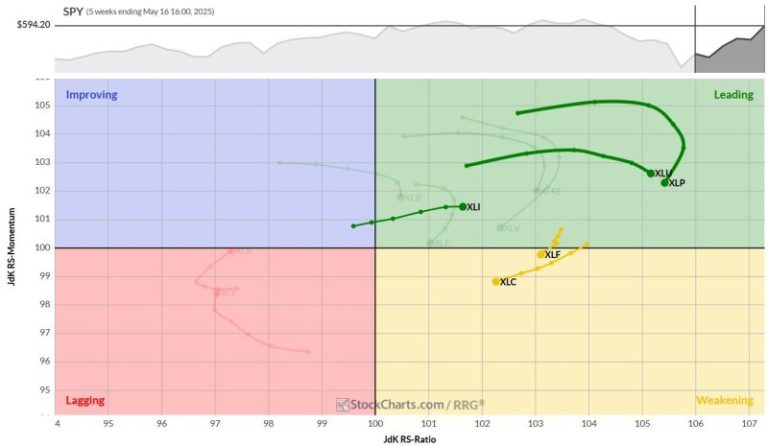
Another week of significant movement in the sector landscape has reshaped the playing field. The Relative Rotation Graph (RRG) paints a picture of shifting dynamics, with some surprising developments in sector leadership. Let’s dive into the details and see what’s happening under the hood.

  1. (6) Industrials – (XLI)*
  2. (4) Financials – (XLF)*
  3. (1) Utilities – (XLU)*
  4. (2) Communication Services – (XLC)*
  5. (3) Consumer Staples – (XLP)*
  6. (8) Technology – (XLK)*
  7. (5) Real-Estate – (XLRE)*
  8. (9) Materials – (XLB)*
  9. (11) Energy – (XLE)*
  10. (10) Consumer Discretionary – (XLY)
  11. (7) Healthcare – (XLV)*

Weekly RRG

On the weekly RRG, Utilities and Consumer Staples maintain their high positions on the RS-Ratio scale. However, there are signs of waning momentum. Staples has rolled over within the leading quadrant and is now showing a negative heading. Utilities, while still strong, are losing some of their relative momentum.

Financials and Communication Services are hanging on in the weakening quadrant, but their tails are relatively short — indicating potential for a quick turnaround.

The show’s star, Industrials, has made a beeline for the leading quadrant, climbing on the RS-Ratio scale while maintaining a positive RRG heading.

Daily RRG

Switching to the daily RRG, we get a more granular view. Utilities, Staples, and Financials are found in the lagging quadrant, but Staples and Utilities are showing signs of life, turning back up towards the improving quadrant.

Financials, meanwhile, are hugging the benchmark.

The daily chart confirms Industrials’ strength, mirroring its weekly performance.

Communication Services, however, is showing some worrying signs — it’s dropped into the weakening quadrant on the daily RRG, confirming its vulnerable position on the weekly chart.

Industrials

XLI flexes its muscles, pushing against overhead resistance around the $144 mark.

A break above this level could trigger a further acceleration in price.

The relative strength line has already broken out of its consolidation pattern, propelling both RRG lines above 100 and driving the XLI tail deeper into the leading quadrant.

Financials

The financial sector continues its upward trajectory, trading above its previous high and closing in on the all-time high of around $53.

Like Industrials, a break above this resistance could spark a new leg up.

The RS line is moving sideways within its rising channel, causing the RRG lines to flatten—something to watch.

Utilities

XLU has finally broken through its overhead resistance, approaching its all-time high around $83.

After months of pushing against the $80 level, this breakout is a clear sign of strength.

The RS line is still grappling with its own resistance, but the RS-Ratio line continues its gradual ascent.

Communication Services

While XLC is moving higher on the price chart, its relative strength is lagging.

The sideways movement in the RS line is causing both RRG lines to move lower, with the RS-Momentum line already below 100.

This sector is rapidly approaching the lagging quadrant on the daily RRG—definitely one to watch for potential risks.

Consumer Staples

XLP is approaching the upper boundary of its trading range ($83-$85), where it is running into resistance. The inability to push higher while the market is moving up is causing relative strength to falter.

The recent strength has pushed both RRG lines well above 100, but the current loss of relative strength is now causing the RRG-Lines to roll over.

The tail is still comfortably within the leading quadrant, but this loss of momentum could signal a potential setback.

Portfolio Performance

The model portfolio’s defensive positioning has led to some underperformance relative to SPY, with the gap now just under 6%.

However, the model is sticking to its guns, maintaining a defensive stance with Staples and Utilities firmly in the top five.

It’s worth noting that Healthcare has now definitively dropped out of the top ranks. Nevertheless, with Staples and Utilities holding firm, and Technology and Consumer Discretionary still in the bottom half, the overall positioning remains cautious.

These are the periods when patience is key. We need to let the model do its work and wait for new, meaningful relative trends to emerge. It’s not always comfortable to endure underperformance, but it’s often necessary to capture longer-term outperformance.

#StayAlert, –Julius


Uvre Limited (ASX: UVA) (the Company or Uvre) is pleased to announce that highly regarded mining entrepreneurs Norman Seckold and Peter Nightingale will be appointed non-executive directors of Uvre with effect from settlement of the acquisition by the Company of 100% of the issued share capital of MEL (Acquisition). Norman Seckold and Peter Nightingale will emerge with 16.5% and 1.3% respective stakes in the Company upon settlement of the Acquisition and Equity Raise.

Highlights

  • Uvre has signed a binding agreement to acquire 100% of the fully paid ordinary shares in the capital of Minerals Exploration Limited (MEL) from the shareholders of MEL (Vendors). MEL’s wholly owned subsidiary is New Zealand gold explorer Otagold Limited (Otagold).
  • Highly regarded mining executives Norman Seckold and Peter Nightingale, who are major shareholders of MEL, will join Uvre as Non-executive Directors.
  • Norman Seckold was previously Chairman of the New Zealand gold developer Santana Minerals (ASX:SMI) and is currently Chairman of Alpha HPA (ASX:A4N), Nickel Industries (ASX:NIC), Fulcrum Lithium (ASX:FUL) and Sky Metals (ASX:SKY).
  • Subject to receipt of Shareholder approval, Uvre will issue 75 million fully paid ordinary shares in the capital of Uvre (Shares) at a deemed issue price of 8c per Share for a total of $6.0 million as the full consideration to the Vendors, including Mr Seckold who is the largest shareholder of MEL.
  • The acquisition of MEL is subject to completion of several conditions precedent, including due diligence on MEL, Otagold and the permits held by Otagold. The acquisition is also contingent on Uvre raising at least $4.0 million in a single tranche share placement at 8c per Share, to be lead managed by Bell Potter Securities Ltd (Equity Raise). The Equity Raise will be subject to shareholder approval.
  • Firm commitments have been secured for the $4.0m Equity Raise following a well-supported bookbuild, including incoming directors Norman Seckold ($500,000) and Peter Nightingale ($100,000) subject to shareholder approval.
  • Otagold holds a 100% interest in three exploration permits, one prospecting permit and one prospecting permit application in New Zealand covering 332sqkm of highly prospective ground (the Permits).
  • Otagold’s flagship asset is the Waitekauri Gold Project located 8km west of OceanaGold Corporation’s Waihi gold mine (10Moz) on New Zealand’s North Island; Waitekauri also sits adjacent to three other +1Moz Au deposits.
  • Extensive gold mineralisation and numerous drilling targets already identified at Waitekauri, which had historical production grade of 48g/t Au+Ag.
  • Uvre has executed a binding Share Sale Agreement (SSA) with the Vendors, MEL and Otagold with due diligence well advanced; Uvre will shortly call a shareholder meeting to approve the transaction, expected to be around the end of June 2025.

Uvre Executive Chairman Brett Mitchell said:

“This transaction is an exceptional opportunity for Uvre on several levels.

“Norm and Peter will bring a wealth of knowledge and experience in the resources business, along with a track record of creating substantial shareholder value through resource asset exploration and proįect development.

“The Otagold proįects led by Waitekauri have compelling gold exploration upside in a tier-one įurisdiction, as shown by the extensive mineralisation and drilling targets already identified.

“The combination of Norman’s well-known record in building successful mining proįects combined with the talented Uvre team, the immense exploration upside at these proįects and the strong financial position which will follow the placement will leave Uvre very well-placed to create significant value”.

Norman Seckold said:

“This transaction will enable Uvre to unlock what we believe is the substantial value of these proįects.

“We will have the assets, the team, the experience and the financial strength to conduct the immediate exploration programs which will maximise our ability to create value.

“The work we have already done on the proįects shows they are highly prospective and with the support of the Uvre team and access to capital, we can take them to the next level with the aim of building substantial gold inventories in a tier one location”.

Otagold Projects Summary

Otagold holds a 100% interest in three exploration permits, one prospecting permit and one prospecting permit application on New Zealand’s North and South Islands, covering 332km2 of highly prospective ground.

Click here for the full ASX Release

This article includes content from Uvre Limited, licensed for the purpose of publishing on Investing News Australia. This article does not constitute financial product advice. It is your responsibility to perform proper due diligence before acting upon any information provided here. Please refer to our full disclaimer here.
This post appeared first on investingnews.com

Astute Metals NL (ASX: ASE) (“ASE”, “Astute” or “the Company”) is pleased to report assay results from the first of six holes completed as part of its highly successful April 2025 diamond drilling campaign at the 100%-owned Red Mountain Lithium Project in Nevada, USA. Drill-hole RMDD003 has returned three high- grade intersections of lithium mineralisation:

  • 32.4m @ 3,260ppm Li / 1.74% Lithium Carbonate Equivalent1 (LCE) from 57.2m, including an internal high-grade zone grading 8.6m @ 5,060ppm Li / 2.69% LCE from 67.7m;
  • 13.8m @ 1,330ppm Li / 0.71% LCE from 39.6m; and
  • 23.3m @ 1,610ppm Li / 0.86% LCE from 94.4m to End-of-hole.

Key Highlights

  • Outstanding lithium mineralisation returned in assays for diamond drill-hole RMDD003, which intersected:
    • 32.4m @ 3,260ppm Li from 57.2m, including 8.6m of ultra high-grade mineralisation @ 5,060ppm Li from 67.7m;
    • 13.8m @ 1,330ppm Li from 39.6m; and
    • 23.3m @ 1,610ppm Li from 94.4m to end-of-hole
  • RMDD003 marks the highest-grade lithium intercept recorded to date at Red Mountain.
  • Mineralisation successfully extended 630m north of previous northernmost intersection in hole RMDD002.
  • Hole ends in lithium, with mineralisation remaining open down-dip to the east and along strike to the north.
  • Assays pending from five other recently completed drill- holes.

To hear CEO Matt Healy discuss this ASX Release click here

The thick zones of lithium mineralisation encountered in the northernmost drill-hole at Red Mountain highlight the increasing scale of the project, with strong lithium mineralisation now intersected in all drill- holes spanning a north-south strike extent of over 5.6km and surface sample geochemistry indicating further potential to the north, south and west of the current drilled extents7, 9 (Figure 3).

Of particular significance in hole RMDD003 is the high-grade nature of the mineralisation. The nearest drill-hole is RMDD002, which intersected 32.1m @ 2,050ppm within a broader 86.9m intersection at 1,470ppm Li from 18.3m. The high-grade zone in RMDD002 has persisted north to RMDD003, and increased in grade significantly to over 3,000ppm lithium.

Assays are pending for the other five holes drilled as part of the April diamond drilling campaign.

Astute Chairman, Tony Leibowitz, said:

“Our 2025 exploration campaign is off to a fantastic start, with exceptional assays returned for the first step-out diamond hole, RMDD003. We are impressed by the thickness and grade of the mineralisation, with the high-grade intercept returned from this hole showing that the previously identified high-grade zone extends for a considerable distance to the north.

“This provides further indication that Red Mountain is unfolding as a lithium discovery of significance in North America. With mineralisation now defined by drilling over a strike length of almost 6 kilometres, we are looking forward to seeing what the remaining drill-holes will deliver. The information obtained from this round of drilling should put us on a clear trajectory to advance Red Mountain towards a maiden JORC Mineral Resource Estimate later this year.”

Background

Located in central-eastern Nevada (Figure 4) adjacent to the Grand Army of the Republic Highway (Route 6), which links the regional mining towns of Ely and Tonopah, the Red Mountain Project was staked by Astute in August 2023.

The Project area has broad mapped tertiary lacustrine (lake) sedimentary rocks known locally as the Horse Camp Formation2. Elsewhere in the state of Nevada, equivalent rocks host large lithium deposits (see Figure 4) such as Lithium Americas’ (NYSE: LAC) 62.1Mt LCE Thacker Pass Project3, American Battery Technology Corporation’s (OTCMKTS: ABML) 15.8Mt LCE Tonopah Flats deposit4 and American Lithium (TSX.V: LI) 9.79Mt LCE TLC Lithium Project5.

Astute has completed substantial surface sampling campaigns at Red Mountain, which indicate widespread lithium anomalism in soils and confirmed lithium mineralisation in bedrock with some exceptional grades of up to 4,150ppm Li2,8 (Figure 3).

A total of 13 RC and diamond drill holes have been drilled at the project for a combined 1,944m, prior to this current drilling program. These campaigns were highly successful, intersecting strong lithium mineralisation in every hole9.

Scoping leachability testwork on mineralised material from Red Mountain indicates high leachability of lithium of up to 98%, varying with temperature, acid strength and leaching duration, and proof of concept beneficiation test-work has indicated the potential to upgrade the Red Mountain mineralisation10,11.

Results

Hole RMDD003 successfully intersected three zones of lithium mineralised clay-bearing mudstones and sandstone, separated by narrow zones of unmineralised rocks (Figure 1). The intersections are as follows:

  • 13.8m @ 1,330ppm Li / 0.71% LCE from 39.6m to 53.4m;
  • 32.4m @ 3,260ppm Li / 1.74% LCE from 57.2m to 89.6m; and
  • 23.3m @ 1,610ppm Li / 0.86% LCE from 94.4m to End-of-hole (117.7m).

The best grades were developed in the most clay-rich zones (Figure 2). An internal very high-grade zone of 8.6m returned a grade of 5,060ppm Li, with a maximum single sample grade of 5,660ppm Li from 69.2-70.7m (227-232ft), which is the drill sample with the highest lithium grade achieved to date at the project.

Click here for the full ASX Release

This post appeared first on investingnews.com