Author

admin

Browsing

FireFly Metals (ASX:FFM,TSX:FFM,OTC Pink:MNXMF) has attained firm commitments to raise up to about AU$95 million, giving it a total of AU$135 million for its multi-pronged growth strategy.

The company highlighted on Tuesday (June 10) that the equity financing will be completed via the issuance of approximately 94.7 million fully paid ordinary shares; it will receive around AU$1 per new share.

The funds will be raised via three transactions, with the first being an AU$11.2 million charity flow-through placement to Canadian investors. This will be followed by a AU$54.9 million two-tranche institutional placement, as well as a AU$28.8 million fully underwritten Canadian bought-deal offering with BMO Capital Markets.

Alongside the equity raising, FireFly is inviting shareholders to participate in a non-underwritten share purchase plan (SPP) that can potentially raise up to AU$5 million before costs.

Proceeds of the equity raising and the SPP will collectively be allotted to advance the Green Bay copper-gold project in Canada, including transaction costs and working capital.

Located in the Baie Verte district of Northeast Newfoundland on Canada’s east coast, Green Bay was acquired by FireFly in August 2023. Green Bay includes Ming underground mine, which was mined between 1972 and 1982, with activity restarting in 2012. Historic production totaled 6.7 million metric tons (MT) at 2 percent for 134,000 MT of copper.

Measured and indicated resources at Ming are at 21.5 million MT at 1.8 percent for 307,000 MT of copper equivalent, while inferred resources are at 28.4 million MT at 2 percent for 576,000 MT of copper equivalent.

FireFly began drilling at Ming in October 2023, completing 79 drill holes across 37,110 meters within a year.

“The overwhelming demand for the raising reflects the quality and growth outlook at Green Bay, our commitment to a multi-rig exploration campaign and the demand among global investors for top-shelf copper-gold projects,” said FireFly Managing Director Steve Parsons in the company’s press release.

He called the asset, alongside FireFly’s exploration team and AU$135 million in funding, “the ideal recipe for growth.”

FireFly states on its website that it will continue with its low-cost rapid resource growth strategy, with the underground exploration drill drive at the Ming deposit to be extended during this year.

The company debuted on the Toronto Stock Exchange in December 2024.

Securities Disclosure: I, Gabrielle de la Cruz, hold no direct investment interest in any company mentioned in this article.

This post appeared first on investingnews.com

Energy sector innovators took center stage on Wednesday (June 11), with Eclipse Automation securing major deals in nuclear infrastructure, and Oklo (NYSE:OKLO) snagging a key US clean energy contract.

Eclipse Automation, part of Accenture (NYSE:ACN), has secured multiple contracts to design, manufacture and supply advanced automated tooling and equipment for upcoming CANDU nuclear reactor refurbishment projects.

The projects are at the Cernavoda plant in Romania and the Qinshan facility in China, and the agreements include automated inspection units, radioactive-handling systems, reactor-assembly tools and a remote-control center.

Based in Cambridge, Ontario, and backed by Accenture’s global footprint, Eclipse Automation is working to bolster nuclear safety and efficiency with cutting-edge technology.

“In the last decade, Eclipse has delivered automated solutions and equipment to support nuclear refurbishment work at the Embalse reactor in Argentina, and at the Darlington and Bruce nuclear generating stations in Canada,” said Steve Mai, CEO of Eclipse Automation, in the company’s press release.

Putting the ‘Can’ in CANDU

Canada’s CANDU (Canada deuterium uranium) reactors trace their origins back to the 1950s, with the first commercial unit, NPD, launching in 1962 using heavy water moderation and natural uranium fuel. Featuring pressure tubes and online refueling, CANDUs allow continuous operation, unlike light-water reactors that require shutdowns.

Today, 19 CANDU reactors operate in Canada, primarily in Ontario and New Brunswick, and over a dozen more are deployed abroad in South Korea, Romania, China, Argentina and India.

The design is prized for high reliability, clean power and the ability to burn natural uranium and alternative fuels.

Canada and other countries are now investing in life extensions and advancing next-generation designs like the Enhanced CANDU-6, the Advanced CANDU reactor and small modular reactors, supported by federal funding to sustain a domestic supply chain and global competitiveness.

Defense department eyes microreactors

Elsewhere, advanced nuclear company Oklo received a notice of intent to award from the US Department of Defense to deploy its Aurora microreactor at Eielson Air Force Base in Alaska.

The project, which will be led by the Defense Logistics Agency Energy, will serve as the Air Force’s pilot for enhancing energy resilience at remote sites. Under a long-term power purchase agreement, Oklo will design, build, own and operate the reactor, supplying both electricity and heat. The Aurora system uses fast reactor technology to deliver continuous, off-grid power — ideal for mission-critical infrastructure.

‘This Notice of Intent to Award reflects continued confidence in Oklo’s ability to deliver clean and secure energy solutions for mission-critical infrastructure,’ said Jacob DeWitte, co-founder and CEO of Oklo. ‘We are honored to support national defense resilience objectives while demonstrating the value of US-pioneered fast reactor technology.’

These contracts reflect a global resurgence in nuclear energy as countries look for ways to power their expanding grids with clean energy.

Securities Disclosure: I, Georgia Williams, hold no direct investment interest in any company mentioned in this article.
This post appeared first on investingnews.com

Peter Krauth, editor of Silver Stock Investor and Silver Advisor, outlines the factors driving silver’s recent price run, which has pushed the white metal to levels not seen in over a decade.

In his view, the current macroeconomic environment is combining with short supply and strong demand dynamics to create a ‘perfect storm.’

Securities Disclosure: I, Charlotte McLeod, hold no direct investment interest in any company mentioned in this article.

This post appeared first on investingnews.com

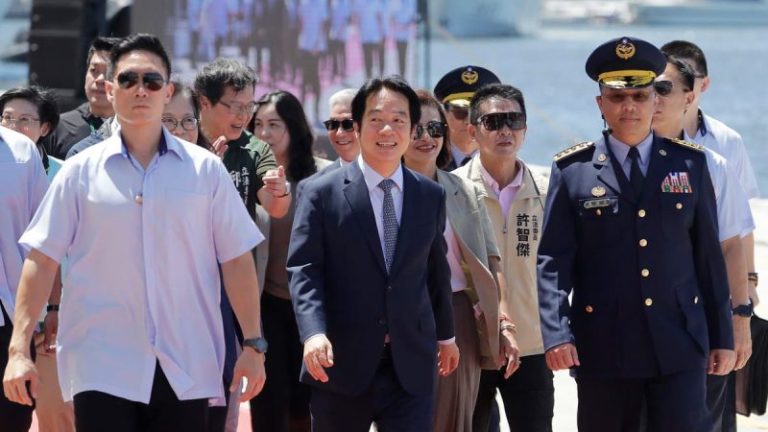
KAOHSIUNG, Taiwan – Taiwan’s coast guard and affiliated military units put on a show of strength during an ‘Ocean Day’ drill last week amid growing threats from China.

Held in southern Taiwan’s largest city, Kaohsiung, the exercise was overseen by Taiwan President William Lai, and while framed as demonstrations of search and rescue and anti-terrorism abilities, there was no escaping the larger reason why Taiwan is strengthening frontline defenses and operational readiness. 

Alongside the navy, Taiwan’s coast guard is undergoing modernization. On display during the Ocean Day exercise was one of Taiwan’s new Anping-class corvettes, stealth-capable vessels with surface-to-land missile systems, and, naturally, advanced rescue capabilities.

This all comes as Taiwan’s top weapons developer recently announced they had developed various new sea drones – including so-called ‘kamikaze’ or suicide drones. An anonymous official claimed Taiwan’s military will test the sea drones in waters off Southern Taiwan this August. 

Defense Minister Wellington Koo confirmed late last month that the navy of independently-ruled Taiwan will soon add unmanned surface vehicles, while the army is set to inaugurate its first drone units this year. Reports say Taiwan produced around 10,000 drones last year, and this year plans to buy 3,000+ more made by local companies for military use. 

In remarks following the Ocean Day exercise, Lai urged Taiwan’s lawmakers to back his administration’s latest defense spending proposals and told the group of select guests that included the highest-ranking American official based in Southern Taiwan, Neil Gibson, that the matter was about more than just ships and hardware.

‘It’s about national resilience.’ 

Taiwanese government officials frequently denounce what they term as escalating ‘gray zone’ warfare from Beijing, actions such as harassing fishing vessels, illegal incursions, and, on at least one occasion, boarding a Taiwan-flagged civilian ferry. Taiwan sees these actions as Chinese attempts to create a ‘new normal’ of uncontested control of the roughly 100-mile-wide Taiwan Strait that separates the two sides.

Taiwan’s coast guard is dwarfed by the growing Chinese coast guard, which is already the largest in the world in terms of the number and size of vessels. Last year, according to statistics provided to Fox News Digital by Taiwan’s Ocean Affairs Council, Taiwan’s coast guard drove away 1,196 vessels from Taiwanese waters – 1,135 of which were from China. 

Lai said there is an urgent need for upgraded infrared surveillance to enable round-the-clock maritime monitoring, as well as other tech that could combat Chinese tactics that include illegal sand dredging, cyber disruptions and even sabotage of undersea cables, actions deliberately chosen to stay below the threshold of ‘acts of war.’

Ross Darrell Feingold, a lawyer and political risk analyst based in Taipei, told Fox News Digital that Lai’s calls for bipartisanship arise from the president’s party not currently holding a majority in Taiwan’s Parliament, which will make the passage of his proposed $13.6 billion USD ‘special budget’ much more difficult.

‘This proposed spending would go to the coast guard, the military, and be used to assist domestic industries affected by higher U.S. tariffs,’ said Feingold, who noted that the Trump administration should have no issues with selling weapons to Taiwan.

Since he took office on May 20, 2024, Lai has increased defense spending within the limits of what he can do while not holding a majority in Parliament. 

Beijing’s communist government stubbornly claims Taiwan as its territory despite never having governed it for a single day, and in recent years, removed language calling for a ‘peaceful settlement’ in official statements. One widely quoted assertion claims Chinese President Xi Jinping has ordered the Chinese military to be ready to invade Taiwan by 2027, now less than two years away. 

This post appeared first on FOX NEWS

The Gaza Humanitarian Foundation’s (GHF) new chairman is ignoring critics and keeping his focus on what he calls the group’s ‘singular mission’ of making sure the people of Gaza have food.

‘Our mission has nothing to do with Hamas. It has nothing to do with Israel. It has everything to do with making sure that hungry Gazans get food. That is our singular mission. No other mission,’ Rev. Johnnie Moore, GHF’s executive chairman, told Fox News Digital.

Moore took the helm June 3, just a few days after the Israeli- and U.S.-backed aid group began its distribution operations.

Even before GHF began distributing aid, it faced criticism in the weeks leading up to its launch. The United Nations came out strongly against the group. U.N. Under-Secretary-General for Humanitarian Affairs and Emergency Relief Coordinator Tom Fletcher was a vocal critic, claiming the U.N. already had the infrastructure and ability to distribute aid.

Moore, however, believes GHF is ‘trying to solve a problem that the U.N. hasn’t been able to solve,’ namely, the issue of Hamas stealing aid. Rather than admonish critics, Moore is urging them to join GHF’s efforts to get food to people on the ground in Gaza.

The GHF chief also noted that, despite what critics have said, Gazans have been ‘incredibly grateful’ to receive the support. Not only have the beneficiaries been thanking the U.S., they’ve been thanking President Donald Trump. Moore attributes this to a promise the commander in chief made in the Oval Office.

‘They’re thanking President Trump specifically because a few weeks ago, in the Oval Office, in one of the many, many press briefings that President Trump does, he made a passing comment,’ Moore said.

‘And the comment related to how Hamas was treating the Gazan people very badly when it came to humanitarian aid. And he made a promise that the United States would do something about it. And the people in Gaza are attributing our free distribution of food as a direct response to the promise of the president of the United States.’

Israel and the U.S. have repeatedly said that GHF is the best mechanism for distributing aid to Gazans and ensuring that Hamas does not get anything. Moore told Fox News Digital humanitarian aid officials have faced a ‘false choice’ for years between Hamas and the people of Gaza.

‘I think for many, many years, the aid community thought that the cost of giving aid to the people of Gaza is that you had to lose a certain amount of that aid to all of these other nefarious purposes. We’re just showing that that’s a false choice. That doesn’t have to be the case. We can actually give aid without facing these dilemmas,’ Moore said.

‘Since the Israeli authorities allowed the U.N. to resume bringing limited aid into Gaza after nearly 80 days of a total blockade of any supplies, there have been understandable instances of trucks carrying food being offloaded by hungry civilians,’ Eri Kaneko, spokesperson for the U.N. Office for the Coordination of Humanitarian Affairs, told Fox News Digital.

‘In some cases, we have also seen unacceptable looting by armed, criminal gangs, which posed tremendous risk to our drivers’ safety. To meet humanitarian needs in Gaza and help reduce looting, far more essential supplies should be allowed into Gaza through multiple crossings and routes.’

In late May, Israeli U.N. Ambassador Danny Danon revealed the international institution was using ‘mafia-like’ tactics against NGOs that were open to working with GHF. The U.N. removed several NGOs from a shared aid database, which acts as a ‘central system for tracking aid deliveries into Gaza,’ according to Danon.

The following week, after Danon exposed the U.N.’s actions, the U.S. vetoed a U.N. Security Council resolution calling for a ceasefire in Gaza. The resolution also addressed humanitarian aid, though Danon said it would have undermined, rather than advanced, such efforts.

Just minutes before vetoing the resolution, U.S. Chargé d’Affaires Dorothy Shea urged the U.N. to support GHF ‘to help it safely deliver aid without being diverted by Hamas. The GHF has emphasized it will deliver aid consistent with the humanitarian principles of humanity, neutrality, impartiality and independence.’

This post appeared first on FOX NEWS

President Donald Trump said Wednesday he was willing to extend the deadline for countries to reach a trade deal with the United States, but he doesn’t think it will be necessary.

At the same time, he also indicated that in one to two weeks his administration would be sending out letters telling countries ‘what the deal is.’ 

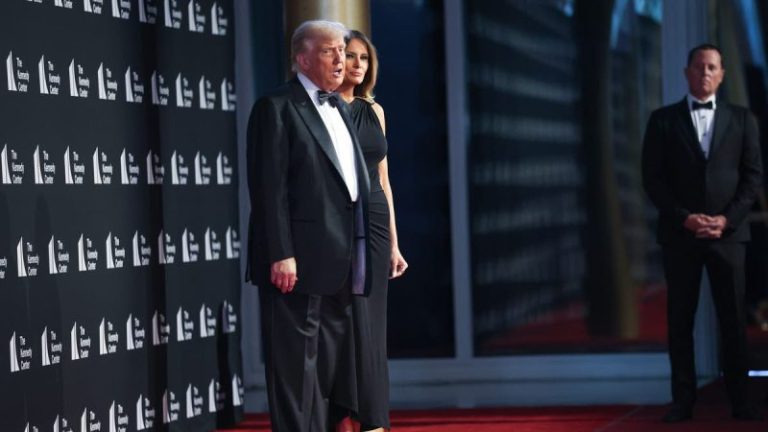
Trump made the remarks ahead of a performance of ‘Les Misérables’ that he attended at the Kennedy Center in Washington with the first lady.

‘I would,’ Trump said when asked if he would be willing to extend the July 8 deadline for countries to negotiate a trade deal or else face steep tariffs. ‘But I don’t think we’re going to have that necessity,’ the president added, telling reporters ‘we’re rocking in terms of deals’ right now.

Shortly after announcing sweeping tariff policies on April 2 for virtually every U.S. trading partner, the Trump administration chose to institute a 90-day pause to give countries a chance to make a deal with the United States. 

Trump noted during the gaggle with reporters ahead of Wednesday’s Kennedy Center performance that the United States remains in talks with about 15 countries with whom it is still trying to cement a deal. But the president said that he intends to send letters to these partners setting unilateral tariff rates if a deal is not reached.   

‘We’re dealing with Japan. We’re dealing with South Korea. We’re dealing with a lot of them. We’re dealing with about 15 countries. But as you know, we have about 150-plus, and you can’t [make a deal with all of them]. So we’re going to be sending letters out in about a week and a half, two weeks, to countries and telling them what the deal is.’

‘At a certain point, we’re just going to send letters out … saying this is the deal, you can take it or leave it,’ Trump added.

Highly anticipated trade talks with China held in London this week led to a preliminary agreement between the world’s two biggest economic powers, but the ‘framework’ is still pending final approval from Chinese President Xi Jinping and Trump.

‘We made a great deal with China. We’re very happy with it,’ Trump told reporters at the Kennedy Center on Wednesday evening. ‘We have everything we need, and we’re going to do very well with it. And hopefully they are, too.’

This post appeared first on FOX NEWS

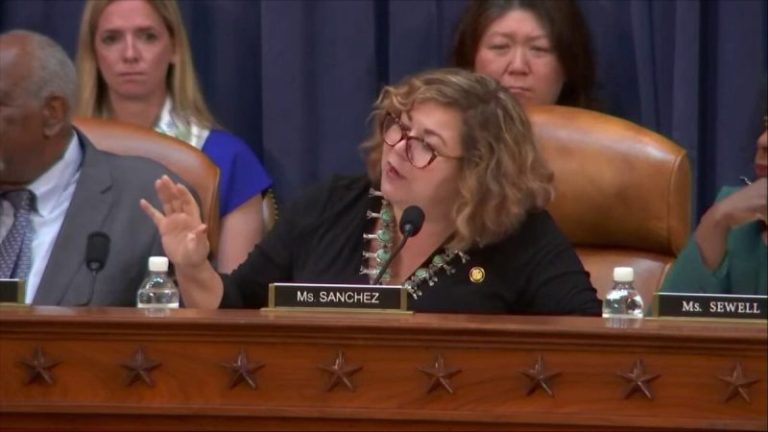
A House Ways and Means Committee hearing took an unexpected turn Wednesday when Rep. Linda Sanchez (D-CA) accused Treasury Secretary Scott Bessent of interrupting her because of her gender—prompting audible groans from the room.

The exchange occurred during a tense five-minute questioning session, where Sanchez challenged Bessent on the impact of tariffs enacted under President Trump’s administration.

‘Prices are rising on many everyday goods,’ Sanchez said, citing increases in clothing, shoes, canned food, toys, and household tools. She added, ‘On average, Trump’s tariffs are estimated to cost households $3,000 more for the same goods than they would have last year,’ though she did not cite the source of the figure when pressed.

When Bessent attempted to interject, Sanchez quickly cut him off: ‘Please don’t interrupt me… I know I’m a woman, but please try to limit yourself to answering my questions.’

That remark prompted groans from the hearing room, with one attendee audibly reacting, ‘Oh, come on.’ Sanchez responded: ‘No, I’m sorry, but we get talked over all the time, and I don’t want that to happen at this hearing.’

Bessent, who is openly gay, did not address the accusation and instead focused on defending the administration’s trade policies. 

When Sanchez challenged him on pricing impacts and China’s trade behavior, Bessent responded, ‘That’s incorrect,’ and said, ‘They met their agreements under President Trump in 2020, and President Biden did not enforce them.’

Sanchez repeatedly claimed that American consumers are paying more due to tariffs and described recent negotiations with China as rushed and lacking transparency. ‘A poorly negotiated trade deal with China is probably not worth the paper that it is written on,’ she said. ‘I was alarmed to hear this morning that Trump said the U.S.–China deal was done after just two days of talks in London.’

Bessent defended the agreement as an initial step. ‘The deal struck was for a specific goal, and it will be a much longer process,’ he said, adding, ‘China has proven an unreliable partner.’

The clash between Sanchez and Bessent was repeatedly moderated by Chairman Adrian Smith (R-NE), who reminded members of time limits and decorum throughout the hearing.

This post appeared first on FOX NEWS

President Donald Trump’s $9.4 billion spending cuts package survived a key hurdle on Wednesday afternoon, setting the measure up for a final House-wide vote later this week.

Trump’s proposal, which was introduced as legislation by House Majority Leader Steve Scalise, R-La., would cut $8.3 billion from the U.S. Agency for International Development (USAID), and just over $1 billion from the Corporation for Public Broadcasting.

The Corporation for Public Broadcasting distributes federal funding to NPR and PBS.

The House of Representatives made a procedural motion known as a ‘rule vote,’ which passed mostly along party lines. 

The rule passing now allows for debate on the $9.4 billion spending cut measure, followed by a final House-wide vote.

But it’s not atypical for House leaders to include unrelated measures in rule votes, as is the case with the spending cuts package – House GOP leaders included a provision with minor changes to Trump’s ‘one big, beautiful bill’ to account for the Senate needing to amend the bill.

That latter piece of legislation, a vast tax and immigration bill, is moving through the budget reconciliation process.

By dropping the Senate’s threshold for advancement from 60 votes to 51, it allows the party in power to skirt the minority – in this case, Democrats – on vast pieces of legislation, provided they adhere to a specific set of budgetary rules.

House GOP leaders said they needed to make the recent changes to the bill to better adhere to the Senate’s ‘Byrd Bath,’ when the Senate parliamentarian reviews the bill and removes anything not adhering to reconciliation guidelines.

Whereas that deals with the government’s mandatory spending processes that are more difficult to amend, the $9.4 billion spending cuts package tackles discretionary spending that Congress controls every year.

It’s called a ‘rescissions package,’ which is a formal proposal by the White House to claw back federal funds already allocated for the current fiscal year.

Like reconciliation, the mechanism allows for a 51-vote majority in the Senate rather than 60. Congress has 45 days to consider it, or it is deemed rejected.

Republican leaders have held up this rescissions package as the first step to codifying the billions of dollars of government waste identified by Elon Musk’s Department of Government Efficiency (DOGE).

Trump allies have also made clear they view this first package as a test of what kind of cuts congressional Republicans can stomach.

And while the rule vote was expected to pass, the bill could have trouble ahead of its expected Thursday afternoon vote.

Rep. Mark Amodei, R-Nev., pointed out in a bipartisan statement that the media funding represents less than 0.01% of the federal budget and said taking that money away would ‘dismantle a trusted source of information for millions of Americans.’

Rep. Don Bacon, R-Neb., told reporters on Tuesday that he got assurances that USAID cuts would exclude critical medical funding.

‘I feel better than what I was hearing last week, that was gonna be a total cut,’ he said, without revealing whether he would support the bill.

This post appeared first on FOX NEWS

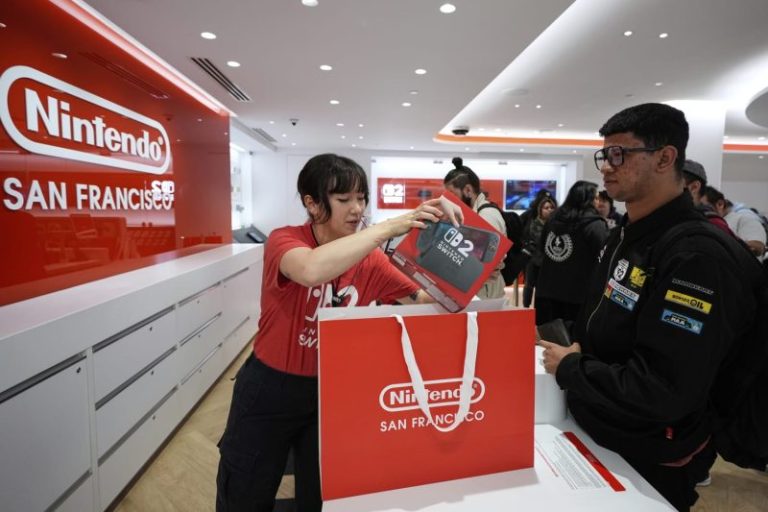
Nintendo sold more than 3.5 million units of its flagship Switch 2 gaming system in the four days following its launch, with online stores of major U.S. retailers putting up “out of stock” signs.

The record-breaking start for the company’s first new console in eight years, puts Nintendo on the path to realizing its aim of selling 15 million units of the Switch 2 console in the fiscal year ending March 2026.

However, analysts continue to believe that those expectations are modest, and forecast the strong initial demand to sustain.

“The market expected a record from Nintendo, and as it turns out, Nintendo delivered,” Serkan Toto, CEO and founder of gaming industry consultancy Kantan Games, told CNBC.

“All signals prior to launch pointed to significant demand, and I believe we will see further records broken over the next weeks or months,” he added.

Toto has maintains that the Switch 2 will sell over 20 million units in its first 12 months. David Gibson, senior research analyst at MST Financial told CNBC that he expects 20 million sales for the year ending March 2026.

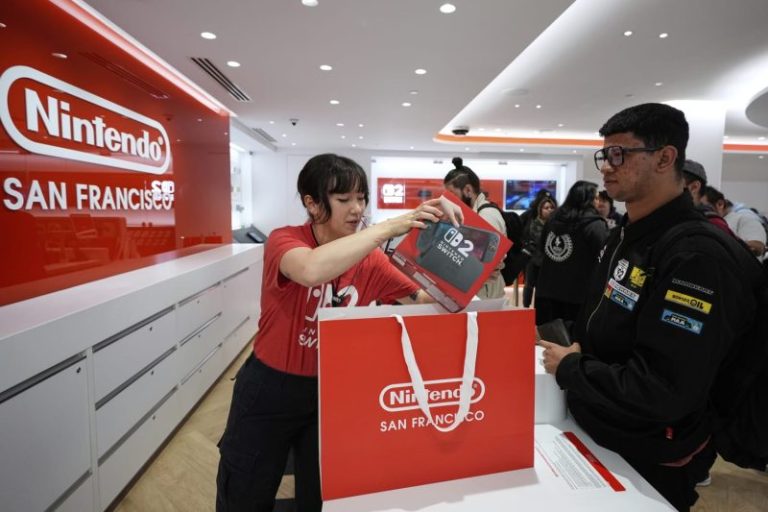
The Switch 2, which was released on June 5, has been met with much fanfare, with people lining up for hours ahead of midnight releases at Nintendo stores.

“Fans around the world are showing their enthusiasm for Nintendo Switch 2 as an upgraded way to play at home and on the go,” Nintendo of America President and Chief Operating Officer Doug Bowser said in a statement, adding the company was thankful for the response.

Tokyo-listed shares of Nintendo, which have gained nearly 30% so far this year, were down 3.5% on Wednesday, LSEG data showed. The company has seen its shares rise nearly fivefold since the original Switch debuted in early March 2017.

It remains to be seen if the Switch 2 can recapture the magic of its predecessor, which had set the bar with 15 million unit sales in its first year. It went on to sell more than 152 million units to become the second-highest selling Nintendo device ever, behind the Nintendo DS.

The record initial sales of the Switch are in line with the strong demand analysts had predicted. However, the rush has put into question Nintendo’s ability to meet demand.

Retailers including Walmart, GameStop, Target and Best Buy were out of stock of the consoles, their online stores showed Wednesday.

In April, Nintendo’s Bowser told CNBC that the company had been working with “retail partners to ensure there’s ample supply for not only the launch weekend, but well beyond.”

However, Nintendo President Shuntaro Furukawa stated the same month that 2.2 million people in Japan had entered the lottery to purchase the Switch 2 on launch day, exceeding expectations and what the company had initially planned to deliver to stores.

Kantan Games’ Toto said shortages in Japan were expected to persist, but would be less impactful elsewhere.

“Except for Japan where demand for Switch 2 is extraordinarily high, it looks like fans who really want the console and invest time in trying to secure one actually can get one,” he said. “It might take a while, but as far as can be monitored, supply seems to be more robust than around the launch of the original Switch in 2017.”

President Donald Trump’s “reciprocal tariffs” on most countries around the world also present headwinds for the Switch 2.

In April, the company announced that it would delay preorders of the Switch 2 in the U.S. while it considers the impact of tariffs.

The Switch 2 retails for $449 in the U.S., which makes it Nintendo’s priciest console to date.

Nintendo’s Bowser said in April the company was going to “monitor where tariffs are going” before making any further decisions on price hikes.

MST Financial’s Gibson said that a resolution to Trump’s tariffs and lower duty rates could see the Switch 2 prices drop in the U.S.

The Switch 2 builds on the success of the original Switch, featuring a larger screen and improved performance. The system also introduces the new GameChat2 feature, which allows players to voice or video chat with friends online and share game screens.

This post appeared first on NBC NEWS

Nintendo sold more than 3.5 million units of its flagship Switch 2 gaming system in the four days following its launch, with online stores of major U.S. retailers putting up “out of stock” signs.

The record-breaking start for the company’s first new console in eight years, puts Nintendo on the path to realizing its aim of selling 15 million units of the Switch 2 console in the fiscal year ending March 2026.

However, analysts continue to believe that those expectations are modest, and forecast the strong initial demand to sustain.

“The market expected a record from Nintendo, and as it turns out, Nintendo delivered,” Serkan Toto, CEO and founder of gaming industry consultancy Kantan Games, told CNBC.

“All signals prior to launch pointed to significant demand, and I believe we will see further records broken over the next weeks or months,” he added.

Toto has maintains that the Switch 2 will sell over 20 million units in its first 12 months. David Gibson, senior research analyst at MST Financial told CNBC that he expects 20 million sales for the year ending March 2026.

The Switch 2, which was released on June 5, has been met with much fanfare, with people lining up for hours ahead of midnight releases at Nintendo stores.

“Fans around the world are showing their enthusiasm for Nintendo Switch 2 as an upgraded way to play at home and on the go,” Nintendo of America President and Chief Operating Officer Doug Bowser said in a statement, adding the company was thankful for the response.

Tokyo-listed shares of Nintendo, which have gained nearly 30% so far this year, were down 3.5% on Wednesday, LSEG data showed. The company has seen its shares rise nearly fivefold since the original Switch debuted in early March 2017.

It remains to be seen if the Switch 2 can recapture the magic of its predecessor, which had set the bar with 15 million unit sales in its first year. It went on to sell more than 152 million units to become the second-highest selling Nintendo device ever, behind the Nintendo DS.

The record initial sales of the Switch are in line with the strong demand analysts had predicted. However, the rush has put into question Nintendo’s ability to meet demand.

Retailers including Walmart, GameStop, Target and Best Buy were out of stock of the consoles, their online stores showed Wednesday.

In April, Nintendo’s Bowser told CNBC that the company had been working with “retail partners to ensure there’s ample supply for not only the launch weekend, but well beyond.”

However, Nintendo President Shuntaro Furukawa stated the same month that 2.2 million people in Japan had entered the lottery to purchase the Switch 2 on launch day, exceeding expectations and what the company had initially planned to deliver to stores.

Kantan Games’ Toto said shortages in Japan were expected to persist, but would be less impactful elsewhere.

“Except for Japan where demand for Switch 2 is extraordinarily high, it looks like fans who really want the console and invest time in trying to secure one actually can get one,” he said. “It might take a while, but as far as can be monitored, supply seems to be more robust than around the launch of the original Switch in 2017.”

President Donald Trump’s “reciprocal tariffs” on most countries around the world also present headwinds for the Switch 2.

In April, the company announced that it would delay preorders of the Switch 2 in the U.S. while it considers the impact of tariffs.

The Switch 2 retails for $449 in the U.S., which makes it Nintendo’s priciest console to date.

Nintendo’s Bowser said in April the company was going to “monitor where tariffs are going” before making any further decisions on price hikes.

MST Financial’s Gibson said that a resolution to Trump’s tariffs and lower duty rates could see the Switch 2 prices drop in the U.S.

The Switch 2 builds on the success of the original Switch, featuring a larger screen and improved performance. The system also introduces the new GameChat2 feature, which allows players to voice or video chat with friends online and share game screens.

This post appeared first on NBC NEWS