Author

admin

Browsing

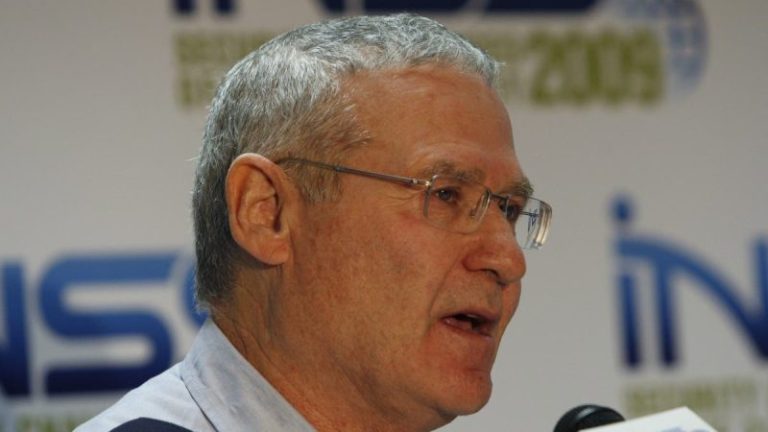
Israel’s ongoing military campaign on Iran’s nuclear infrastructure could mark not just a military escalation but a strategic shift, according to retired Maj. Gen. Amos Yadlin. 

The former head of Israeli military intelligence and one of the architects behind the legendary 1981 strike on Iraq’s Osirak nuclear reactor said Israel should expand its sights not just military targets, but political ones. 

‘Israel took the decision that, on one hand, it’s time to end the leadership of the Axis of Evil — the head of the snake,’ Yadlin told Fox News Digital. ‘At the same time, deal with the main problems there. Which is the nuclear.’

Yadlin didn’t say how long he thought the conflict would drag on. While he didn’t openly call for regime change, Yadlin suggested the IDF take out regime targets ‘beyond the military level.’

‘It’s not a one-day operation. It seems more like a week, two weeks. But when you start a war, even if you start it very successfully, you never know when it is finished.’

‘I hope that the achievements of the IDF, which are degrading the Iranian air defense, degrading the Iranian missile, ballistic missile capabilities, drones capabilities, and maybe even some regime targets beyond the military level that Israel started with, will convince the Iranians that it is time to stop. And then they will come to negotiation with the Trump administration much weaker.’

While Secretary of State Marco Rubio initially insisted it was not involved in the initial strikes on Tehran, President Donald Trump seemed to suggest he hoped Israel’s strikes would pressure a weaker Iran to acquiesce at the negotiating table.

The two sides are at loggerheads over the U.S.’s insistence that Iran cannot have any capacity to enrich uranium and Iran’s insistence that it must have uranium for a civil nuclear program. 

‘The military operation is aimed, in my view, to a political end, and the political end is an agreement with Iran that will block a possibility to go to the border,’ Yadlin said.

‘We need a stronger agreement’ than the 2015 Joint Comprehensive Plan of Action, he said. 

Yadlin, who in 1981 flew one of the F-16s that destroyed Iraq’s nuclear facility in a single-night operation, made clear that Israel’s latest campaign is far more complex.

‘This is not 1981,’ he said. ‘Iran has learned. Their facilities are dispersed, buried in mountains, and protected by advanced air defenses. It’s not a one-night operation.’

He added, ‘There are sites that I’m not sure can be destroyed.’

He said the recent attack was the result of years of intelligence gathering – and brave Mossad agents on the ground in Iran. Israel lured top Iranian commanders into a bunker, where they coordinated a response to Israel’s attacks, then blew up the bunker. 

‘All of the intelligence that Israel collected, from the time I was chief of intelligence 2005 to 2010, enabled this operation against the Iranian nuclear program to be very efficient, very much like the good intelligence enabled Israel to destroy Hezbollah. Unfortunately, the same intelligence agencies missed the seventh of October, 2023.’ 

Indeed, Israel’s past preventive strikes — 1981’s Operation Opera and the 2007 airstrike on Syria’s suspected reactor — were rapid, surgical and designed to neutralize a singular target. In contrast, Yadlin suggested the current campaign could last weeks and involve broader goals.

‘It’s not a one-day operation. It seems more like a week, two weeks. But when you start a war, even if you start it very successfully, you never know when it is finished.’

The operation is being framed by Israeli defense officials as a continuation of the Begin Doctrine, established after the 1981 Osirak strike, which declared that Israel would never allow a hostile regime in the region to obtain weapons of mass destruction.

Yadlin himself is a symbol of that doctrine. As one of the eight pilots who flew into Iraq over four decades ago, he helped define Israel’s policy of preemptive action — a legacy that is now being tested again under radically different circumstances.

‘This campaign,’ Yadlin emphasized, ‘is unlike anything the country has done before.’

This post appeared first on FOX NEWS

U.S. President Donald Trump said on Friday that concerns over national security risks posed by Nippon Steel’s $14.9 billion bid for U.S. Steel can be resolved if the companies fulfill certain conditions that his administration has laid out, paving the way for the deal’s approval.

Shares of U.S. Steel rose 3.5% on the news in after-the-bell trading as investors bet the deal was close to done. Trump, in an executive order, said conditions for resolving the national security concerns would be laid out in an agreement, without providing details. “I additionally find that the threatened impairment to the national security of the United States arising as a result of the Proposed Transaction can be adequately mitigated if the conditions set forth in section 3 of this order are met,” Trump said in the order, which was released by the White House.

The companies thanked Trump in a news release, saying the agreement includes $11 billion in new investments to be made by 2028 and governance commitments including a golden share to be issued to the U.S. government. They did not detail how much control the golden share would give the U.S. Shares of U.S. Steel had dipped earlier on Friday after a Nippon Steel executive told the Japanese Nikkei newspaper that its planned takeover of U.S. Steel required “a degree of management freedom” to go ahead after Trump earlier had said the U.S. would be in control with a golden share.

The bid, first announced by Nippon Steel in December 2023, has faced opposition from the start. Both Democratic former President Joe Biden and Trump, a Republican, asserted last year that U.S. Steel should remain U.S.-owned, as they sought to woo voters ahead of the presidential election in Pennsylvania, where the company is headquartered.

Biden in January, shortly before leaving office, blocked the deal on national security grounds, prompting lawsuits by the companies, which argued the national security review they received was biased. The Biden White House disputed the charge.

The steel companies saw a new opportunity in the Trump administration, which began on January 20 and opened a fresh 45-day national security review into the proposed merger in April.

But Trump’s public comments, ranging from welcoming a simple “investment” in U.S. Steel by the Japanese firm to floating a minority stake for Nippon Steel, spurred confusion.

At a rally in Pennsylvania on May 30, Trump lauded an agreement between the companies and said Nippon Steel would make a “great partner” for U.S. Steel. But he later told reporters the deal still lacked his final approval, leaving unresolved whether he would allow Nippon Steel to take ownership.

Nippon Steel and the Trump administration asked a U.S. appeals court on June 5 for an eight-day extension of a pause in litigation to give them more time to reach a deal for the Japanese firm. The pause expires Friday, but could be extended.

June 18 is the expiration date of the current acquisition contract between Nippon Steel and U.S. Steel, but the firms could agree to postpone that date

This post appeared first on NBC NEWS

With Friday’s pullback after a relatively strong week, the S&P 500 chart appears to be flashing a rare but powerful signal that is quite common at major market tops. The signal in question is a bearish momentum divergence, formed by a pattern of higher highs in price combined with lower peaks in momentum, which indicates weakening buying power after an extended bullish phase.

Today, we’ll share a brief history lesson of previous market tops starting with the COVID peak in 2020. And while we don’t necessarily see a sudden downdraft as the most likely outcome, this bearish price and momentum structure suggests limited upside for the S&P 500 until and unless this divergence is invalidated.

First, let’s review some classic market tops, see how divergences are formed, and learn what often comes next.

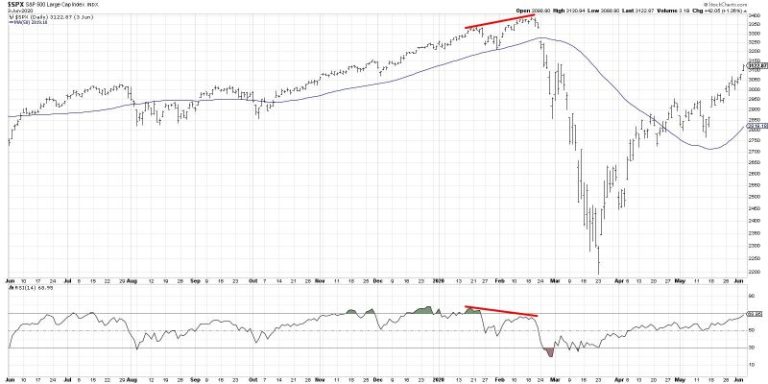
The year 2020 started in a position of strength, continuing the uptrend phase of 2019. But conditions soon deteriorated, with weaker momentum and breadth signals flashing cautionary patterns. In the chart below, we can see the higher highs and higher lows in price action in January and February 2020.

Notice how the RSI was overbought at the January peak but not overbought at the February top? This pattern of higher prices on weaker momentum is what we’re looking for, as it implies a lack of buying power and therefore limited upside.

Almost two years later, the market had been driven higher due to an unprecedented amount of liquidity injected into the financial system. Toward the end of 2021, however, we saw the familiar bearish divergence flash again.

Here, we can see the higher price highs in November 2021 through January 2022 were marked by lower readings on momentum indicators like RSI. It’s worth noting here that these divergences don’t happen in a vacuum. In other words, we can use other tools in the technical analysis toolkit to evaluate the trend and determine if the price is reacting as expected to the bearish divergence.

In the weeks after the 2022 peak, we can see that the price broke down through an ascending 50-day moving average. The RSI eventually broke below the 40 level, confirming the rotation from a bullish phase to a bearish phase. So while the divergence itself does not imply a particular path in the months after the signal, it alerts us to use other indicators to validate and track a subsequent downtrend move.

More recently, the February 2025 market peak featured some classic momentum patterns going into the eventual top.

Starting in August 2024, we can see a series of higher price highs that were accompanied by improving RSI peaks. As the price was moving higher, the stronger momentum readings confirmed the uptrend phase. Then, starting December 2024, the next couple price peaks were marked with weaker momentum readings. This bearish divergence with price and RSI once again signaled waning momentum going into a major market peak.

That brings us to the current S&P 500 chart, featuring yet another bearish momentum divergence. And based on what we’ve reviewed so far, you can probably understand why I’m a bit skeptical going into next week!

To be fair, I’ve highlighted price and momentum divergences from significant market tops, many of which came after extended bull market phases. In this case, we’re still only two months off a major market low. However, I would argue the basic premise still holds true. With Friday’s pullback, the S&P 500 appears to be flashing this same pattern of higher prices on weaker momentum. Considering this negative rotation on momentum, I would anticipate at least a retest of the May swing low around 5770.

What would change this tactical bearish expectation? The only way for a bearish divergence to be negated is for the price to continue higher on stronger momentum. So, until we see the price make a new peak combined with the RSI pushing back up to overbought levels, a pullback may be the most likely scenario in the coming weeks.

RR#6,

Dave

P.S. Ready to upgrade your investment process? Check out my free behavioral investing course!


David Keller, CMT

President and Chief Strategist

Sierra Alpha Research LLC

marketmisbehavior.com

https://www.youtube.com/c/MarketMisbehavior


Disclaimer: This blog is for educational purposes only and should not be construed as financial advice. The ideas and strategies should never be used without first assessing your own personal and financial situation, or without consulting a financial professional.

The author does not have a position in mentioned securities at the time of publication. Any opinions expressed herein are solely those of the author and do not in any way represent the views or opinions of any other person or entity.

Catching a sector early as it rotates out of a slump is one of the more reliable ways to get ahead of an emerging trend. You just have to make sure the rotation has enough strength to follow through.

On Thursday morning, as the markets maintained a cautiously bullish tone, I checked the New Highs panel on the StockCharts Dashboard, scanning the 1-, 3-, 6-, and 9-month highs list. A clear theme emerged—biotech and healthcare stocks dominated the shorter-term highs.

Seeing strength in healthcare and biotech, I checked the Market Summary BPI panel to compare breadth across sectors. Healthcare posted a 63.93% reading—an early sign the sector may be turning higher.

Comparing the broader sector with the biotech industry, the Key Ratios – Offense vs. Defense panel showed that Biotech outperformed Healthcare by a modest 2.31% over the past three months. This panel compares the SPDR S&P Biotech ETF (XBI), which represents the biotech sector, with the broader Health Care Select Sector SPDR Fund (XLV).

Are Biotech and Healthcare Starting a Bullish Rotation?

So, are we seeing an early rotation of both industry and sector toward the upside, and could either be shaping up as an opportunity for investment? Let’s take a comparative look at both relative to the SPDR S&P 500 ETF (SPY), our broad market stand-in.

Comparing XBI and XLV to SPY: Signs of Leadership?

FIGURE 1. PERFCHARTS OF XBI, XLV, AND SPY. This is typical of what you’d see during an early-stage rotation.

This PerfCharts view shows a one-year snapshot of relative performance, with biotech lagging behind healthcare, and both trailing the SPY in negative territory. Yet XBI and XLV are showing signs of recovery, with XBI exhibiting a sharper angle of ascent.

Seasonal Strength in Healthcare and Biotech Stocks

Now here’s an interesting addition to the current analysis: what if we considered the industry and the sector from a seasonality perspective? The reason for this is that certain sectors and the industries within them tend to exhibit recurring patterns of strength or weakness during specific times of the year. If we’re seeing a potential turning point in either, could a seasonality lens offer additional insight or clarity to the analysis?

Biotech Seasonality: Strong Months for XBI

Let’s start with XBI, and notice how it’s now entering a cluster of seasonally-favorable months.

FIGURE 2. SEASONALITY CHART OF XBI. The industry is entering a cluster of seasonally strong months.

According to this 10-year seasonality chart, June, July, August, and November tend to be strong months for XBI, with positive closing rates well above 50% (see figures above each bar) and higher-than-average returns (see figures at the bottom of the bars). Among them, June and November stand out as XBI’s strongest seasonal months.

XLV Seasonality: November Still Reigns

FIGURE 3. SEASONALITY CHART OF XLV.  According to this, July is XLV’s second-strongest month after November.

XLV’s seasonal profile shares a similar pattern, with a few key differences. July emerges as XLV’s second-strongest month, boasting a close rate of 89% and an average return of 3.1%. Like XBI, November is XLV’s top month in terms of average return.

What this tells us is that the biotech industry and the broader healthcare sector have historically performed well during these periods (especially November), suggesting that seasonal strength could serve as a tailwind if the current rotation continues to build momentum.

Charting the Rotation: XBI Trend Structure Shows Some Clarity

Next, let’s take a look at their current price action, starting with a daily chart of XBI.

FIGURE 4. DAILY CHART OF XBI. Notice how the trend structure is well-defined by the Fibonacci retracement, providing clear measurements for you to gauge the subsequent directionality once the market decides which way XBI will go.

XBI’s price action shows it reversed at the 50% Fibonacci Retracement level (November high to April low). Will the bears take control, or will XBI’s near-term reaction strengthen into an uptrend, eventually pushing XBI past the 61.8% retracement level, a threshold wherein bears may fold their positions and bulls increase theirs?

In light of the latter, the Relative Strength Index (RSI) is at 61 and rising, indicating room for upside, but only under the condition that the current bullish swing maintains its trajectory.

A few actionable tips. If you’re bullish on XBI and planning to add it to your portfolio, consider the following:

  • If XBI were to pull back deeper, watch to see if it bounces near the last recent swing low area at $76.
  • If XBI reverses to the upside, expect resistance at the 61.8% Fib retracement at around $91. Also, watch the yellow-shaded zone around $94, an area of concentrated trading activity which may also act as a strong resistance zone.

If XBI rotates in a bullish fashion, these key levels can help guide your analysis.

XLV Technical Setup: Strength, But Not Yet a Breakout

Next, shift over to a daily chart of XLV. You’ll notice it’s quite different despite also exhibiting a recovery.

FIGURE 5. DAILY CHART OF XLV. Unlike the previous example, XLV’s price action is more muddled.

XLV’s recovery doesn’t appear as convincing just yet, as it still needs to clear multiple swing highs and resistance levels clustered between $139 and $141 (highlighted in green). If it manages to break above this zone, the next resistance range—shaded in yellow—sits between $148 and $150. In short, the sector proxy faces several hurdles and technical headwinds ahead.

The RSI, at 58 and rising, is nowhere near overbought territory, but it may not immediately indicate bullishness unless XLV is able to establish an uptrend. For now, it isn’t clear if that will happen, so exercise caution.

From an actionable standpoint, the current technical structure doesn’t offer a clear entry setup. That’s largely because the trend lacks a well-defined sequence of higher swing highs and higher swing lows—something you’d typically look for when establishing favorable entry and exit positions.

At the Close

If healthcare and biotech are starting to rotate higher, XBI and XLV are the charts to watch. XBI shows a stronger trend structure, while XLV still faces resistance.  With seasonality on their side, add them to your ChartLists to track key levels and price action.


Disclaimer: This blog is for educational purposes only and should not be construed as financial advice. The ideas and strategies should never be used without first assessing your own personal and financial situation, or without consulting a financial professional.

Three sectors stand out, with one sporting a recent breakout that argues for higher prices. Today’s report will highlight three criteria to define a leading uptrend. First, price should be above the rising 200-day SMA. Second, the price-relative should be above its rising 200-day SMA. And finally, leaders should trade at or near 52-week highs. Let’s compare the Utilities SPDR (XLU) to see how it stacks up.

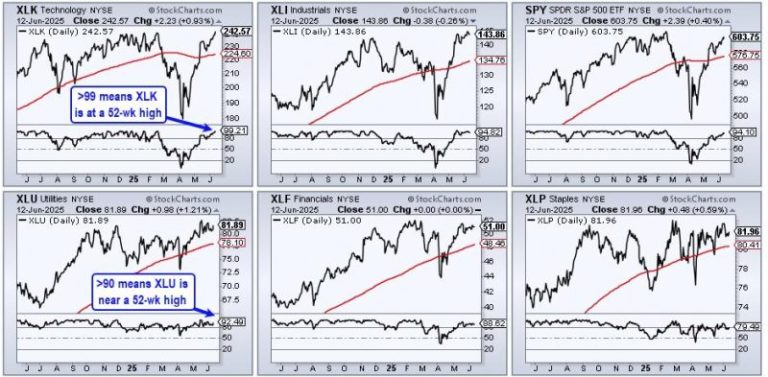
The CandleGlance charts below show the top five sectors and SPY. I am ranking performance using Fast Stochastics (255,1). Stochastic values reflect the level of the close relative to the high-low range over the given period. 255 trading days is around 1 year. An ETF is at a 52-week high when the value is above 99 (XLK) and an ETF is near a new high with a value above 90 (XLU). The CandleGlance charts show XLK, XLI and XLU with values above 90, which means the are near new highs.

***********************

TrendInvestorPro is following the breakout in XLU, the bull flag in GLD, a small wedge in AMLP, a breakout in XLP and more. We also covered trailing stop alternatives for the pennant breakouts in some key tech related ETFs. Take a trial and get three free bonus reports.

***********************

Now let’s turn to price action. XLU is trading above its rising 200-day SMA. Thus, the long-term trend is up. XLU also broke falling channel resistance in early May. The pink lines show a falling channel that retraced around 61.8% of the July-December advance (23.6%). Both the pattern and the retracement amount are typical for corrections within a bigger uptrend. The early May breakout signals a continuation of the long-term uptrend and new highs are expected. The May lows mark first support at 78. A close below this level would warrant a re-evaluation.

And finally, let’s measure relative performance using the price-relative (XLU/RSP ratio). The lower window shows the price-relative in an uptrend for over a year and above its 200-day SMA since early March. This shows long-term relative strength. The pink trendlines show relative performance corrections when XLU underperformed for short periods. XLU is currently experiencing an underperformance correction because the broader market surge from early April to early June.

TrendInvestorPro is following the breakout in XLU, the bull flag in GLD, a small wedge in AMLP, a breakout in XLP and more. We also covered trailing stop alternatives for the pennant breakouts in some key tech related ETFs. Click here to learn more and gain immediate access.

//////////////////////////////////////////////////

Here’s a quick recap of the crypto landscape for Friday (June 13) as of 9:00 p.m. UTC.

Get the latest insights on Bitcoin, Ethereum and altcoins, along with a round-up of key cryptocurrency market news.

Bitcoin and Ethereum price update

Bitcoin (BTC) was priced at US$105,555, a decrease of 1.6 percent in 24 hours after an earlier slide of over 4 percent. The day’s range for the cryptocurrency brought a low of US$104,309 and a high of US$105,918.

Bitcoin price performance, June 13, 2025.

Chart via TradingView.

Bitcoin dropped sharply after Israel’s airstrikes on Iran, with over US$400 million in long trades wiped out before its price consolidated at around US$105,000. This came just days after Bitcoin came close to its May 22 record of US$111,940.

Gold and oil prices rose while Bitcoin fell, and a Bollinger band analysis shows a typical three-push pattern, often signaling the end of a rally. Popular trader CrypNuevo said there could be “more upside” to come as long as the price doesn’t dip below the US$100,000 level.

Ethereum (ETH) ended the day at US$2,529.19, a 6.3 percent decrease over the past 24 hours, after reaching an intraday low of US$2,513.97 and a high of US$2,576.80.

Altcoin price update

  • Solana (SOL) closed at US$145.08, down 6.3 percent over 24 hours. SOL experienced a low of US$144.19 and reached a high of US$148.20 on Friday.
  • XRP was trading at US$2.13, down by 3.6 percent in 24 hours. The cryptocurrency’s lowest valuation today was US$2.12, and its highest was US$2.16.
  • Sui (SUI) was trading at US$3.01, showing a decreaseof 7.5 percent over the past 24 hours. It reached an intraday low of US$2.98 and a high of US$3.07.
  • Cardano (ADA) closed at US$0.6319, down 5.5 percent over the past 24 hours. Its lowest valuation on Friday was US$0.6291, and its highest valuation was US$0.6426.

Today’s crypto news to know

Tether expands gold exposure

Tether Investments has acquired a 31.9 percent stake in Canadian gold royalty firm Elemental Altus Royalties through the purchase of 78,421,780 common shares from La Mancha Investments. Valued at C$1.55 (US$1.14) per share, the transaction cost Tether roughly US$89.4 million and brings its total stake in the royalty firm to 33.7 percent.

While the official announcement didn’t come until Thursday, the deal was finalized on Tuesday, June 10. The company also shared that it signed an option agreement that will allow it to acquire a further 34,444,580 common shares owned by AlphaStream subsidiary Alpha 1 SPV. Executing the option would bring Tether’s interest in Elemental Altus to 47.7 percent.

“Tether’s growing investments in gold and Bitcoin reflect our forward-looking strategy to build a more resilient and transparent financial system,” Paolo Ardoino, CEO of Tether, said. “By gaining exposure to a diversified portfolio of gold royalties through Elemental, we are strengthening the backing of our ecosystem while advancing Tether Gold and future commodity-backed digital assets.”

Retail giants explore stablecoin issuance

Walmart (NYSE:WMT) and Amazon (NASDAQ:AMZN) are reportedly in talks to launch their own stablecoins, according to sources cited in a Wall Street Journal report published early on Friday morning. The move would mark a shift in how these two major retailers manage payments, with the potential to eliminate billions in bank fees and streamline e-commerce and cross-border transactions.

This report comes days after the US Senate advanced the Guiding and Establishing National Innovation for US Stablecoins, or GENIUS Act, in a 68-30 procedural vote. On Thursday, a notice was issued by Senate Democrats of a full chamber vote on the GENIUS Act scheduled for Tuesday, June 17, coinciding with the start of the Federal Open Market Committee two-day meeting.

Betting platform becomes second-largest ETH holder after Ethereum Foundation

Sports betting platform SharpLink Gaming (NASDAQ:SBET) has become the world’s largest publicly traded ETH holder with its latest acquisition of 176,271 ETH for approximately US$463 million, an average acquisition price of US$2,626 per coin.

According to an announcement on the company’s page on Friday, the company has increased its ETH holdings by 11.8 percent per share since June 2, 2025, primarily using US$79 million raised through its stock sales, in addition to an earlier private investment.

The company said over 95 percent of its ETH was deployed in staking and liquid staking platforms, earning yield while contributing to Ethereum’s network security.

“This is a landmark moment for SharpLink and for public company adoption of digital assets,” said Rob Phythian, CEO of SharpLink Gaming. “Our decision to make ETH our primary treasury reserve asset reflects deep conviction in its role as programmable, yield-bearing digital capital.”

Coinbase announces several new offerings

Coinbase made a series of announcements on Thursday at its annual State of Crypto Summit, unveiling a plan to evolve from a crypto exchange into a full-scale decentralized and centralized financial app.

First, the company’s chief legal officer, Paul Grewal, revealed that all tokens on Coinbase’s Ethereum Layer 2 network, Base, are now tradable directly on the Coinbase platform, giving developers building on Base access to Coinbase’s ecosystem of over 100 million users. Meanwhile, Max Branzburg, Coinbase’s vice president of consumer and business products, announced that the company will soon offer perpetual futures contracts under Commodity Futures Trading Commission oversight, marking a major easing of restrictions for US crypto traders.

Also at the event, a partnership was announced between Coinbase and Shopify (NYSE:SHOP) that Shopify has begun accepting payments in USDC stablecoin from customers on Base. Currently in early access, the new payment option could help normalize on-chain payments among mainstream e-commerce businesses and consumers.

Coinbase also introduced the Coinbase One Card, a co-branded American Express (NYSE:AXP) credit card slated for release this fall that will offer up to 4 percent cashback in Bitcoin. Finally, it revealed Coinbase Business, a new full-stack platform offering for streamlining financial workflows with features including instant crypto payment settlements, up to 4.1 percent annual percentage yield on USDC and streamlined integration with accounting tools such as Intuit (NASDAQ:INTU) QuickBooks and XERO (NASDAQ:XRX).

These announcements help further Coinbase’s vision to position itself as a one-stop shop for businesses operating in the Web3 space.

Securities Disclosure: I, Giann Liguid, hold no direct investment interest in any company mentioned in this article.

Securities Disclosure: I, Meagen Seatter, hold no direct investment interest in any company mentioned in this article.

This post appeared first on investingnews.com

Here’s a quick recap of some of the most impactful resource sector news items for the week.

The period saw the Trump administration move to reverse a Biden-era ban on copper and nickel mining near Minnesota’s Boundary Waters, while Dundee Precious Metals (TSX:DPM,OTC Pink:DPMLF) penned a deal for assets in Bosnia and Herzegovina and Serbia, and China exerted control over rare earth mines in Myanmar.

Trump admin moves to roll back mining moratorium near Boundary Waters

The Trump administration is starting the process of reversing the Biden-era 20 year moratorium on copper-nickel mining in a 350-square-mile area upstream of Minnesota’s Boundary Waters Canoe Area Wilderness.

The decision could allow the restart of development at the proposed Twin Metals underground mine, owned by Chile’s Antofagasta (LSE:ANTO,OTC Pink:ANFGF). The Biden administration had cancelled the leases for the project, located in the region affected by the moratorium, as part of the 2022 decision.

Agriculture Secretary Brooke Rollins and Interior Secretary Doug Burgum argue that the original mineral withdrawal was unnecessary and pledged to boost domestic critical mineral supply.

Rollins shared the news on her social media account.

The news was quickly denounced by the Save the Boundary Waters advocacy group and Tina Smith, US Senator for Minnesota.

“The announcement by Secretaries Burgum and Rollins is shocking,” said Ingrid Lyons, the group’s executive director. “They claim to have consulted with the people of Minnesota about the Boundary Waters when they clearly have not. We deserve so much better than this, as Minnesotans and as Americans.”

Senator Smith took to social media to highlight her dismay and condemn what she described as ‘pseudoscience (used) to justify bad actions.’

The Trump admin decision aligns with a broader push to accelerate mining approvals and reduce red tape, aiming to enhance US supply chain security for critical minerals.

Dundee Precious Metals to acquire Adriatic in US$1.3 billion deal

Canada’s Dundee Precious Metals has agreed to acquire UK-based Adriatic Metals (LSE:ADT1,OTCQX:ADMLF) in an approximately US$1.3 billion cash-and-stock transaction.

The deal secures Dundee full control of Adriatic’s high-grade Vareš underground silver-lead-zinc-gold mine in Bosnia and Herzegovina, plus its Raška zinc-silver project in Serbia.

Vareš offers an estimated 15 year mine life with annual payable output around 168,000 ounces gold equivalent and low all-in sustaining costs of US$893 per ounce.

“Vareš is a logical fit with our portfolio, as it significantly increases DPM’s mine life while adding near-term production growth, a highly prospective land package, and cash flow diversification,” said David Rae, president and CEO of Dundee Precious Metals.

Upon closing, Dundee shareholders will own 75.3 percent of the combined entity, with Adriatic shareholders holding 24.7 percent. The transaction is expected to close by year-end, pending shareholder, regulatory and Bosnian competition approvals.

China tightens grip on Myanmar’s rare earths

The United Wa State Army (UWSA), a China-supported militia, has taken control of newly established rare-earth mining operations in Myanmar’s Shan State, according to a Reuters report. Satellite imagery confirms the construction of leaching pools and chemical extraction facilities, with Chinese-speaking managers overseeing operations and trucks ferrying ore across the border.

As noted in the report, China currently relies heavily on Myanmar for heavy rare-earth elements like terbium and dysprosium, critical materials for high-tech industries including EVs, wind turbines and electronics. The country supplied nearly half of China’s imports during the first four months of 2025.

Rare earth exports to China have surged since Myanmar’s military junta took power in 2021. Between 2021 and 2024, Myanmar exported US$3.6 billion worth of rare earth metals to its neighbor, a dramatic increase compared to just US$400 million in the prior four year period.

The majority of these imports previously came from mineral belts in Kachin State, but this supply was disrupted in October 2024 when the Kachin Independence Army seized control of the region from the junta.

Analysts suggest this move to protect operations in Shan State helps Beijing reinforce its global dominance in rare earth supply chains by tapping into more stable regions under Chinese-aligned militia protection.

China has further tightened its grip on the global rare earth industry over the past year, reinforcing control across multiple fronts. Domestically, Beijing implemented new regulations in late 2024 to centralize mine quotas, smelting, separation and export licensing, reinforcing state dominance across the entire rare earth supply chain.

Securities Disclosure: I, Georgia Williams, hold no direct investment interest in any company mentioned in this article.

This post appeared first on investingnews.com
Harvest Gold Corporation (TSXV: HVG) (“Harvest Gold ” or the “Company ”) is pleased to announce the results of its annual general meeting (the “AGM”) held on June 12, 2025. All resolutions presented to the shareholders were approved with over 99% of votes cast being in favour of each resolution.

A total of 21,129,144 common shares were voted representing 23.97% of the issued and outstanding common shares. As a result,

  • Dale Matheson Carr‑Hilton Labonte LLP was re-appointed as the auditor of the Company
  • The number of Directors was set at five with the following nominees elected as directors: Richard Mark, Christopher P. Cherry, Edward Zablotny, Patrick Donnelly and Len Brownlie.
  • The Company’s 10% Rolling Stock Options Plan was re-approved.

Following the AGM, the board appointed Len Brownlie (Chair); Edward Zablotny and Patrick Donnelly to its Audit Committee and Patrick Donnelly (Chair) and Edward Zablotny to its Compensation Committee.

About Harvest Gold Corporation

Harvest Gold is focused on exploring for near surface gold deposits and copper-gold porphyry deposits in politically stable mining jurisdictions. Harvest Gold’s board of directors, management team and technical advisors have collective geological and financing experience exceeding 400 years.

Harvest Gold has three active gold projects focused in the Urban Barry area, totalling 377 claims covering 20,016.87 ha, located approximately 45-70 km west of Gold Fields – Windfall Deposit.

Harvest Gold acknowledges that the Mosseau Gold Project straddles the Eeyou Istchee-James Bay and Abitibi territories. Harvest Gold is committed to developing positive and mutually beneficial relationships based on respect and transparency with local Indigenous communities.

Harvest Gold’s three properties, Mosseau, Urban-Barry and LaBelle, together cover over 50 km of favorable strike along mineralized shear zones.

ON BEHALF OF THE BOARD OF DIRECTORS

Rick Mark
President and CEO
Harvest Gold Corporation

For more information please contact:

Rick Mark or Jan Urata
@ 604.737.2303 or info@harvestgoldcorp.com

Neither TSX Venture Exchange nor its Regulation Services Provider (as that term is defined in the policies of the TSX Venture Exchange) accepts responsibility for the adequacy or accuracy of this release.

Forward Looking Information

This news release includes certain statements that may be deemed ‘forward looking statements’. All statements in this news release, other than statements of historical facts, that address events or developments that Harvest Gold expects to occur, are forward looking statements. Forward looking statements are statements that are not historical facts and are generally, but not always, identified by the words ‘expects’, ‘plans’, ‘anticipates’, ‘believes’, ‘intends’, ‘estimates’, ‘projects’, ‘potential’ and similar expressions, or that events or conditions ‘will’, ‘would’, ‘may’, ‘could’ or ‘should’ occur.

Although the Company believes the expectations expressed in such forward-looking statements are based on reasonable assumptions, such statements are not guarantees of future performance and actual results may differ materially from those in the forward-looking statements. Factors that could cause the actual results to differ materially from those in forward looking statements include market prices, exploitation and exploration successes, and continued availability of capital and financing, and general economic, market or business conditions. Investors are cautioned that any such statements are not guarantees of future performance and actual results or developments may differ materially from those projected in the forward-looking statements. Forward looking statements are based on the beliefs, estimates and opinions of the Company’s management on the date the statements are made. Except as required by securities laws, the Company undertakes no obligation to update these forward-looking statements in the event that management’s beliefs, estimates or opinions, or other factors, should change.

Source

This post appeared first on investingnews.com

Democratic lawmakers are sounding off on the Israel-Iran conflict, criticizing Israel’s initial airstrikes Thursday night in the capital of Tehran.

Israel launched ‘Operation Rising Lion,’ targeting Iran’s nuclear and missile infrastructure, and Iran responded with strikes in Tel Aviv, injuring at least five people.

Sen. Bernie Sanders (I-Vt.) released a statement Friday calling Israeli Prime Minister Benjamin Netanyahu an ‘extremist.’

‘The world is more dangerous and unstable as a result of the extremist Netanyahu’s government ongoing defiance of international law,’ Sanders wrote. ‘First, he uses the starvation of children in Gaza as a tool of war, a barbaric violation of the Geneva Conventions. Now, his illegal unilateral attack on Iran risks a full-blown regional war.’

Sanders added the strikes ‘directly contravened’ U.S. interests in resolving long-standing tensions over Iran’s nuclear program. 

‘Talks were planned for Sunday, but Netanyahu chose instead to launch an attack,’ Sanders wrote. ‘The U.S. must make it clear that we will not be dragged into another Netanyahu war. Along with the international community we should do everything possible to prevent an escalation of this conflict and bring the warring parties to the negotiating table.’

Senate Foreign Relations member Christopher S. Murphy, D-Conn., chimed in on social media Friday morning.

‘Netanyahu wasn’t trying to help diplomacy; he was trying to destroy diplomacy,’ Murphy wrote. ‘How do we know? They reportedly targeted and killed Iran’s chief negotiator with Trump.’

Tim Kaine, D-Va., who also serves on the Senate Foreign Relations Committee, added he could not understand why Israel would launch a preemptive strike when a meeting was scheduled between the U.S. and Iran this weekend.

Sen. Jack Reed, D-R.I., the ranking member of the Senate Armed Services Committee, said military aggression is ‘never the answer.’

‘Israel’s alarming decision to launch airstrikes on Iran is a reckless escalation that risks igniting regional violence,’ Reed wrote. ‘These strikes threaten not only the lives of innocent civilians but the stability of the entire Middle East and the safety of American citizens and forces. While tensions between Israel and Iran are real and complex, military aggression of this scale is never the answer.’

By Friday afternoon, some Democrats seemingly changed their tune in response to the counter-attack.

Rep. Brad Sherman, D-Calif., slammed Iran’s response, calling it ‘cowardice.’

‘#Israel’s strike on #Iran was targeted precisely at senior Iranian military commanders and military sites that posed an existential threat to Israel,’ Sherman wrote. ‘The Islamic Republic’s response? To target civilian centers in #TelAviv. Unsurprising cowardice from a regime that has spent decades brutalizing its own people.’

Others evaded the conversation all together.

‘This is a rapidly evolving situation, and it’s critical that the United States works with our allies and avoid steps that will cause further escalation across the region,’ Sen. Mark Warner, D-Va., wrote in a statement. ‘For years, Iran has threatened the safety of Israel and the region, and Israel has an undeniable right to defend itself and its citizens.’

This post appeared first on FOX NEWS

A new report released on Wednesday (June 11) by Canada’s Climate Institute suggests Canada risks missing out on a C$12 billion market for critical minerals should the government not enact policy to drive investment in Canada’s mining sector.

The report outlines a growing need for minerals like copper, cobalt, lithium, nickel, graphite and rare earths, all of which are found in Canada. These critical minerals are all used to produce goods needed for the energy transition, from photovoltaics to electric vehicles.

Overall, to meet this demand, the mining sector will require an estimated US$480 billion to US$750 billion in investment globally. To remain competitive, the institute suggests Canada will need to generate between C$30 billion and $65 billion in investments in upstream projects between now and 2040.

To reduce investor risk and ensure Canada and local communities see a net benefit, the report makes several suggestions aimed at different levels of government.

It recommends the Federal government collaborate with an arms-length financial institution to develop or expand risk-sharing agreements to support mineral assets through price volatility, and provincial governments strengthen mining regulations to mitigate risks and liabilities.

Additionally, it recommends both levels of government facilitate greater participation by Indigenous communities in mining projects through scaling up their resources for capacity and increasing their access to capital.

South of the border, the US Bureau of Labor Statistics released May’s consumer price index (CPI) data on Wednesday. The figures show a worsening of year-over-year inflation as all-items CPI ticked up to 2.4 percent from the 2.3 percent recorded in April. On a monthly basis, it rose just 0.1 percent versus the 0.2 percent the previous month.

Analysts had been expecting a steeper increase, but the numbers were offset by significant declines in energy prices in May.

However, the expectation is that higher figures will be coming over the next few months as the effects of the Trump administration’s tariffs begin to work their way through the economy. The slow response to the tariffs is primarily attributed to retailers working through inventories which were purchased prior to the tariffs coming into effect.

The CPI and other data will play a crucial role in the Federal Open Market Committee’s rate decision when it meets next week, on June 17 and 18. The overwhelming consensus by market watchers is the Fed will continue to hold the current range of 4.25 to 4.5 percent until its September meeting.

Markets and commodities react

In Canada, major indexes were mixed at the end of the week. The S&P/TSX Composite Index (INDEXTSI:OSPTX) was largely flat, posting a small 0.32 percent gain during the week to close at 26,504.35 on Friday. The S&P/TSX Venture Composite Index (INDEXTSI:JX) fared worse, losing 1.16 percent to 721.13, and the CSE Composite Index (CSE:CSECOMP) slid 2.48 percent to 114.88.

US equities were also in negative territory this week, with the S&P 500 (INDEXSP:INX) losing 0.46 percent to close at 6,976.96, the Nasdaq-100 (INDEXNASDAQ:NDX) slipping 0.79 percent to 21,612.68 and the Dow Jones Industrial Average (INDEXDJX:.DJI) sinking 1.38 percent to 42,197.80.

On the other hand, the gold price was up significantly this week, gaining 3.68 percent to US$3,432.17 as investors sought safe-haven assets amid the threat of war between Israel and Iran. The silver price climbed 0.91 percent during the period to end the week US$36.31, although it spiked as high as US$36.86 during trading Monday.

In base metals, the COMEX copper price sank 1.44 percent over the week to US$4.80 per pound. Meanwhile, the S&P GSCI (INDEXSP:SPGSCI) posted a gain of 4.4 percent to close at 568.42.

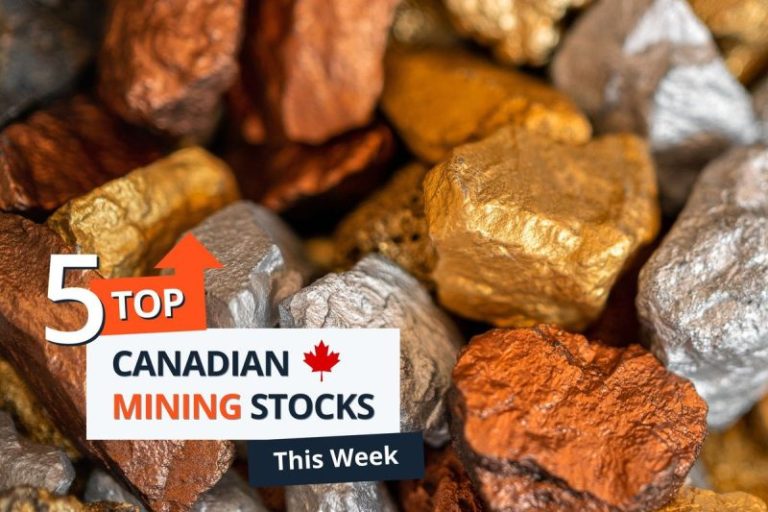
Top Canadian mining stocks this week

How did mining stocks perform against this backdrop?

Take a look at this week’s five best-performing Canadian mining stocks below.

Stock data for this article was retrieved at 3:30 p.m. EDT on Friday using TradingView’s stock screener. Only companies trading on the TSX, TSXV and CSE with market capitalizations greater than C$10 million are included. Mineral companies within the non-energy minerals, energy minerals, process industry and producer manufacturing sectors were considered.

1. St. Augustine Gold and Copper (TSX: SAU)

Weekly gain: 66.67 percent
Market cap: C$116.31 million
Share price: C$0.125

St. Augustine Gold and Copper is a development company focused on its King-king copper-gold project in the Philippines’ Davao de Oro province. The project consists of 184 mining claims.

According to the most recent preliminary economic assessment from 2013, the company projects an after-tax net present value of US$1.78 billion, with an internal rate of return of 24 percent and a payback period of 2.4 years using a base case scenario of a copper price of US$3.00 per pound and a gold price of US$1,250 per ounce. The company is currently working towards an update to the study.

The most recent news from the project was announced on May 30, when St. Augustine stated that it had entered into an agreement with the National Development Corporation (Nadecor) to acquire a 100 percent interest in Nadecor’s wholly owned subsidiary Kingking Milling, which holds the development rights to King-king. Under the terms of the deal, Nadecor will receive C$9.02 million convertible into 185 million shares.

The project’s exploration and development permits are held by Kingking Mining, which remains a 40/40/20 joint venture between St. Augustine, Nadecor and Queensberry Mining and Development. The release also included details of new ore sales and royalty agreements between Kingking Milling and Kingking Mining.

Shares in St. Augustine rose this week after the company announced Tuesday (June 10) it had entered into a non-brokered private placement for up to 341 million shares for gross proceeds of C$24.9 million.

The company said it will use the proceeds to fund the completion of a feasibility study and organizing financing for the King-king project. The first tranche of the placement is expected to close on June 20.

2. Barksdale Resources (TSXV:BRO)

Weekly gain: 50 percent
Market cap: C$12.88 million
Share price: C$0.105

Barksdale Resources is a copper exploration company focused on advancing its assets in Arizona, US.

The company’s flagship Sunnyside project has been in focus in 2025. The site is located in the Patagonia Mountains of Southern Arizona and covers approximately 21 square kilometers. Sunnyside is located adjacent to South32’s (ASX:S32,OTC Pink:SHTLF) Hermosa project.

The most recent news from the project came on May 13, when the company completed the drilling campaign and expenditures necessary to acquire the initial 51 percent interest in the property as part of an earn-in agreement with Regal Resources. Under the terms, Barksdale was required to complete 7,620 meters of drilling and make C$6 million in total expenditures.

The company has until September 2025 to provide an additional C$1 million in cash payment and 5 million shares to Regal to complete the transaction. Once complete, the company will have 20 days to decide whether to proceed to Phase 2 for the option to increase its interest to 67.5 percent, which it can earn by completing another 7,620 meters of drilling, paying Regal C$550,000 and issuing Regal 4.9 million shares within a two year period.

3. Avalon Advanced Materials (TSXV:AVL)

Weekly gain: 50 percent
Market cap: C$18.91 million
Share price: C$0.03

Avalon Advanced Materials is an exploration and development company focused on lithium projects in Canada.

Its flagship project is its 40 percent owned Separation Rapids lithium project in Ontario, a joint venture with SCR-Sibelco, which owns the remaining 60 percent. The project consists of three primary lithium targets: the Separation Rapids deposit; the Snowbank target, located near Kenora; and the Lilypad project near Fort Hope, which also hosts tantalum and cesium mineralization.

The pair increased the project’s measured and indicated mineral resource by 28 percent in late February.

Although the company didn’t release news this week, its share price jumped significantly during the period.

4. Excellon Resources (TSXV:EXN)

Weekly gain: 48.44 percent
Market cap: C$12.88 million
Share price: C$0.105

Excellon Resources is an exploration and development company working to advance a portfolio of assets around the world.

Its most advanced project is the past-producing Mallay silver mine in Central Peru. The company executed a definitive agreement to acquire the project, as well as the Tres Cerros gold-silver project, in March. Between 2012 and 2018, mining at the site produced 6 million ounces of silver, 45 million pounds of zinc and 35 million pounds of lead before the operation was placed on care and maintenance.

On May 23, Excellon announced it had entered into an offtake and financing agreement with Glencore plc (LON:GLEN) that will provide the final piece of funding to allow Excellon to restart mining operations at Mallay, bringing its available capital to US$18 million.

Under the terms of the agreement, Glencore will provide up to US$7.5 million in funding through a pre-export finance loan agreement backed by concentrate production at the mine. Glencore has also agreed to purchase 100 percent of zinc-lead concentrate until 2028 or 2029 depending on certain conditions.

5. Latin Metals (TSXV:LMS)

Weekly gain: 42.86 percent
Market cap: C$23.77 million
Share price: C$0.20

Latin Metals is a South America focused project generator company with 18 projects across Argentina and Peru.

Its primary focus for 2025 has been on its Argentine portfolio, which includes the Organullo gold project in the Salta province, as well as the Cerro Bayo and La Flora gold projects in the Deseado Massif metal belt in the Santa Cruz province.

The company’s most recent news came on Monday when it announced it had secured drill permits for the Organullo site. The permits provide approval for up to 11,900 meters of diamond drilling as well as other exploration activities. Latin Metals said the permit is a key milestone for the project.

The project is subject to an option agreement with AngloGold Argentina, a subsidiary of AngloGold Ashanti (NYSE:AU), which has the right to earn up to an 80 percent stake in the site. AngloGold is preparing to ‘test targets that have potential scale and alteration characteristics consistent with Tier 1 high-sulphidation epithermal gold systems.’

FAQs for Canadian mining stocks

What is the difference between the TSX and TSXV?

The TSX, or Toronto Stock Exchange, is used by senior companies with larger market caps, and the TSXV, or TSX Venture Exchange, is used by smaller-cap companies. Companies listed on the TSXV can graduate to the senior exchange.

How many mining companies are listed on the TSX and TSXV?

As of February 2025, there were 1,572 companies listed on the TSXV, 905 of which were mining companies. Comparatively, the TSX was home to 1,859 companies, with 181 of those being mining companies.

Together the TSX and TSXV host around 40 percent of the world’s public mining companies.

How much does it cost to list on the TSXV?

There are a variety of different fees that companies must pay to list on the TSXV, and according to the exchange, they can vary based on the transaction’s nature and complexity. The listing fee alone will most likely cost between C$10,000 to C$70,000. Accounting and auditing fees could rack up between C$25,000 and C$100,000, while legal fees are expected to be over C$75,000 and an underwriters’ commission may hit up to 12 percent.

The exchange lists a handful of other fees and expenses companies can expect, including but not limited to security commission and transfer agency fees, investor relations costs and director and officer liability insurance.

These are all just for the initial listing, of course. There are ongoing expenses once companies are trading, such as sustaining fees and additional listing fees, plus the costs associated with filing regular reports.

How do you trade on the TSXV?

Investors can trade on the TSXV the way they would trade stocks on any exchange. This means they can use a stock broker or an individual investment account to buy and sell shares of TSXV-listed companies during the exchange’s trading hours.

Article by Dean Belder; FAQs by Lauren Kelly.

Securities Disclosure: I, Dean Belder, hold no direct investment interest in any company mentioned in this article.

Securities Disclosure: I, Lauren Kelly, hold no direct investment interest in any company mentioned in this article.

This post appeared first on investingnews.com