Author

admin

Browsing

U.S. Supreme Court Chief Justice John Roberts warned Saturday of the dangers of politicians using heated rhetoric against judges. 

‘It becomes wrapped up in the political dispute that a judge who’s doing his or her job is part of the problem,’ Roberts said in Charlotte, North Carolina, at the Judicial Conference of the Fourth Circuit, a gathering of judges and lawyers. 

‘And the danger, of course, is somebody might pick up on that. And we have had, of course, serious threats of violence and murder of judges just simply for doing their work. So, I think the political people on both sides of the aisle need to keep that in mind.’

Roberts didn’t name anyone but appeared to be referencing President Donald Trump and Senate Democratic leader Chuck Schumer when he said he’d felt compelled to speak out against rhetoric by Democrats and Republicans in the past. 

Trump has criticized judges many times over the years, including calling for the impeachment of a judge who ruled against a deportation policy earlier this year, referring to him as ‘radical left’ and a ‘lunatic.’ 

Roberts responded at the time, saying, ‘For more than two centuries, it has been established that impeachment is not an appropriate response to disagreement concerning a judicial decision. The normal appellate review process exists for that purpose.’

In 2020, Roberts condemned Schumer for saying that Trump-appointed Supreme Court justices Brett Kavanaugh and Neil Gorsuch would ‘pay the price’ regarding an abortion rights case during Trump’s first term. 

‘You have released the whirlwind, and you will pay the price,’ Schumer said at a rally outside the Supreme Court at the time. ‘You will not know what hit you if you go forward with these awful decisions.’

Schumer later said he was referring to the political price he believed Senate Republicans would pay, but he said, ‘I shouldn’t have used the words I did, but in no way was I making a threat. I never, never would do such a thing, and Leader McConnell knows that.’ 

Roberts, at the time, said of Schumer, ‘Justices know that criticism comes with the territory, but threatening statements of this sort from the highest levels of government are not only inappropriate, they are dangerous. All members of the court will continue to do their job, without fear or favor, from whatever quarter.’

In April, an armed man who was arrested outside of Kavanaugh’s home pleaded guilty to attempting to assassinate the justice. 

Roberts’ remarks came after the Supreme Court issued the final decisions of its term, handing the Trump administration a win Friday by limiting judges’ ability to block his agenda through court orders. 

The Associated Press contributed to this report.

This post appeared first on FOX NEWS

Secretary of State Marco Rubio on Saturday said alleged calls in Iran for the arrest and execution of International Atomic Energy Agency (IAEA) Director General Rafael Mariano Grossi are ‘unacceptable and should be condemned.’

Rubio’s warning came after Iranian parliament vice speaker Hamid Reza Haji Babaei banned Grossi and removed surveillance from its nuclear facilities, accusing Israel of acquiring ‘sensitive facility data,’ according to a report from Mehr news.

‘We support the lAEA’s critical verification and monitoring efforts in Iran and commend the Director General and the lAEA for their dedication and professionalism,’ Rubio wrote in an X post. ‘We call on Iran to provide for the safety and security of IAEA personnel.’

The lAEA this week commented on damage at Iranian nuclear facilities, following U.S. airstrikes on key nuclear sites in Iran, including Fordow, Natanz and Isfahan.

While speaking on Fox News’ ‘The Story with Martha MacCallum,’ Grossi said Isfahan and Natanz were damaged, with Natanz showing ‘very serious damage’ in one of the centrifuge halls where enrichment was being performed.

Though a ceasefire agreement was made between Israel and Iran, Grossi alleged 900 pounds of potentially enriched uranium had been taken to an ancient site near Isfahan.

‘I have to be very precise, Martha,’ Grossi said. ‘We are the IAEA, so we are not speculating here. We do not have information of the whereabouts of this material.’

He claimed Iranian officials had told him they were taking protective measures, which could include moving the material.

‘My job is to try to see where is this material, because Iran has an obligation to report and account for all the material that they have, and this is going to continue to be my work,’ Grossi said.

President Donald Trump withdrew from the 2015 nuclear deal Tehran signed with the U.S., U.K., European Union, France, Germany and Russia in 2018, prompting Iranian threats to remove cameras and limit access to its facilities.

Rubio did not immediately respond to Fox News Digital’s request for comment.

Fox News Digital’s Greg Wehner contributed to this report.

This post appeared first on FOX NEWS

The top Democrat in the Senate plans to inflict maximum pain on Senate Republicans in their march to pass President Donald Trump’s ‘big, beautiful bill’ before lawmakers even get a chance to debate the legislative behemoth.

Indeed, Senate Minority Leader Chuck Schumer, D-N.Y., plans to force clerks on the Senate floor to read the entirety of the GOP’s 940-page megabill. His move to drain as much time as possible will come after Republicans vote on a key procedural test to open debate on the legislation.

‘I will object to Republicans moving forward on their Big, Ugly Bill without reading it on the Senate floor,’ Schumer said on X. ‘Republicans won’t tell America what’s in the bill

‘So Democrats are forcing it to be read start to finish on the floor,’ he said. ‘We will be here all night if that’s what it takes to read it.’

Indeed, staffers were seen carting the bill onto the Senate floor in preparation for the all-night read-a-thon.

Schumer’s move is expected to take up to 15 hours and is designed to allow Senate Democrats more time to parse through the myriad provisions within the massive legislative text. Ultimately, it will prove a smokescreen as Senate Republicans will continue to march toward a final vote.

Once the bill reading is done, 20 hours of debate evenly divided between Democrats and Republicans will begin, likely early Sunday morning. Democrats are expected to use their entire 10-hour chunk, while Republicans will go far under their allotted time.

Then comes the ‘vote-a-rama’ process, where lawmakers can offer an unlimited number of amendments to the bill.

Democrats will again look to extract as much pain as possible during that process, while Republicans, particularly senators that have lingering issues with key Medicaid and land sale provisions, will continue to try and shape and mold the bill.

The last time clerks were forced to read the entirety of a bill during the budget reconciliation process was in 2021, when Senate Democrats held the majority in the upper chamber.

At the time, Sen. Ron Johnson, R-Wis., demanded that the entire, over-600-page American Rescue Act be read aloud. Schumer, who was the Senate Majority Leader attempting to ram then-President Joe Biden’s agenda through the upper chamber, objected to the reading. 

This post appeared first on FOX NEWS

Lawmakers from across the aisle are reacting to President Donald Trump’s ‘big, beautiful bill’ passing a key Senate vote on Saturday night.

Sen. Ron Johnson, R-Wis., who flipped his vote from a ‘no’ to ‘yes’ in dramatic fashion, said in a statement that the mammoth bill is a ‘necessary first step’ to fiscal sustainability and cleaning up the mess left by the Biden administration.

‘Biden and the Democrats left behind enormous messes that we are trying to clean up – an open border, wars, and massive deficits,’ Johnson said. ‘After working for weeks with President Trump and his highly capable economic team, I am convinced that he views this as a necessary first step and will support my efforts to help put America on a path to fiscal sustainability.’

The 51-49 vote went along party lines, with only Sens. Thom Tillis, R-N.C., and Rand Paul, R-Ky., voting against unlocking a marathon 20-hour debate on the bill.

Senate Minority Leader Chuck Schumer, D-N.Y., was among the Democrats against what he called a ‘radical’ bill.

‘Senate Republicans are scrambling to pass a radical bill, released to the public in the dead of night, praying the American people don’t realize what’s in it,’ Schumer said in a statement. ‘If Senate Republicans won’t tell the American people what’s in this bill, then Democrats are going to force this chamber to read it from start to finish.’

The bill will not immediately be debated thanks to Senate Democrats’ plan to force the reading of the entire, 940-page legislative behemoth on the Senate floor.

Sen. Rick Scott, R-Fla., however, said he was ‘proud’ to work with Trump on the bill and ‘put our nation on a path to balance the budget after years of Democrats’ reckless spending.’

Trump has said that he wants the bill, which must pass the Senate before being sent to the House for a vote, on his desk by July 4.

Trump called the Senate vote a ‘great victory’ and directly praised Sens. Johnson, Scott, Mike Lee, R-Ariz., and Cynthia Lummis, R-Wyo., in a post on his Truth Social platform.

‘They, along with all of the other Republican Patriots who voted for the Bill, are people who truly love our Country!’ Trump wrote. ‘As President of the USA, I am proud of them all, and look forward to working with them to GROW OUR ECONOMY, REDUCE WASTEFUL SPENDING, SECURE OUR BORDER, FIGHT FOR OUR MILITARY/VETS, ENSURE THAT OUR MEDICAID SYSTEM HELPS THOSE WHO TRULY NEED IT, PROTECT OUR SECOND AMENDMENT, AND SO MUCH MORE. GOD BLESS AMERICA &, MAKE AMERICA GREAT AGAIN!!!’

In a second post, Trump wrote, ‘VERY PROUD OF THE REPUBLICAN PARTY TONIGHT. GOD BLESS YOU ALL! MAKE AMERICA GREAT AGAIN!!!’

Fox News Digital’s Alex Miller contributed to this report.

This post appeared first on FOX NEWS

Senate Republicans rammed President Donald Trump’s ‘big, beautiful bill’ through a procedural hurdle after hours of tense negotiations that put the megabill’s fate into question. 

Speculation swirled whether Republicans would be satisfied by the latest edition of the mammoth bill, which was released just before the stroke of midnight Saturday morning.

Nearly every Republican, except Sens. Thom Tillis, R-N.C., and Rand Paul, R-Ky., all voted to unlock a marathon 20-hour debate on the bill. Senate Majority Leader John Thune, R-S.D., could only afford to lose three votes.

Though successful, the 51-49 party line vote was not without drama.

Sen. Ron Johnson, R-Wis., flipped his vote from a ‘no’ to ‘yes’ in dramatic fashion, as he and Sens. Rick Scott, R-Fla., Cynthia Lummis, R-Wyo., and Mike Lee, R-Utah, made their way to the Senate floor accompanied by Vice President JD Vance.

Vance was called in case he was needed for a tie-breaking vote, but only his negotiating services ended up being used.

No lawmaker wanted to be the fourth and final decisive vote to kill the bill. Republican leadership kept the floor open for nearly four hours while negotiations continued – first on the Senate floor and then eventually in Thune’s office.

The bill won’t immediately be debated thanks to Senate Democrats’ plan to force the reading of the entire, 940-page legislative behemoth on the Senate floor, which could drain several hours and go deep into the night.

The megabill’s fate, and whether it could pass its first test, was murky at best after senators met behind closed doors Friday, and even during another luncheon on Saturday.

Lingering concerns in both chambers about Medicaid — specifically the Medicaid provider tax rate and the effect of direct payments to states — energy tax credits, the state and local tax (SALT) deduction and others proved to be pain points that threatened the bill’s survival.


However, changes were made at the last-minute to either sate holdouts or comply with the Senate rules. Indeed, the Senate parliamentarian stripped numerous items from the bill that had to be reworked.

The Medicaid provider tax rate was kept largely the same, except its implementation date was moved back a year. Also included as a sweetener for lawmakers like Sens. Susan Collins, R-Maine, Josh Hawley, R-Mo., and others was a $25 billion rural hospital stabilization fund over the next five years.

Collins said that she would support the bill through the procedural hurdle, and noted that the rural hospital stabilization fund was a start, but whether she supports the bill on final passage remains to be seen.

‘If the bill is not further changed, I will be leaning against the bill, but I do believe this procedural vote to get on the bill so that people can offer amendments and debate it is appropriate,’ Collins said.

Tillis, who is also concerned about the changes to Medicaid and would like to see a return to the House GOP’s version, said that he would not vote in favor of the bill during final passage.

The SALT deduction included in the House GOP’s version of the bill also survived, albeit the $40,000 cap will remain intact for five years. After that, the cap will revert to its current $10,000.

Other sweeteners, like expanding nutrition benefit waivers to Alaska and a tax cut for whaling boat captains, were thrown in, too, to get moderates like Sen. Lisa Murkowski, R-Alaska, on board with the bill.

Lee announced that he withdrew his open lands sale provision, which proved a sticking point for lawmakers in Montana and Idaho. 

Still, Republicans who are not satisfied with the current state of the bill will use the forthcoming ‘vote-a-rama,’ when lawmakers can offer an unlimited number of amendments, to try and change as much as they can before final passage. 

Democrats, however, will use the process to inflict as much pain as possible on Republicans.

Once the amendment marathon concludes, which could be in the wee hours of Monday morning, lawmakers will move to a final vote to send the bill, which is an amendment to the House GOP’s version of the ‘big, beautiful bill,’ back to the lower chamber.

From there, it’s a dead sprint to get the package on the president’s desk by July 4.

In a statement of administration policy obtained by Fox News Digital, Trump signaled that he would sign the bill.

‘President Trump is committed to keeping his promises,’ the memo read. ‘And failure to pass this bill would be the ultimate betrayal.’ 

This post appeared first on FOX NEWS

As we head into the second half of 2025, here are three stocks that present strong technical setups with favorable risk/reward profiles. One is the largest market cap stock we’re familiar with, which bodes well for the market in general. The second is an old tech giant that’s making a comeback. The third is a beaten-down S&P 500 name that may be ready to rally.

Let’s dive into these three stocks.

NVIDIA (NVDA) is Leading the Market

Nvidia (NVDA) shares have finally broken out and closed above $150, a level we’ve been closely watching. With price action above that resistance threshold, NVDA’s stock price has room to run.

DeepSeek and tariff concerns seem to be in the rearview mirror. The fundamental positives are continued earnings growth, continued large tech cap-ex spend, and, more recently, Jensen Huang’s unveiling of a cute robot he feels could be the next big thing.

Technically, this move has legs, and we have the patterns and history to show for it. The risk/reward set-up is now quite favorable. Let’s break it down.

Over the last five years, there have been periods of consolidation (green boxes) and then significant breakouts to the upside. In all cases, shares became overbought according to the relative strength index (RSI). But overbought doesn’t mean NVDA’s stock price will reverse. During uptrends, overbought conditions can last for quite some time, as they did after the prior two significant breakouts.

With the official breakout above $150 and RSI again reading over 70, history suggests an extended rally is in the cards. A gain of 25–30% from current levels and a run to $200 is likely.

The downside risk is to the $150 level, from which shares just broke out. If this move is just a head fake, then use that level as a stop to limit your losses. This risk/reward set-up is why we believe this is one to own for the back half of 2025.

Cisco Systems (CSCO) Finds New Life

Old-timers like me may remember what a high flyer Cisco Systems (CSCO) once was. It’s been a member of the Dow Jones Industrial Average ($INDU) since June 2009, and shares have struggled to sustain any upward momentum until lately.

Fundamentally, the company continued to grow through acquisition. Now, those deals are starting to help their bottom line, namely the $28 billion acquisition of Splunk that closed in 2024. 

Technically — and that’s what we care about on the StockCharts platform — we can have some fun.

Below is a 30-year chart going back to the dot-com boom. Cisco was one of Wall Street’s darlings and climbed astronomically before falling from the skies. It has struggled to revisit those levels, but that could change soon. 

Switching to a smaller time frame — a three-year weekly chart (see below) — we are seeing great set-ups as we head into the back half of 2025.

CSCO’s stock price consolidated between $43 and $55 for 15 months and broke out in late 2024. Shares rallied and then pulled back to old resistance (now support) at $55 and began their climb back.

Now shares are breaking out again. An upside target of $82, the all-time high set back during the dot-com era, is within reach and may just get there by year-end. The risk/reward seems favorable and, given the run in tech and cyber stocks which CSCO represents, the momentum is there to reach those highs.

Generac’s Power Play

Welcome to hurricane season! It lasts from June 1st to November 30. Generac (GNRC), a leader in home backup power, tends to perform well during weather extremes. It isn’t always the primary catalyst for rallies over the long term in the stock, but it can spur short-term rallies.

Last week, as much of the country was in the middle of a heat wave, GNRC had the best week of gains since November 2024, rallying nearly 12%. The trend change seems to be underway. Shares are lower by -8.1% year-to-date, and there’s room to run.

However, the charts are showing signs of life. Let’s keep this one as simple as possible.

The stock broke its longer-term downtrend (red line)

Shares have made a consistent set of higher lows (green uptrend)

Shares recaptured their 50-day moving average

Shares consolidated in an ascending triangle and broke out

Shares tested and failed to recapture their 200-day moving average

Progress is being made. The trend has changed, there’s something to reverse, and seasonal factors and reduced tariff concerns are a true tailwind.

Shares could easily pull back — a flag, if you will — to the $135 area, but should be a great entry point from a risk/reward perspective. Overall, shares are poised to continue reversing that longer-term downtrend, and could be a good addition to the portfolio for the end of 2025.

The Bottom Line

Each of these stocks offers a viable investment strategy with favorable risk-to-reward ratios. If you’re going to enter a position, use clearly-defined stop levels to manage your risks.


If you’ve looked at enough charts over time, you start to recognize classic patterns that often appear. From head-and-shoulders tops to cup-and-handle patterns, they almost jump off the page when you bring up the chart. I would definitely include Fibonacci Retracements on that list, because before I ever bring up the Fibonacci tool on StockCharts, I’m pretty confident the levels are going to line up well with the price action.

Today, we’re going to look at a breakout name that shows why Fibonacci Retracements can be so valuable for confirming upside potential. We’ll also explain some best practices for identifying the most important price levels to use when setting up a Fibonacci framework. Finally, we’ll show how Fibonacci analysis could have helped you validate the current uptrend phase for the S&P 500 index.

Confirming Breakouts: Norwegian Cruise Line Holdings (NCLH)

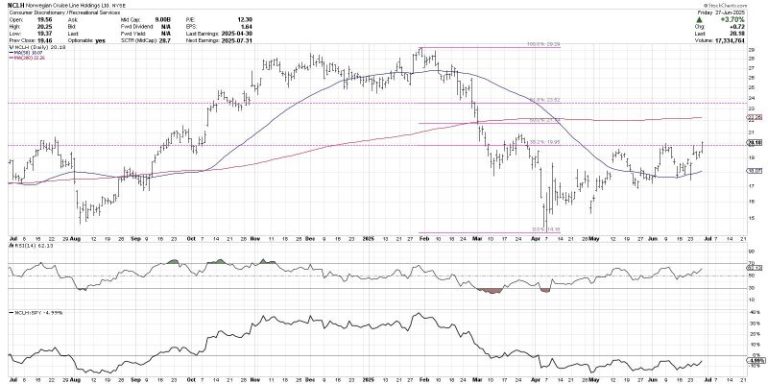
I started dropping quite a few Fibonacci Retracements on price charts soon after the April 7, 2025 market low. As stocks experienced a sudden and severe bounce off those lows, it became clear that we would need some way to validate a potential upside swing. That helped me zero in on the $20 level for Norwegian (NCLH), a level which was finally eclipsed this week.

Using the January high and the April low, we can see a 38.2% Fibonacci level come in right around $20. A gap higher in mid-May took NCLH close to that level, which was then retested again in early June. After bouncing off the 50-day moving average last week, Norwegian finally pushed above this first Fibonacci resistance level with Friday’s rally.

One of the ways we can differentiate between a “dead cat bounce” off a major low and the beginning of a much larger recovery phase is to key in on the first Fibonacci retracement level. If the price can push above this initial upside target, ideally on heavier than normal volume, then the chances of further upside are significantly increased.

In the case of NCLH, we can now bump up a price target to further Fibonacci levels. The 50% line, just below $20, lines up fairly well with the 200-day moving average. The 61.8% comes in right around $23.50, which represents my next upside target, assuming this week’s strength is confirmed by a follow-through day next week.

Identifying Pullbacks: Raytheon Technologies (RTX)

We can also use Fibonacci Retracements to identify downside targets after a major price peak. In the case of Raytheon Technologies (RTX), that means we use the April low and the high from mid-June to generate potential support levels.

In this case, we can see that the Fibonacci retracement levels line up very well with traditional support levels using the price action itself. The 38.2% level lines up with the mid-June low around $135, which also coordinates with the 50-day moving average. Beyond that support, the 50% level sits right at the late May low at $131, and the 61.8% level comes in right around the early May support at $126.

Given an initial pullback from the June peak around $149, I’m seeing strong potential support at the 38.2% level and 50-day moving average around $135. Now I can use Fibonacci levels to better define my risk vs. reward, showing how much downside action I’d anticipate while still keeping an eye on a return to the previous all-time highs.

Validating Uptrends: The S&P 500 Index ($SPX)

Sometimes Fibonacci Retracements are valuable in that they help validate that an uptrend is progressing with a decent pace. For the S&P 500 chart, every break of a Fibonacci resistance level has confirmed the strength of the broad market indexes off the April low.

It took only two sessions for the SPX to break above the 38.2% retracement of the February to April downtrend phase. In fact, the S&P almost reached the 50% level before pulling back to around 5100 in mid-April. From there, we can see a gap back above the 38.2% level, which helped confirm the strength of the new uptrend phase.

I still have the pink trendline on my chart that I remember drawing during the downtrend phase. “As long as the S&P remains below trendline resistance, the market is in a clear downtrend,” I remember saying out loud on my market recap show. So when the SPX broke above the 50% level, as well as that clear trendline, I was forced to acknowledge the staying power of this new uptrend phase.

The S&P 500 stalled out at the 61.8% retracement level in early May, but another price gap higher signaled that the final Fibonacci resistance level was no longer going to hold. And once you eclipse the final Fibonacci level, that implies a full retest back to the 100% point.

So am I surprised that the S&P 500 has pushed to new all-time highs this week? Absolutely not. Indeed, using Fibonacci Retracements on charts like this have helped me admit when a new uptrend is showing strength, and provide plenty of reminders to follow the trend until proven otherwise!

RR#6,

Dave

P.S. Ready to upgrade your investment process? Check out my free behavioral investing course!


David Keller, CMT

President and Chief Strategist

Sierra Alpha Research LLC

marketmisbehavior.com

https://www.youtube.com/c/MarketMisbehavior


Disclaimer: This blog is for educational purposes only and should not be construed as financial advice. The ideas and strategies should never be used without first assessing your own personal and financial situation, or without consulting a financial professional.

The author does not have a position in mentioned securities at the time of publication. Any opinions expressed herein are solely those of the author and do not in any way represent the views or opinions of any other person or entity.

The bears are now left grasping at straws. What about tariffs? What about inflation? What about recession? What about the Fed? What about interest rates? What about the Middle East? What about the deficits? Blah, blah, blah.

When it comes to the media, you need to bury your head in the sand. Actually, take your head out of the sand and bury it in the charts. That’s where you’ll find the truth.

I said all-time highs were coming back at the April low and here we are. The S&P 500 has set a new all-time record high today and, barring a significant afternoon decline, will set its all-time closing high above the previous closing high of 6144, which was set on February 19, 2025. This new high comes just as we begin to prepare for Q2 earnings season. The run up to earnings season is generally and historically quite strong, so get ready for more highs ahead.

Since 1950, the S&P 500 has produced annualized returns of nearly 27% during the period June 28th through July 17th. This annualized pre-earnings run is nearly triple the average S&P 500 annual return of 9% since 1950. Care to guess how the NASDAQ and Russell 2000 have fared during this bullish pre-earnings period?

  • NASDAQ: +38.67%
  • Russell 2000 (IWM): +32.61% (bullish period ends July 15th for small caps)

Clearly, the bulls have the historical advantage for the next 3 weeks. Technically, evidence began turning in the bulls’ favor in mid-March, despite the last big move lower in early April. I have the research to back that up and will discuss it at an event on Saturday (more details below). While the stock market was rapidly declining in April, Wall Street was happily stealing everyone’s shares during the panicked selloff.

Technical Strength

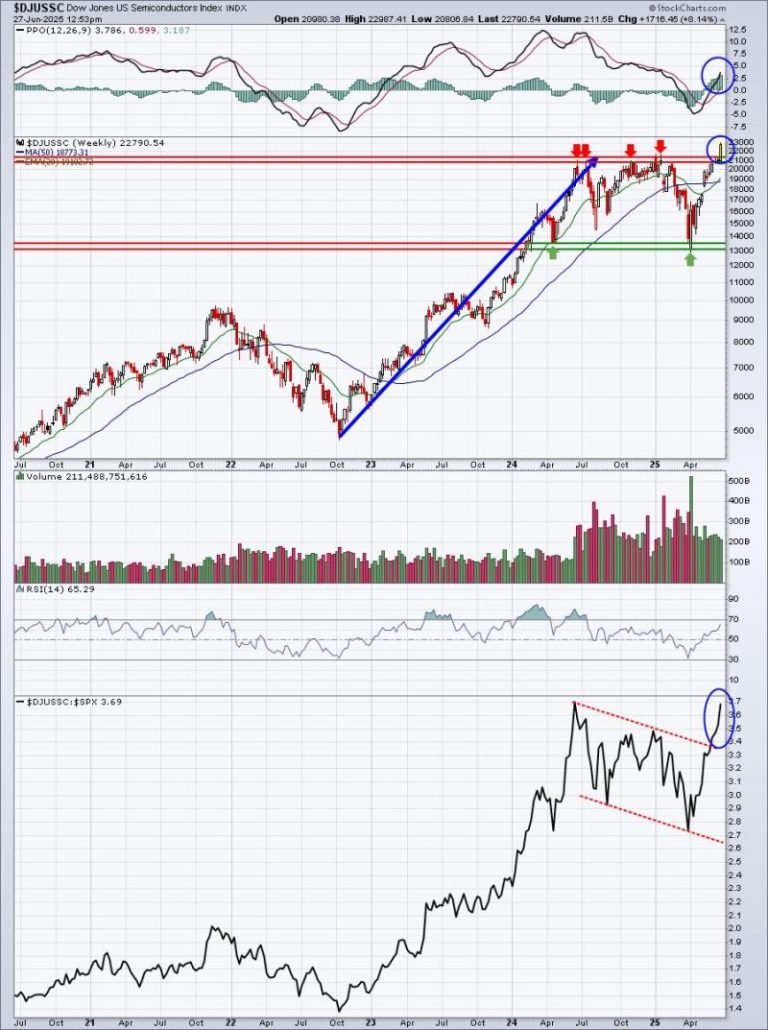
Two of the most important industry groups to follow are semiconductors ($DJUSSC) and software ($DJUSSW). These two groups are among the most influential in terms of driving the S&P 500 higher. Check out both of these charts and be sure to check out both the absolute and relative strength currently.

Semiconductors:

Software:

Now I’m going to provide charts of these same two groups, but this time show you how positively they correlate to the S&P 500’s direction over the course of this century.

Semiconductors:

Software:

Honestly, you don’t need a PhD in Economics to understand the above charts. It’s really quite simple. When semiconductors and software are rallying to new highs and showing relative strength, BUY U.S. stocks! They both have extremely tight positive correlation with the S&P 500 and they both look very technically sound right now.

Interest Rate Cut

It’s coming and it’s coming fast! I’m now convinced that the Fed will cut the fed funds rate in a month at their next scheduled meeting on July 29-30. I’m not saying it because I feel the Fed should cut or needs to cut. I’m saying it because there’s a ton of buying right now in the 1-month treasury, sending its yield down. The 1-month treasury yield ($UST1M) typically begins to move BEFORE any Fed action occurs. We saw it back in August/September 2024, just prior to the 50 basis point cut at the September 2024 meeting:

The black directional lines in the bottom panel mark approximately the date that the Fed lowered the fed funds rate. The red directional lines in the top panel highlight the downward movement in the $UST1M PRIOR to the Fed’s lowering roughly a month later. Again, I’m not making this stuff up. The charts are telling me a story here and the current story is that rates are about to come down.

Checkmate bears.

Follow the charts, not the media!

The Game

I’m beginning to believe that capitulation is nothing more than a staged event for the Wall Street elite and we’re the panicked pawns running around with our hair on fire. Those days are over for EarningsBeats.com members. We saw this one coming, just like we saw it coming in 2022. Getting out at the top with the Wall Street elite and getting back in at the bottom before them is an excellent recipe for beating the S&P 500 by a mile!

Learning is the key. We focus on market research, guidance, and education at EarningsBeats.com. Those are our 3 pillars of business. Calling the 2025 market top wasn’t a coincidence. We’ve done it before and we’ll do it again. Jumping back in near the bottom was no coincidence either. Our signals are proven and they work.

On Saturday morning at 10:00am ET, we’re hosting a FREE educational event, “Trading the Truth: How Market Manipulation Creates Opportunity”. I’m going to show everyone the “play-by-play” of how we were able to move to cash BEFORE the market top and back into stocks NEAR the market bottom. Market tops form with many of the same signals each time. To learn more about this event and to register with your name and email address, CLICK HERE.

If you’ve struggled with all the uncertainty in 2025 and haven’t trusted stocks, it’s time that you change your process and strategies. I’ll see you on Saturday!

Happy trading!

Tom

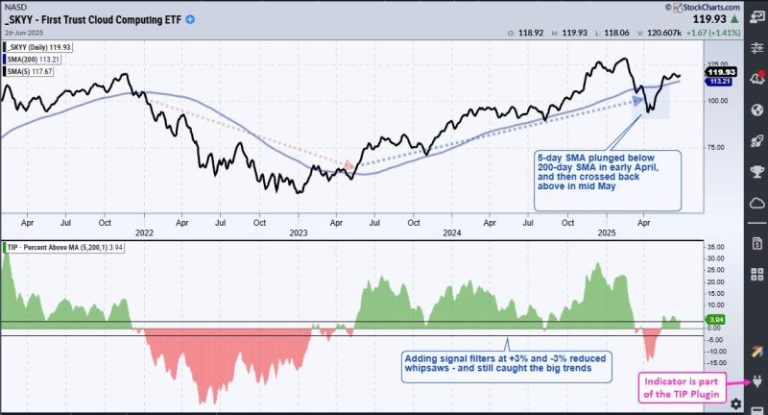
Chartists can improve their odds and increase the number of opportunities by trading short-term bullish setups within bigger uptrends. The first order of business is to identify the long-term trend using a trend-following indicator. Second, chartist can turn to more granular analysis to find short-term bullish setups. Today’s example will use the Cloud Computing ETF (SKYY).

***********************

, which has over a dozen reports. These cover the Zweig Breadth Thrust, trend-following signals, trailing stops and finding bullish setups. Check it out!

//////////////////////////////////////////////////

Rio Silver Inc. (the ‘Company’ or ‘Rio Silver’) (TSX.V: RYO) (OTC: RYOOF) announces that, further to the announcement on May 1, 2025, it will consolidate (the ‘Consolidation’) its common shares on the basis of five pre-Consolidation common shares for one post-Consolidation share.

The Company expects that the TSX Venture Exchange (the ‘Exchange’) will issue a bulletin in short order, confirming that the Company’s common shares will then commence trading on a post-Consolidation basis effective on or about the opening of trading on Thursday, July 3, 2025. There will be no change to the Company’s name or trading symbol. The new CUSIP and ISIN numbers for the post-Consolidation shares are 76721A113 and CA76721A1131, respectively.

No fractional common shares will be issued, and fractions of less than one-half of a common share will be cancelled and fractions of at least one-half of a common share will be converted to a whole common share. Outstanding options, warrants and other convertible securities will likewise be adjusted for the Consolidation, with the number of underlying common shares and exercise prices being adjusted accordingly.

The Company currently has 84,832,845 common shares issued and outstanding, and immediately following the Consolidation the Company expects to have, subject to rounding adjustment, approximately 16,966,572 common shares issued and outstanding, none of which are subject to escrow.

Letters of Transmittal will be mailed shortly to registered shareholders who hold share certificates, with instructions for the exchange of existing share certificates for new share certificates. Shareholders holding uncertificated shares (such as BEO, NCI and DRS positions) will have their holdings adjusted electronically by the Company’s transfer agent and need not take any further action to exchange their pre-Consolidation shares for post-Consolidation shares.

The Company expects that the Consolidation will provide the Company with increased flexibility in structuring and completing financings and potential business transactions. Shareholder approval for the Consolidation was received at the Company’s Annual General and Special Meeting of Shareholders held on June 12, 2025, as previously announced on June 25, 2025.

ON BEHALF OF THE BOARD OF DIRECTORS OF Rio Silver INC.
Chris Verrico
Director, President and Chief Executive Officer

Neither the TSX Venture Exchange nor its Regulation Services Provider accepts responsibility for the adequacy or accuracy of this release.

For further information,

Christopher Verrico, President, CEO
Tel: (604) 762-4448
Email: chris.verrico@riosilverinc.com
Website: www.riosilverinc.com

This news release includes forward-looking statements that are subject to risks and uncertainties. All statements within, other than statements of historical fact, are to be considered forward looking. Although the Company believes the expectations expressed in such forward-looking statements are based on reasonable assumptions, such statements are not guarantees of future performance and actual results or developments may differ materially from those in forward-looking statements. Factors that could cause actual results to differ materially from those in forward-looking statements include market prices, exploitation and exploration successes, continued availability of capital and financing, and general economic, market or business conditions. There can be no assurances that such statements will prove accurate and, therefore, readers are advised to rely on their own evaluation of such uncertainties. We do not assume any obligation to update any forward-looking statements except as required by applicable laws.

News Provided by GlobeNewswire via QuoteMedia

This post appeared first on investingnews.com