Author

admin

Browsing
NEWYou can now listen to Fox News articles!

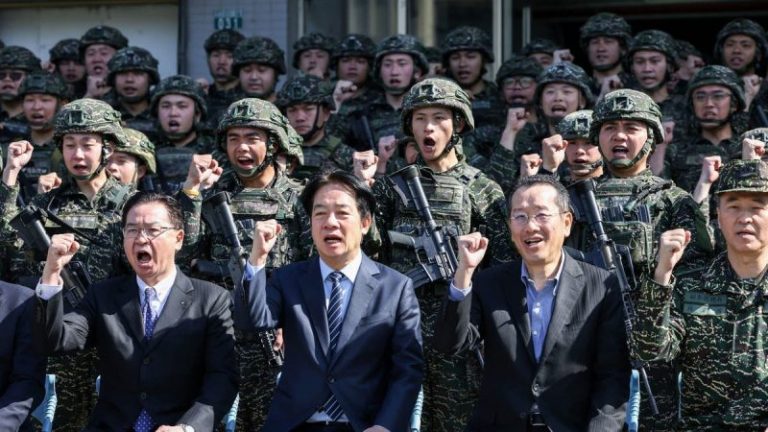
U.S. Secretary of Defense Pete Hegseth issued a stark warning Saturday at the Shangri-La Dialogue security conference in Singapore: China’s military is ‘rehearsing for the real deal,’ and a full-scale invasion of Taiwan ‘could be imminent.’

‘We are not going to sugarcoat it – the threat China poses is real,’ he added.

Beijing swiftly rejected the allegation. Rear Admiral Hu Gangfeng, head of the Chinese delegation and vice president of China’s National Defense University, called the remarks ‘groundless accusations,’ stating that ‘some of the claims are completely fabricated, some distort facts and some are cases of a thief crying ‘stop thief.’’ Despite such denials, a growing body of evidence suggests China may indeed be preparing for a military move against Taiwan.

Numerous indicators draw this conclusion. Here are nine:

1. China has intensified its joint sea and air exercises surrounding Taiwan, including rehearsals simulating blockades, encirclements, and amphibious assaults. These drills closely mirror operational strategies that would likely be employed in an actual invasion and are widely interpreted by analysts as concrete signals of Beijing’s willingness to use force.

2. The Peoples’ Liberation Army (PLA) has positioned H-6 bombers, capable of delivering nuclear payloads, on outposts such as Woody Island in the South China Sea. These platforms significantly extend China’s strike capability and serve as strategic messaging to both Taipei and Washington.

3. China continues to conduct gray-zone operations aka non-kinetic forms of coercion, including cyberattacks on Taiwan’s infrastructure, disinformation campaigns, and illegal incursions by maritime militia vessels. Though these actions fall below the threshold of open warfare, they are designed to wear down Taiwan’s defenses and destabilize the region. 

4. According to U.S. intelligence assessments, Chinese President Xi Jinping has instructed the PLA to be capable of launching an invasion of Taiwan by 2027. While not a confirmed deadline for action, it has catalyzed PLA modernization, emphasizing joint force integration and amphibious readiness. 

5. China’s strategic expansion in Latin America – especially through Belt and Road investments and attempts to influence key nodes such as the Panama Canal reflect broader ambitions to project global power and encircle U.S. interests. These moves indirectly support Taiwan-related ambitions by distracting or overextending U.S. response capabilities.

6. Recent PLA exercises have incorporated civilian ferries capable of transporting tanks and personnel—suggesting preparations for amphibious operations on Taiwan’s shores. The dual-use nature of these assets allows China to mask military buildup under the guise of civilian activity.

7. Beijing has intensified its political narrative around ‘reunification,’ including state media coverage, educational reforms, and speeches by top Chinese officials. These ideological signals often precede military action in authoritarian regimes.

8, China has rapidly expanded its coastal infrastructure, including new docks, airstrips, and logistics hubs in Fujian Province—directly across the Taiwan Strait. Satellite imagery suggests these assets are optimized for a cross-strait operation.

9. Chinese fighter jets and warships have entered Taiwan’s Air Defense Identification Zone (ADIZ) at unprecedented levels. In early 2025 alone, PLA aircraft breached Taiwan’s ADIZ over 1,200 times, prompting elevated readiness levels in Taipei.

The question of whether China will invade Taiwan is no longer hypothetical but a matter of timing and risk calculus. While Beijing continues to deny aggressive intent, the evidence suggests a sustained and deliberate military buildup with the intent to compel reunification—if not peacefully, then by force. 

Hegseth’s warning reflects not alarmism, but a sober assessment of escalating realities. These indicators—military drills, strategic deployments, political rhetoric, and infrastructure mobilization—align with historical precedents for pre-invasion posturing.

The international community must take this threat seriously. Strengthening deterrence, improving intelligence sharing, and reinforcing Taiwan’s self-defense capabilities are critical to avoiding a regional catastrophe. For the United States and its allies, readiness is no longer optional—it is a strategic imperative.

This post appeared first on FOX NEWS

The gold price saw peaks and troughs this week.

After rising to almost US$3,350 per ounce on Monday (May 26), the yellow metal took a dive, dropping just below the US$3,260 level on May 28 (Wednesday). It was back on the rise the next day, hitting US$3,324.

Trade tensions were in focus throughout the period.

Concerns lessened early in the week, when US President Donald Trump said he would delay raising tariffs on the EU, but uncertainty ratcheted back up on Wednesday (May 28), when an American trade court issued a ruling that blocked most of his tariffs put in place by his administration.

“It is not for unelected judges to decide how to properly address a national emergency” — Kush Desai, White House spokesperson

The decision prompted a flurry of activity and backlash from Trump and his supporters, with a federal appeals court ultimately reinstating the tariffs on May 29 (Thursday).

The turmoil was beneficial for gold, as was news that the US economy shrank by 0.2 percent annually in Q1. The GDP estimate is the second of three from the Bureau of Economic Analysis, and comes in lower than the first calculation of a 0.3 percent contraction.

Bullet briefing — Glencore restructures, Anglo completes spinoff

Glencore restructuring move sparks M&A talk

Commodities giant Glencore (LSE:GLEN,OTC Pink:GLCNF) has quietly moved billions worth of global coal and ferroalloys assets into an Australian subsidiary.

The Australian Financial Review was the first to report the news, and it’s already sparked speculation about renewed M&A talks between Glencore and Rio Tinto (ASX:RIO,NYSE:RIO,LSE:RIO). The two major companies reportedly engaged in discussions last year, but in the end did not move forward.

With this restructuring from Glencore and Rio Tinto’s CEO due to step down later this year, market watchers see potential for a deal to be done.

Anglo American spins off Valterra Platinum

Anglo American (LSE:AAL,OTCQX:AAUKF) made headlines elsewhere this week as the firm finished demerging its platinum-group metals unit, Valterra Platinum (JSE:VAL).

Valterra, formerly Anglo American Platinum, began trading on the Johannesburg Stock Exchange on May 28, and will have a secondary listing in London as of June 2.

Anglo made the decision to spin off Valterra after heading off a US$49 billion takeover bid from BHP (ASX:BHP,NYSE:BHP,LSE:BHP) last year. The company embarked on a restructuring plan that will see it hone in on copper and iron ore.

Interestingly, Valterra’s debut comes alongside a platinum price boost. The metal recently broke out to its highest level in about two years, nearly reaching US$1,100 per ounce.

Edward Sterck of the World Platinum Investment Council believes it’s too soon to tell whether the rise is sustainable, but he does see a ‘perfect storm’ brewing for platinum.

Here’s how he explained it:

I think platinum’s fundamentals are just highly attractive at the moment. You’ve got really constrained supply, you’ve got demand that is actually beginning to show some real signs of growth, driven principally by an inflection in jewelry demand and by ongoing growth in investment demand.

And so given those things are resulting in these really significant deficits — this is the third year of almost a million ounces of deficit out of an 8 million ounce market — those are just rapidly depleting those aboveground stocks … this has all generally come together as a perfect storm. We are seeing that tightness in the market, and I feel quietly optimistic that we’re going to see that long-awaited price response come through.

Watch the full interview for a more in-depth look at supply and demand dynamics for platinum.

Securities Disclosure: I, Charlotte McLeod, hold no direct investment interest in any company mentioned in this article.

This post appeared first on investingnews.com

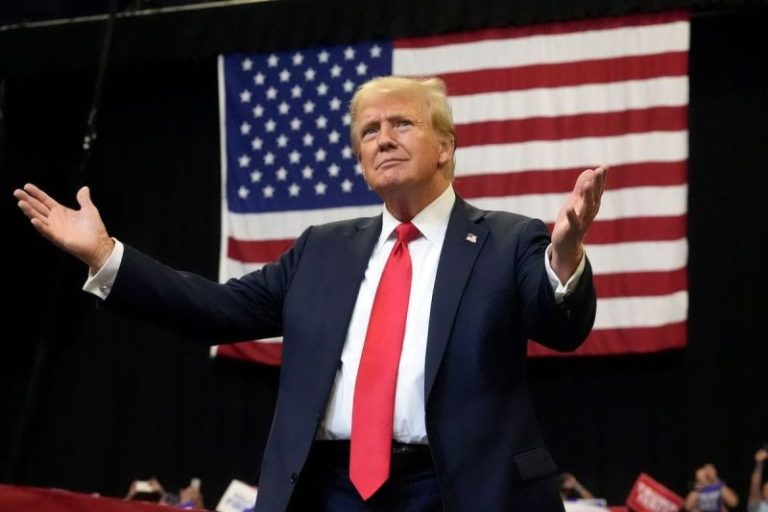
President Donald Trump on Saturday warned Sen. Rand Paul, R-Ky., he would be ‘playing right into the hands of the Democrats’ if he votes against Trump’s ‘Big, Beautiful Bill.’ 

‘If Senator Rand Paul votes against our Great, Big, Beautiful Bill, he is voting for, along with the Radical Left Democrats, a 68% Tax Increase and, perhaps even more importantly, a first time ever default on U.S. Debt,’ Trump wrote on Truth Social Saturday afternoon. 

‘Rand will be playing right into the hands of the Democrats, and the GREAT people of Kentucky will never forgive him! The GROWTH we are experiencing, plus some cost cutting later on, will solve ALL problems. America will be greater than ever before!’

Paul told ‘Fox News Sunday’ last weekend he supports the tax and spending cuts in the bill, which he still slammed as ‘wimpy and anemic, but I still would support the bill, even with wimpy and anemic cuts if they weren’t going to explode the debt. The problem is the math doesn’t add up. They’re going to explode the debt by, the House says, $4 trillion. The Senate’s actually been talking about exploding the debt $5 trillion.’ 

The bill narrowly passed the House May 22 and will soon be voted on in the Senate, where Republicans can only afford to lose three votes. 

Others, like Sen. Ron Johnson, R-Wis., have also expressed concerns about the bill. 

Last weekend, Trump told reporters he was open to changes in the bill.

‘I want the Senate and the senators to make the changes they want,’ he said. ‘It will go back to the House, and we’ll see if we can get them. In some cases, the changes may be something I’d agree with, to be honest.’ 

Along with tax cuts, the One Big Beautiful Bill Act also includes stricter requirements for accessing Medicaid, changes to the Supplemental Nutrition Assistance Program (SNAP) program and no taxes on overtime or tips. 

Democrats have slammed the Medicaid reform section of the bill, mentioning possible cuts as a driving issue ahead of competitive midterm elections in 2026. 

The Congressional Budget Office (CBO), a nonpartisan analyst for the U.S. Congress, estimates that 8.6 million people in the United States will lose health insurance by 2034 through the One Big Beautiful Bill Act’s Medicaid reform. 

‘The Democrats have been focusing on this specific line of attack that 13.7 million Americans are going to lose their health care, and that’s just blatantly false,’ Rep. Erin Houchin, R-Ind., told Fox News Digital in an exclusive interview this week. 

‘Five million of those people are receiving a tax credit under the Affordable Care Act that was passed by the Democrats with a sunset date that was implemented by the Democrats. We’re simply allowing the sunset date to expire as the Democrats originally intended,’ Houchin said. 

CBO estimates that 13.7 million Americans will lose coverage by 2034, which also includes the 5 million Americans who were already about to lose coverage. A number of Democrats have already deployed the figure in campaign messages rejecting Trump’s bill passing in the House.

‘I don’t trust the CBO score, nor should the American people, because it’s been proven again and again to be wildly off,’ added Houchin, who served on three major committees leading budget markup, including the House Rules, Budget and Energy and Commerce committees. 

Fox News’ Deirdre Heavey contributed to this report.

This post appeared first on FOX NEWS

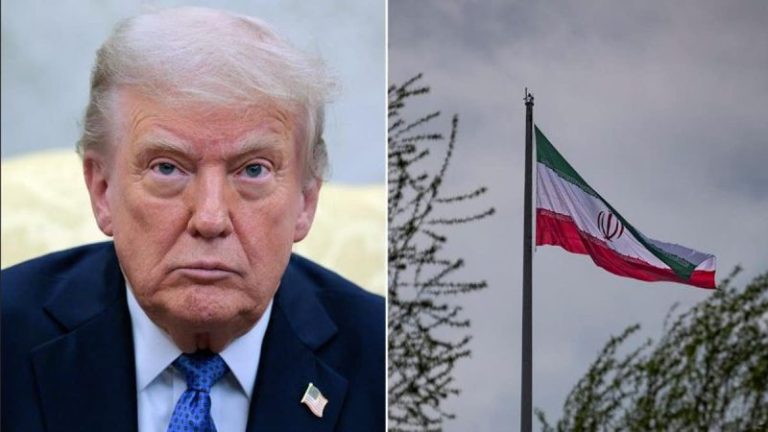
The White House on Saturday said it is in Iran’s ‘best interest to accept’ its proposal on a nuclear deal following a report from the International Atomic Energy Agency saying the country is swiftly increasing its stockpile of near weapons-grade enriched uranium. 

‘President Trump has made it clear that Iran can never obtain a nuclear bomb,’ White House press secretary Karoline Leavitt said in a statement. ‘Special Envoy [Steve] Witkoff has sent a detailed and acceptable proposal to the Iranian regime, and it’s in their best interest to accept it. Out of respect for the ongoing deal, the administration will not comment on details of the proposal to the media.’ 

The IAEA’s report said Iran had increased its stockpile to 900.8 pounds of uranium enriched by up to 60% as of May 17, a nearly 50% increase since the agency’s last report in February, which put the stockpile at 605.8 pounds. 

The report said Iran is ‘the only non-nuclear-weapon state to produce such material,’ which is a ‘serious concern.’

The IAEA added that just 92 pounds of 60% enriched uranium is enough to produce an atomic bomb if it is enriched to 90%. 

Iran maintains that its nuclear program is for peaceful purposes, but U.S. intelligence agencies say the country has ‘undertaken activities that better position it to produce a nuclear device, if it chooses to do so.’

Iran’s Foreign Ministry and the Atomic Energy Organization of Iran said in a joint statement that the report was based on ‘unreliable and differing information sources,’ claiming that it was biased and unprofessional. 

The statement added, ‘The Islamic Republic of Iran expresses its disappointment about the report, which was prepared by imposing pressure on the agency for political purposes, and expresses its obvious objection about its content.’

On Thursday, Iran Foreign Minister Abbas Araghchi wrote on X that he was unsure a U.S.-Iran nuclear deal could be imminently reached.

‘Iran is sincere about a diplomatic solution that will serve the interests of all sides. But getting there requires an agreement that will fully terminate all sanctions and uphold Iran’s nuclear rights — including enrichment,’ he wrote. 

Oman Foreign Minister Badr al-Busaidi presented the Trump administration’s first formal proposal in Tehran Saturday, which calls for Iran to cease all uranium enrichment and for a regional consortium that includes Iran, Saudi Arabia and other Arab states and the U.S. for producing nuclear power, The New York Times reported, citing people familiar with the document. 

Israeli Prime Minister Benjamin Netanyahu’s office also put out a rare statement on a Saturday about the IAEA’s report, calling it ‘grave.’

‘The agency presents a stark picture that serves as a clear warning sign: Despite countless warnings by the international community, Iran is totally determined to complete its nuclear weapons program,’ Netanyahu’s office said. 

‘The report strongly reinforces what Israel has been saying for years — the purpose of Iran’s nuclear program is not peaceful. This is evident from the alarming scope of Iran’s uranium enrichment activity. Such a level of enrichment exists only in countries actively pursuing nuclear weapons and has no civilian justification whatsoever.

‘The report clearly indicates that Iran remains in non-compliance of its fundamental commitments and obligations under the Non-Proliferation Treaty (NPT) and continues to withhold cooperation from IAEA inspectors. The international community must act now to stop Iran.’

This post appeared first on FOX NEWS

Hamas has agreed to release 10 living hostages and return the bodies of 18 more, but the terms of the proposed deal have been deemed unacceptable by the U.S. and Israel.

The group, which has been on the State Department’s list of Foreign Terrorist Organizations since 1997, made the announcement in a statement Saturday and said it was being done on the condition that a number of Palestinian prisoners be returned in exchange as part of a means to achieve a permanent ceasefire.

Israeli media reported that Hamas added new demands to the proposal from U.S. Special Envoy Steve Witkoff, including a permanent ceasefire, complete Israeli withdrawal from Gaza and unrestricted humanitarian aid flow into the strip.

Witkoff’s proposal did not include a full withdrawal or a ceasefire, the Jerusalem Post reported, and that Hamas added terms of its own.

In a statement posted to X on Saturday, Witkoff called Hamas’ response to the American proposal ‘totally unacceptable’ and warned it ‘only takes us backward.’ He urged the group to accept the original framework in order to begin proximity talks as early as next week, which could pave the way for a 60-day ceasefire and the return of both living and deceased hostages.

In a statement before Witkoff’s response, Hamas wrote: ‘After conducting a round of national consultations, and based on our immense sense of responsibility towards our people and their suffering, the Islamic Resistance Movement (Hamas) today submitted its response to US Special Envoy Steve Witkoff’s latest proposal to the mediating parties. 

‘This proposal aims to achieve a permanent ceasefire, a comprehensive withdrawal from the Gaza Strip, and ensure the flow of aid to our people and our families in the Gaza Strip.’

Reacting to the announcement, the Israeli Prime Minister’s Office said in a statement that while Israel had agreed to the updated Witkoff framework, ‘Hamas continues to cling to its refusal.’ The office emphasized that Israel remains committed to bringing its hostages home and defeating Hamas, citing Witkoff’s remarks as confirmation that Hamas’ latest stance undermines progress.

Hamas is holding 58 hostages in Gaza. Of these, Israeli intelligence assesses that at least 34 are deceased, leaving approximately 24 believed to be alive. More than 250 people were captured during the Hamas terror attacks on southern Israel on Oct. 7, 2023. 

The latest proposal being negotiated involves the release of 10 living hostages and a number of bodies during a 60-day pause in exchange for more than 1,100 Palestinians imprisoned by Israel, including 100 serving long sentences after being convicted of deadly attacks, The Associated Press reported Friday, citing a Hamas official and an Egyptian official speaking on condition of anonymity.

U.S. negotiators had not publicized the terms of the proposal.

Witkoff’s office reiterated on social media that the proposed deal could allow ‘half of the living hostages and half of those who are deceased’ to return to their families if Hamas agrees to enter talks under the current terms. 

The statement stressed that the window to finalize the deal is narrowing, and that major negotiations could begin ‘in good faith’ within days if Hamas accepts.

‘As stated by the U.S. President’s special envoy to the Middle East, Steve Witkoff: Hamas’ response is unacceptable and sets the situation back,’ the Prime Minister’s Office said.

President Donald Trump said Friday that negotiators were nearing a deal.

‘They’re very close to an agreement on Gaza, and we’ll let you know about it during the day or maybe tomorrow,’ Trump told reporters in Washington. Late in the evening, asked if he was confident Hamas would approve the deal, he told reporters: ‘They’re in a big mess. I think they want to get out of it.’

Deep differences between Hamas and Israel have stymied previous attempts to restore a ceasefire that broke down in March.

Israel has insisted that Hamas disarm completely, be dismantled as a military and governing force and return all hostages still held in Gaza before it agrees to end the war. Hamas has rejected the demand to give up its weapons and says Israel must pull its troops out of Gaza and commit to ending the war.

The Associated Press and Reuters contributed to this report.

This post appeared first on FOX NEWS

Discover the top 10 stock charts to watch this month with Grayson Roze and David Keller, CMT. From breakout strategies to moving average setups, the duo walk through technical analysis techniques using relative strength, momentum, and trend-following indicators.

In this video, viewers will also gain insight into key market trends and chart patterns that could directly impact your trading strategy. Whether you’re a short-term trader or a long-term investor, this breakdown will help you stay one step ahead.

This video originally premiered on May 30, 2025. Click on the above image to watch on our dedicated Grayson Roze page on StockCharts TV.

You can view previously recorded videos from Grayson at this link.

There’s no denying that the equity markets have taken on a decisively different look and feel in recent weeks.  We’ve compared the charts of the S&P 500 and Nasdaq 100, as well as leading growth stocks like Nvidia, to an airplane experiencing a “power-on stall”.  Basically, the primary uptrend has been paused, but it’s unclear whether we’ll resume the uptrend after a brief corrective period.

I stand by my previous comments that the 200-day moving average, as well as the price gap formed in early May, remains the most important “line in the sand” for this market.  And as long as the S&P 500 and other leading names remain above their 200-day moving averages, then equities are still in decent shape.

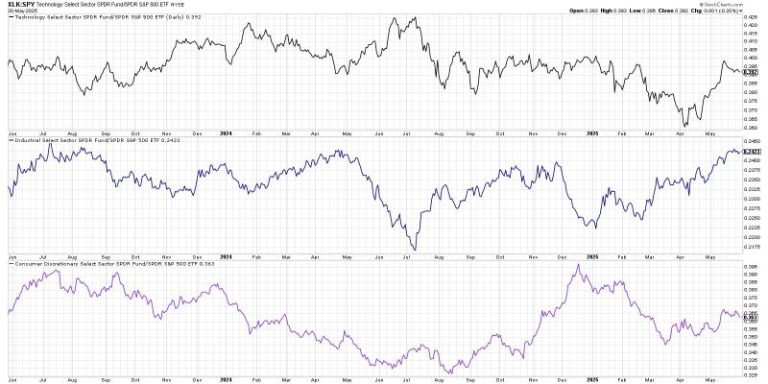
One of the key features of this market off the early April has been the dominance of traditionally “offensive” sectors such as technology and consumer discretionary.  But are these leading sectors maintaining their leadership role as we progress through the spring months into the summer?

Leading Sectors Off the April Low Starting to Falter

My Market Misbehavior LIVE ChartList includes a series of relative strength charts showing the performance of key sectors versus the S&P 500.  When these lines are trending higher, the sector is outperforming the benchmark.  Generally speaking, I’d prefer to own stocks where the relative strength line is trending higher, as that confirms I’m doing better than a passive investment strategy!

Only three sectors have outperformed the S&P 500 index over the last month: technology, industrials, and consumer discretionary.  Notice how two of those sectors, technology and consumer discretionary, are seeing a downturn in relative strength over the last week?  It still may be early to declare a full leadership rotation, but this initial downturn in the relative performance could be a sign of further weakness to come.

Defensive Sectors Showing Early Signs of Strength

So if these leadership sectors are starting to slow down, which sectors are showing an improving relative strength?  Our next chart shows the relative performance of the four traditionally defensive sectors, most of which have turned higher over the last two weeks. 

Again, I’d hesitate to declare this a full and confirmed rotation, but the fact that defensive sectors are improving here suggests investors are beginning to reallocate a bit to more risk-off positions.  Over the next few weeks, improvement in these defensive sectors could provide a clear validation to a “market in correction” thesis.

Relative Rotation Graphs Confirm Defensive Rotation

Of course, when we’re talking about sector rotation, I always want to bring up the Relative Rotation Graphs (RRG) and benefit from Julius de Kempenaer’s innovative data visualization approach.  First, let’s see how the daily RRG showed the 11 S&P 500 sectors back in early May.

We can see that the Leading quadrant includes those leading sectors such as technology.  In the Lagging quadrant we’ll find pretty much everything else, including all four of the defensive sectors discussed above.  Now let’s fast forward to the current RRG and see how things have rotated.

Now you’ll find health care, consumer staples, and other defensive sectors in the Improving quadrant.  Technology, industrials, and consumer discretionary have now rotated down into the Weakening quadrant.  So the RRG is showing at least an initial rotation away from the sectors that have been leading off the April market low.

One of the most important arguments from the bulls has been the dominance of offensive sectors over the last six weeks.  But as we’ve shown here today, the sector may be changing from a clearly bullish reading to a much more defensive warning sign for investors.

RR#6,

Dave

PS- Don’t miss our daily market recap show on YouTube every trading day at 5:00pm ET!

David Keller, CMT

President and Chief Strategist

Sierra Alpha Research LLC

marketmisbehavior.com

https://www.youtube.com/c/MarketMisbehavior

Disclaimer: This blog is for educational purposes only and should not be construed as financial advice.  The ideas and strategies should never be used without first assessing your own personal and financial situation, or without consulting a financial professional.  

The author does not have a position in mentioned securities at the time of publication.    Any opinions expressed herein are solely those of the author and do not in any way represent the views or opinions of any other person or entity.

Manage your stock portfolio like a pro! Learn stock portfolio management, trading strategy, and how to build stock watchlists like a professional investor with this insightful video from Grayson. He shares how to run your portfolio like a championship sports team—organizing stocks like players, keeping top performers in play, and tracking trade opportunities with precision.

This video originally premiered on May 30, 2025. Click on the above image to watch on our dedicated Grayson Roze page on StockCharts TV.

You can view previously recorded videos from Grayson at this link.

VANCOUVER, BC , May 30, 2025 /CNW/ – 1911 Gold Corporation (‘ 1911 Gold ‘ or the ‘ Company ‘) (TSXV: AUMB) (OTCQB: AUMBF) (FRA: 2KY) announces the temporary suspension of operations at its True North complex in Bissett, Manitoba , following the evacuation order issued by the Province of Manitoba due to escalating wildfire activity in the region.

The Company has safely evacuated all personnel from the site and is closely monitoring the situation in coordination with local and provincial authorities. The Company has taken precautionary measures to safeguard certain site infrastructure and continues to assist with the wildfire response by hosting frontline personnel at the True North camp facilities.

Shaun Heinrichs , CEO and President, stated, ‘The safety of our employees and the community is our top priority. We are grateful for the swift and coordinated response of emergency services and are committed to supporting firefighting efforts, including the ongoing use of our camp facilities. Our thoughts are with everyone impacted by the wildfires, and we stand ready to support the community during this challenging time.’

The Company will provide further updates as more information becomes available and will resume operations at the True North complex when it is safe to do so.

About 1911 Gold Corporation

1911 Gold is a junior explorer that holds a highly prospective, consolidated land package totaling more than 61,647 hectares within and adjacent to the Archean Rice Lake greenstone belt in Manitoba , and also owns the True North mine and mill complex at Bissett, Manitoba . 1911 Gold believes its land package is a prime exploration opportunity, with the potential to develop a mining district centred on the True North complex. The Company also owns the Apex project near Snow Lake, Manitoba and the Denton-Keefer project near Timmins, Ontario , and intends to focus on organic growth and accretive acquisition opportunities in North America .

1911 Gold’s True North complex and exploration land package are located within the traditional territory of the Hollow Water First Nation, signatory to Treaty No. 5 (1875-76). 1911 Gold looks forward to maintaining open, co-operative and respectful communication with the Hollow Water First Nation, and all local stakeholders, in order to build mutually beneficial working relationships.

ON BEHALF OF THE BOARD OF DIRECTORS

Shaun Heinrichs
President and CEO

www.1911gold.com

CAUTIONARY STATEMENT REGARDING FORWARD-LOOKING INFORMATION

This news release may contain forward-looking statements. Often, but not always, forward-looking statements can be identified by the use of words such as ‘plans’, ‘expects’ or ‘does not expect’, ‘is expected’, ‘budget’, ‘scheduled’, ‘estimates’, ‘forecasts’, ‘intends’, ‘anticipates’ or ‘does not anticipate’, or ‘believes’, or describes a ‘goal’, or variation of such words and phrases or state that certain actions, events or results ‘may’, ‘could’, ‘would’, ‘might’ or ‘will’ be taken, occur or be achieved.

All forward-looking statements reflect the Company’s beliefs and assumptions based on information available at the time the statements were made. Actual results or events may differ from those predicted in these forward-looking statements. All of the Company’s forward-looking statements are qualified by the assumptions that are stated or inherent in such forward-looking statements, including the assumptions listed below. Although the Company believes that these assumptions are reasonable, this list is not exhaustive of factors that may affect any of the forward-looking statements.

Forward-looking statements involve known and unknown risks, future events, conditions, uncertainties and other factors which may cause the actual results, performance or achievements to be materially different from any future results, prediction, projection, forecast, performance or achievements expressed or implied by the forward-looking statements. All statements that address expectations or projections about the future, including, but not limited to, statements with respect to the terms of the Offering, the use of proceeds of the Offering, the timing and ability of the Company to close the Offering, the timing and ability of the Company to receive necessary regulatory approvals, the tax treatment of the securities issued under the Offering, the timing for the Qualifying Expenditures to be renounced in favour of the subscribers, and the plans, operations and prospects of the Company, are forward-looking statements. Although 1911 Gold has attempted to identify important factors that could cause actual actions, events or results to differ materially from those described in forward-looking statements, there may be other factors that cause actions, events or results not to be as anticipated, estimated or intended. There can be no assurance that forward-looking statements will prove to be accurate, as actual results and future events could differ materially from those anticipated in such statements. Accordingly, readers should not place undue reliance on forward-looking statements.

All forward-looking statements contained in this news release are given as of the date hereof. The Company disclaims any intention or obligation to update or revise any forward-looking statements whether as a result of new information, future events or otherwise, except in accordance with applicable securities laws.

Neither TSX Venture Exchange nor its Regulation Services Provider (as that term is defined in the policies of the TSX Venture Exchange) accepts responsibility for the adequacy or accuracy of this release.

SOURCE 1911 Gold Corporation

View original content to download multimedia: http://www.newswire.ca/en/releases/archive/May2025/30/c0974.html

News Provided by Canada Newswire via QuoteMedia

This post appeared first on investingnews.com

US President Donald Trump scored a temporary reprieve in his ongoing trade war efforts after a federal appeals court stayed a lower court’s decision that struck down most of his global tariffs.

The Thursday (May 29) decision allows the administration’s controversial import duties to remain in place for now.

The decision by the US Court of Appeals for the Federal Circuit provides breathing room for Trump and his trade team as they prepare a full appeal, following a blistering Wednesday (May 28) night ruling by the US Court of International Trade that invalidated nearly all of the Trump-imposed tariffs not tied to national security.

The trade court found Trump overstepped under the 1977 International Emergency Economic Powers Act, saying it “does not confer such unbounded authority” to enact sweeping economic penalties without congressional oversight.

The decision jeopardized key components of Trump’s aggressive tariff program — including a blanket 10 percent import tax and recent “reciprocal tariffs” targeting countries like China, Canada, Mexico and members of the European Union.

But for now, the tariffs will remain in effect. The appellate court granted the Trump administration’s request to pause enforcement of the trade court’s order “until further notice while this court considers the motions papers.”

The next hearing is set for June 5.

White House reacts swiftly, blasts judicial overreach

Trump administration officials reacted with fury to the trade court’s initial decision, describing it as an affront to executive authority in foreign policy and economic matters.

“The political branches, not courts, make foreign policy and chart economic policy,” the White House said in its appeal filing. White House Press Secretary Karoline Leavitt expressed similar concerns on Thursday, saying:

“America cannot function if President Trump, or any other president for that matter, has their sensitive diplomatic or trade negotiations railroaded by activist judges.”

Trump himself took to social media on Thursday morning to vent, writing: “Hopefully, the Supreme Court will reverse this horrible, Country threatening decision, QUICKLY and DECISIVELY.”

He later added: “This would completely destroy Presidential Power — The Presidency would never be the same!”

Peter Navarro, Trump’s top trade advisor, also signaled that the administration was already exploring alternatives, stating that even if it lost the battle in the Supreme Court, it “will do it another way.”

The Wednesday judgment had required the White House to make changes within 10 days.

The administration responded by notifying both the trade court and the appellate court of its intent to challenge the ruling all the way to the Supreme Court, if necessary.

“TACO trade” meme gains steam as Trump backpedals

Adding to the storm surrounding the tariffs is growing traction of the term “TACO trade” — a satirical acronym coined by Financial Times columnist Robert Armstrong that stands for “Trump Always Chickens Out.”

The phrase has caught fire on Wall Street and social media, referring to Trump’s habit of threatening steep tariffs, only to roll them back amid market backlash or diplomatic pressure.

The phenomenon was on full display last month, when Trump announced what he called “Liberation Day,” unveiling sweeping tariffs as high as 145 percent on imports from nearly every major trading partner.

Within a week, those tariffs were scaled down to a baseline 10 percent. Duties on Chinese goods were first reduced to 30 percent and then to 10 percent, while deadlines for tariffs on European goods were postponed.

On Wednesday, visibly irritated by the nickname, Trump lashed out at a reporter who asked about the “TACO trade” label. “Oh, I chicken out. Isn’t that nice? I’ve never heard that,” Trump said, bristling at the question.

“You call that chickening out? It’s called negotiation,” he added.

“Six months ago, this country was stone cold dead. We had a dead country. We had a country that people didn’t think was going to survive. And you ask a nasty question like that,’ Trump continued.

Despite his protests, “TACO trade” has become a viral symbol of his erratic approach to global commerce. California Governor Gavin Newsom mocked the administration after the trade court ruling, saying, “It’s raining tacos today.”

So far, the administration’s tariffs on steel, aluminum and cars remain untouched by the ruling.

Securities Disclosure: I, Giann Liguid, hold no direct investment interest in any company mentioned in this article.

This post appeared first on investingnews.com