Author

admin

Browsing

Former White House aide Ashley Williams is the latest ex-Biden administration official to appear in the House Oversight Committee’s probe.

Oversight Committee Chair James Comer, R-Ky., is investigating allegations that Biden’s former top White House aides covered up signs of his mental and physical decline while in office, and whether any executive actions were commissioned via autopen without the president’s full knowledge. Biden allies have pushed back on those claims.

Williams is the third member of Biden’s White House inner circle to show up, though she said nothing to reporters on her way into the room late Friday morning nor during a brief lunch break in the afternoon.

She’s a longtime Biden ally whose time with the Democrat goes back to assisting then-second lady Jill Biden during the Obama administration, according to a 2019 profile of Biden staffers.

Williams later worked for both Biden’s 2020 campaign and presidential transition team. She served as his trip director before being hired to the White House as deputy director of Oval Office Operations and a special assistant to the president.

Williams ended her White House tenure as deputy assistant to the president, senior advisor to the president, and director of Strategic Outreach, according to her LinkedIn page.

Notably, the social media page also says Williams still works for the ex-leader as senior advisor in the Office of Former President Joe Biden.

Williams is a graduate of Georgetown University, and received a doctorate of Law from the University of Pennsylvania. She also got a Master’s degree in political management from George Washington University.

She was subpoenaed by the House Oversight Committee last year in Republicans’ investigation into Biden’s cognitive health, but GOP investigators say the White House blocked her from giving any information.

‘The Biden White House obstructed the Committee’s investigation and refused to make the aides available for depositions or interviews,’ the committee said in a press release this year.

Williams’ Friday appearance was not forced under subpoena, however. She appeared voluntarily for her closed-door transcribed interview.

The Trump White House waived executive privilege for Williams along with several other former Biden aides last month.

This post appeared first on FOX NEWS

Progressive firebrand Rep. Jasmine Crockett, D-Texas, made a second surprise appearance at the House Oversight Committee’s closed-door discussions with former Biden administration aides this week, once again criticizing President Donald Trump on the way out.

Crockett surprised reporters when she arrived roughly 15 minutes after House investigators’ transcribed interview with former White House advisor Ashley Williams began, declining to speak on the way in.

The Texas Democrat emerged just over 30 minutes later, saying little about what went on inside but telling reporters she still had ‘absolutely’ no concerns about Biden’s mental fitness while in office.

She said it was important to ‘be there physically’ for Biden allies being interviewed in the GOP probe – even going as far as suggesting the Trump administration created a threatening environment for members of Congress and its own political opponents.

‘It is important…in my mind, to be there for these witnesses. Unfortunately, we know what happens when this regime gets going. We know about the threats that come upon them, that come upon us as members of Congress,’ Crockett said.

‘I think it is important to stand there in solidarity and to at least be there physically so that they don’t feel like they’re alone as they are enduring egregious attacks consistently from this administration.’

Crockett was the only lawmaker seen going in or out of Williams’ meeting with investigators on Friday. The transcribed interview was expected to be staff-led, and lawmakers were not required to attend.

‘Right now, the Republicans continue to act as if this is a main priority. Yet none of them are showing up,’ she said.

‘I do think that it is important that I show up because if they are going to make allegations about the former commander-in-chief, egregious allegations they continue to wage. I want to make sure that I’m in the room to correct the record, because a lot of times they like to mischaracterize things.’

When asked by Fox News Digital if the interview was still ongoing as she exited, however, Crockett answered, ‘It’s still going. I’m leaving early. I’ve got to get to another thing.’

A source familiar with the ongoing proceeding told Fox News Digital that Crockett came in during Republican investigators’ round of questioning and so was unable to make inquiries herself. Fox News Digital reached out to Crockett for a response.

Williams was the former Director of Strategic Outreach under the Biden administration. She did not speak to reporters on the way into her transcribed interview.

Crockett initially caught reporters and potentially even staff off guard when she arrived for the closed-door deposition of Biden’s former White House physician, Dr. Kevin O’Connor.

House Oversight Committee Chairman James Comer, R-Ky., was there as well, as is the norm for sworn depositions.

Williams, unlike O’Connor, is not on Capitol Hill under subpoena.

During her Wednesday appearance, Crockett declared she never had any concerns about Biden’s mental state while he was president, though she did raise similar claims about Trump.

White House spokesman Harrison Fields told Fox News Digital in response to Crockett questioning Trump’s mental acuity: ‘The Democrats’ rising star has done more to cement the party’s demise than the President she breathlessly supported, the decrepit and feeble Joe Biden. Jasmine continues to prove she’d be better suited as a reality TV star on VH1 than an elected official on Capitol Hill.’

Comer is investigating accusations that Biden’s former top White House aides covered up signs of his mental and physical decline while in office, and whether any executive actions were commissioned via autopen without the president’s full knowledge. Biden allies have pushed back on those claims.

This post appeared first on FOX NEWS

I wrote recently about the chilling jurisprudence of Justice Ketanji Brown Jackson, who has drawn the ire of colleagues in opinions for her rhetoric and extreme positions. Many have expressed alarm over her adherence to what has been described by one as an ‘imperial judiciary’ model of jurisprudence. Now, it appears that Jackson’s increasingly controversial opinions are serving a certain cathartic purpose for the far-left Biden appointee.

‘I just feel that I have a wonderful opportunity to tell people in my opinions how I feel about the issues, and that’s what I try to do,’ Jackson told ABC News.

Her colleagues have not entirely welcomed that sense of license. The histrionic and hyperbolic rhetoric has increased in Jackson’s opinions, which at times portray her colleagues as abandoning not just the Constitution but democracy itself.

Her dissent in the recent ruling on universal injunctions drew the rebuke of Justice Amy Coney Barrett over what was described as ‘a vision of the judicial role that would make even the most ardent defender of judicial supremacy blush.’

‘We will not dwell on Justice Jackson’s argument, which is at odds with more than two centuries’ worth of precedent, not to mention the Constitution itself,’ Barrett wrote. ‘We observe only this: Justice Jackson decries an imperial Executive while embracing an imperial Judiciary.’

Jackson, however, clearly feels that opinions are a way for her to opine on issues of the day. 

She is not alone. Across the country, liberal judges have been adding their own commentary to decisions in order to condemn Trump, his supporters, and his policies.

I previously wrote about this pattern of extrajudicial commentary.

District Court Judge Tanya Chutkan, an Obama appointee who previously presided over Trump’s election interference case, was criticized for failing to recuse herself from that case after she made highly controversial statements about Trump from the bench. Chutkan lashed out at ‘a blind loyalty to one person who, by the way, remains free to this day.’ That ‘one person’ was still under investigation at the time, and when Trump was charged, Chutkan refused to let the case go.

Later, Chutkan again added her own commentary when asked to dismiss a case due to Trump pardoning January 6 defendants. She acknowledged that she could not block the pardons, but proclaimed that the pardons could not change the ‘tragic truth’ and ‘cannot whitewash the blood, feces and terror that the mob left in its wake. And it cannot repair the jagged breach in America’s sacred tradition of peacefully transitioning power.’

One of Chutkan’s colleagues, Judge Beryl Howell, also an Obama appointee, lashed out at Trump’s actions, writing, ‘[T]his Court cannot let stand the revisionist myth relayed in this presidential pronouncement.’

Then there is Judge Amit Mehta, another Obama appointee, who has been criticized for conflicted rulings in Trump cases and his bizarre (and ultimately abandoned) effort to banish January 6 defendants from the Capitol.

Last week, Mehta had a straightforward question of jurisdiction concerning a challenge to the denial of grants by the Trump administration. While correctly dismissing the challenge, Mehta decided to add his own commentary on Trump’s priorities and policies:

‘Defendants’ rescinding of these awards is shameful. It is likely to harm communities and individuals vulnerable to crime and violence. But displeasure and sympathy are not enough in a court of law.’

For Jackson, her opinions have at times left her isolated on the Court. Weeks ago, Jackson and Sotomayor were alone in dissent over the defiance of a district court judge of the Court’s decision on universal injunctions. To her credit, Justice Elena Kagan (who voted with Sotomayor and Jackson in dissent in the earlier case) voted with her conservative colleagues in rebuking Judge Brian Murphy in Boston.

Kagan joined in the reversal of Murphy’s conflicting order and wrote the new order ‘clarifies only one thing: Other litigants must follow the rules, but the administration has the Supreme Court on speed dial.’

This week, Jackson lost even Sotomayor and stood alone in her dissent in support of an injunction over plans to downsize the government. Sotomayor observed that the Trump order only directed agencies to plan for such downsizing and said that the courts could hardly enjoin such policy preparations in the Executive Branch.

However, Jackson could and would. 

The controversial position of Jackson on the Court is not due to her liberal views. We have had many such liberal jurists. The difference is how Jackson views her role as a justice.

The danger is not confined to opinions. For years, justices have yielded to the temptations of public speaking before supportive groups. I have long been a critic of what I called the era of ‘celebrity justices,’ where members seem to maintain political constituencies at public events. 

Such speeches not only undermine the integrity of the Court by discussing matters that may come before it, but they can create a desire to maintain the adoration of supporters. The greatest danger is that justices will consciously or subconsciously pander to their bases with soundbites and inflammatory rhetoric.

Judicial advocacy from the bench has been a concern since the founding. Article III can have a corrosive impact on certain jurists who come to view themselves as anointed rather than appointed. Most judges and justices are acutely aware of that danger and struggle to confine their rulings to the merits of disputes, avoiding political questions or commentary.

The ‘opportunity to tell people how I feel’ can become a slippery slope where opinions become more like judicial op-eds. The Court is not a cable show. The price of the ticket to being ‘one of nine’ is that you should speak only through your opinions and only on the narrow legal matter before you. 

Opinions must remain ‘opportunities’ to do simple justice, not a supreme editorial.

This post appeared first on FOX NEWS

President Donald Trump’s proposed 50% tariff on Brazilian imports is bad news for coffee drinkers.

Brazil, the largest U.S. supplier of green coffee beans, accounts for about a third of the country’s total supply, according to data from the U.S. Department of Agriculture.

Coffee beans need to grow in a warm, tropical climate, making Hawaii and Puerto Rico the only suitable places in the United States to farm the crop. But, as the world’s top consumer of coffee, the U.S. requires a massive supply to stay caffeinated. Mintel estimates that the U.S. coffee market reached $19.75 billion last year.

The increase in trade duties could leave consumers with even higher costs after several years of soaring coffee prices. Inflation-weary consumers have seen prices for lattes and cold brew climb as droughts and frost hit the global coffee supply, particularly in Brazil. Earlier this year, coffee bean futures hit all-time highs. They rose 1% on Thursday, although still well below the record set in February.

To be sure, there’s still time for Brazil to strike a deal with the White House before the tariffs go into effect on Aug. 1. Plus, food and beverage makers are hoping that the Trump administration will grant exemptions for key commodities. U.S. Department of Agriculture Secretary Brooke Rollins said in an interview in late June that the White House is considering exemptions for produce that can’t be grown in the U.S. — including coffee.

But if that doesn’t happen, coffee companies like Folgers owner J.M. Smucker, Keurig Dr Pepper, Starbucks and Dutch Bros will face much higher costs for the commodity. Giuseppe Lavazza, chair of Italian roaster Lavazza, said on Bloomberg TV on Thursday morning that the latest tariff could mean “a lot of inflation” for the coffee industry.

Roasters will try to mitigate the impact of the higher tariff, but it won’t be easy.

“Every company is always trying to eke out the next efficiency, to dial into their operations or find the way to minimize inflationary pressures, but a 50% tariff on a commodity that fundamentally is not available in the U.S. — you can’t really do much with that,” Tom Madrecki, vice president of supply chain and logistics for the Consumer Brands Association, a trade group that represents the consumer packaged goods industry.

One mitigation tactic could be to import beans from countries other than Brazil, but companies will likely still be paying more for the commodity.

“A characteristic of tariffs, especially when you have tariffs on multiple countries at once, is that not just the inbound cost rises. It allows the pricing floor to also rise,” Madrecki said. “If you have cheaper coffee in a country different than Brazil, you’re not inclined to sell it at a 30% lower cost. You’re going to try to bump your coffee up a bit more, too.”

At-home coffee brands, like JM Smucker’s Dunkin’ and Kraft Heinz’s Maxwell House, have already been hiking their prices this year in response to spiking commodity costs. More price increases could be on the way for consumers, although retailers may push back.

Keurig Dr Pepper would consider additional price hikes in the latter half of the year to mitigate the impact of tariffs, CEO Tim Cofer said in late April, after Trump introduced his initial round of so-called reciprocal duties.

And Smuckers warned investors on its quarterly conference call in early June that tariffs on coffee were weighing on its profits. Coffee accounts for roughly a third of the company’s revenue.

“Green coffee is an unavailable natural resource that cannot be grown in the continental United States due to its reliance on a tropical climate,” Smuckers CEO Mark Smucker said. “We currently purchase approximately 500 million pounds of green coffee annually, with the majority coming from Brazil and Vietnam, the two largest coffee-producing countries.”

Vietnam, which announced a tentative trade deal with the White House earlier this month, supplies about 8% of the U.S.’s green coffee beans. Under the agreement, the U.S. will impose a 20% duty on Vietnamese imports.

Consumers who prefer a caramel macchiato from Starbucks for their caffeine hit will likely see a more muted impact on their wallets.

After several quarters of sluggish U.S. sales, Starbucks CEO Brian Niccol said in late 2024 that the company wouldn’t raise prices in 2025, in the hopes of winning back customers who had complained about how expensive its drinks had gotten. While it waits for its turnaround to take hold, Starbucks might choose to swallow the higher coffee costs.

The coffee giant also benefits from its diversity — both in suppliers and the breadth of its menu, which now includes the popular Refreshers line. Starbucks imports its coffee from 30 different countries, and roughly 10% of its cost of goods sold in North America comes from coffee.

The new trade duty could mean a 0.5% increase in Starbucks’ North American cost of goods sold, assuming about 22% of its beans come from Brazil, TD Cowen analyst Andrew Charles wrote in a note to clients on Thursday. Starbucks’ packaged drinks, which are distributed by Nestle, could see their cost of goods sold increase 3.5%. Altogether, that represents a 5-cent drag on annual earnings per share, according to Charles.

For rival Dutch Bros, higher coffee costs also wouldn’t hurt its bottom line much. Coffee accounts for less than a tenth of the drive-thru coffee chain’s cost of goods sold. Assuming that Dutch Bros sources more than half of its coffee from Brazil, its cost of goods sold would rise just 1.3%, according to Charles’ estimates.

This post appeared first on NBC NEWS

A new analysis from the International Council on Clean Transportation (ICCT) has found that battery electric vehicles (BEVs) sold in Europe today produce 73 percent fewer greenhouse gas emissions over their lifetime than comparable gasoline-powered cars

The findings are based on an updated life-cycle assessment (LCA) of all major vehicle powertrain types, including internal combustion engine vehicles (ICEVs), hybrids (HEVs), plug-in hybrids (PHEVs), battery electric vehicles (BEVs), and hydrogen fuel cell electric vehicles (FCEVs).

The report accounts for emissions from vehicle and battery manufacturing, energy production, use and maintenance, while crucially considering changes in the EU’s electricity mix over a car’s operational life.

“Battery electric cars in Europe are getting cleaner faster than we expected and outperform all other technologies, including hybrids and plug-in hybrids,” said lead researcher Dr. Marta Negri. “This progress is largely due to the fast deployment of renewable electricity across the continent and the greater energy efficiency of battery electric cars.”

Further estimates show that BEVs sold this year emit an average of 63 grams (g) of CO₂-equivalent per kilometer (e/km)—down from 83 g CO₂e/km in the ICCT’s 2021 study, and far below the 235 g CO₂e/km estimated for gasoline ICEVs.

The improvement, the ICCT said, reflects rapid decarbonization of Europe’s grid and growing efficiency gains in battery and vehicle production.

When BEVs are powered solely by renewable electricity, their life-cycle emissions fall even further—to 52 g CO₂e/km, or 78 percent lower than those of gasoline cars.

In contrast, the ICCT found that other powertrain types show only limited progress. Plug-in hybrids emit about 30 percent less than gasoline cars over their lifetime, and hybrids achieve just a 20 percent reduction. Natural gas vehicles offer only a 13 percent cut, and diesel cars show emissions similar to gasoline models.

The report also assessed hydrogen fuel cell vehicles. When powered by hydrogen derived from renewable electricity—a technology not yet widely available—FCEVs can reduce emissions by 79 percent compared to gasoline cars.

However, nearly all hydrogen currently used in Europe is produced from natural gas, limiting the actual emission savings to around 26 percent.

Decarbonizing the grid key to BEV success

The ICCT attributes the growing emissions advantage of electric cars to the rapid transition toward renewable energy across the EU.

In 2025, renewables are expected to make up 56 percent of electricity generation, up from 38 percent in 2020. This trend is projected to continue, reaching 86 percent by 2045, based on data from the EU’s Joint Research Centre.

Even with their higher production emissions—largely due to battery manufacturing—electric cars close the “emissions debt” within the first 17,000 kilometers of use, typically within the first one to two years in Europe.

Another purpose of its updated LCA, according to ICCT, was to counter widespread misinformation about electric vehicles’ environmental impacts.

“We hope this study brings clarity to the public conversation, so that policymakers and industry leaders can make informed decisions,” said Dr. Georg Bieker, co-author of the report. “We’ve recently seen auto industry leaders misrepresenting the emissions math on hybrids.”

“Life-cycle analysis is not a choose-your-own-adventure exercise. Our study accounts for the most representative use cases and is grounded in real-world data. Consumers deserve accurate, science-backed information,” he added.

A common misperception, the ICCT notes, is that electric cars are worse for the climate because of their manufacturing footprint.

However, the study concludes that failing to account for the evolving electricity mix and real-world driving patterns leads to distorted comparisons that undervalue electric cars’ advantages.

The full report can be viewed on the ICCT’s website.

Securities Disclosure: I, Giann Liguid, hold no direct investment interest in any company mentioned in this article.

This post appeared first on investingnews.com

Over a number of years working for a large money manager with a rich history of stock picking, I became more and more enamored with the benefits of scanning for constructive price charts regardless of the broad market conditions.  Earlier in my career, as I was first learning technical analysis, I devoured work by stock picking guru Mike Webster and other William O’Neil disciples who advocated for finding strong charts in any market environment.

Given that background, I was super excited this week to apply a true stock picker’s mindset, with the goal of identifying one compelling chart in each of ten S&P 500 sectors.  From Communication Services to Utilities, there are plenty of interesting technical setups and nuances to discuss.  And if you’re wondering why there are only ten charts instead of 11, that’s because I skipped Real Estate.  It’s a smaller sector, which I tend to think of more in terms of sector rotation than specific security selection.

Let’s kick things off with a top-performing chart in Communication Services that is showing all the signs of accumulation.

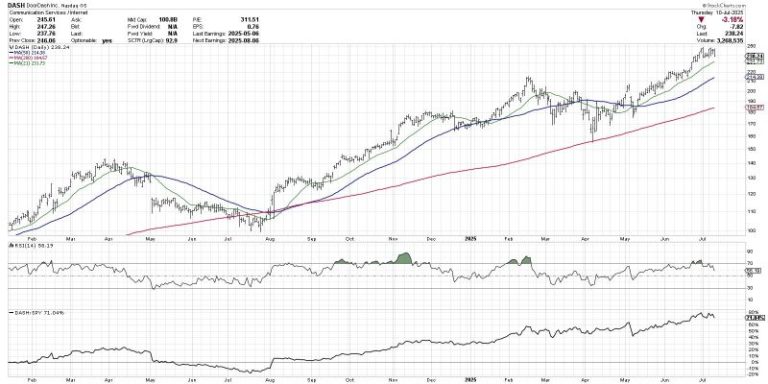
DoorDash Inc. (DASH)

While the mega cap Magnificent 7 stocks like Meta Platforms (META) and Alphabet Inc (GOOGL) tend to grab all the headlines, I’m more intrigued by other names in this sector demonstrating positive technical characteristics.  DoorDash has been making higher highs and higher lows, and remains above three upward-sloping moving averages.

The price is above the 21-day exponential moving average, which is above the 50-day simple moving average, which is above the 200-day simple moving average.  Combined with strong but not excessive momentum, along with improving relative strength, and we have a chart that continues to feature bullish signs in July 2025.

Booking Holdings Inc. (BKNG)

If it seems as if DoorDash is a little too overextended, Booking Holdings is a bit earlier on in its breakout journey.  Here we can see a clear resistance level around $5300, with a breakout and subsequent retest confirming a new uptrend phase.

When a chart like this shows a clear and consistent resistance level, the initial breakout can be quite tempting on the long side.  The subsequent pullback to that same breakout point, followed by new support at the breakout point, serves to validate the breakout and confirm the bullish reading.

With charts like BKNG, I like to use the 21-day exponential moving average as an initial warning sign.  As long as the price remains above this short-term trend mechanism, then the uptrend is still intact.  If and when the price violates this moving average, that’s when I like to review the chart to determine whether the stock still deserves a place in my portfolio.

Boston Scientific Corp. (BSX)

Our final example, Boston Scientific, is one that I would argue still has a bit to prove.  We can observe a clear resistance level around $107.50, which was initially set in February and then retested in May and June.  

This is exactly where I would leverage the Alert Workbench on StockCharts to let me know when the price has finally broken above this crucial resistance level.  I love to save potential breakout candidates to a new ChartList, and then set alerts for if and when the price finally breaks above the entry point.  That way, you’re able to identify an opportunity and develop a simple trading plan up front, and then let StockCharts do the “heavy lifting” and keep a close watch on the price action in the days and weeks to come!

To see the other seven charts in all their glory, head over to the StockCharts TV YouTube channel!

RR#6,

Dave

PS- Ready to upgrade your investment process?  Check out my free behavioral investing course!

David Keller, CMT

President and Chief Strategist

Sierra Alpha Research LLC

marketmisbehavior.com

https://www.youtube.com/c/MarketMisbehavior

Disclaimer: This blog is for educational purposes only and should not be construed as financial advice.  The ideas and strategies should never be used without first assessing your own personal and financial situation, or without consulting a financial professional.  

The author does not have a position in mentioned securities at the time of publication.    Any opinions expressed herein are solely those of the author and do not in any way represent the views or opinions of any other person or entity.

Investing in triple-leveraged ETFs may not be on your radar. But that may change after you watch this video. 

Tom Bowley of EarningsBeats shares how he uses the 3x leveraged ETFs to take advantage of high probability upside moves. Tom shows charts of 3x leveraged ETFs that mirror their benchmark — TNA (Russell 2000), SOXL (Semiconductors), and LABU (Biotech), and maps out how you can use the setups in these charts to multiply your returns. 

With money rotating heavily into growth stocks, investors should be looking for opportunities. Tom shares charts of indexes, sectors, and individual stocks/ETFs that are displaying technical strength and strong accumulation patterns. 

Ready to multiply your returns while the market’s moving higher? Watch Tom chart out the trades he’s making today. 

This video was published on July 10. Click this link to watch on Tom’s dedicated page. 

Missed a session? Archived videos from Tom are available at this link


FPX Nickel Corp. (TSXV: FPX) (OTCQB: FPOCF) (‘ FPX ‘ or the ‘ Company ‘) announces that the board of directors of the Company has approved the grant of 5,305,000 stock options (the ‘ Options ‘) to directors, officers and employees of the Company pursuant to the Company’s Share Compensation Plan. The Options have an exercise price of $0.30 per share, with a five-year term and are fully vested on the grant date, July 10, 2025 .


The Company also granted an aggregate 750,000 restricted share units (the ‘ RSUs ‘) to certain officers of the Company. The RSUs vest in three equal installments on the annual anniversaries of the grant date and each vested RSU will entitle the holder to receive one common share of the Company or the equivalent cash value upon settlement.


  About FPX Nickel Corp.  


 FPX Nickel Corp. is focused on the exploration and development of the Decar Nickel District, located in central British Columbia , and other occurrences of the same unique style of naturally occurring nickel-iron alloy mineralization known as awaruite. For more information, please view the Company’s website at https://fpxnickel.com/ or contact Martin Turenne , President and CEO, at (604) 681-8600 or ceo@fpxnickel.com .


On behalf of FPX Nickel Corp.


‘Martin Turenne’
Martin Turenne , President, CEO and Director


   Forward-Looking Statements   


  Certain of the statements made and information contained herein is considered ‘forward-looking information’ within the meaning of applicable Canadian securities laws. These statements address future events and conditions and so involve inherent risks and uncertainties, as disclosed in the Company’s periodic filings with Canadian securities regulators. Actual results could differ from those currently projected. The Company does not assume the obligation to update any forward-looking statement.  


  Neither the TSX Venture Exchange nor its Regulation Services Provider accepts responsibility for the adequacy or accuracy of this release.  


SOURCE FPX Nickel Corp.


  View original content to download multimedia: http://www.newswire.ca/en/releases/archive/July2025/11/c5569.html  


News Provided by Canada Newswire via QuoteMedia

This post appeared first on investingnews.com


Cygnus Metals Limited (‘Cygnus’ or the ‘Company’) advises that it has issued an aggregate of 67,050,000 performance rights (‘Performance Rights’) to directors, and key employees and consultants, under the Company’s Omnibus Equity Incentive Plan (‘Plan’).


Shareholders approved the Plan and the issue of Performance Rights to directors at the Company’s annual general meeting held on May 14, 2025. The Performance Rights to key personnel were issued on the same terms and conditions as the director Performance Rights, as set out in the notice of annual general meeting released to ASX on April 14, 2025.


The Performance Rights vest on the later of (a) one year after their date of issue, and (b) the successful completion of specific key performance objectives within three years from the date of issue. Each vested Performance Right is exercisable to one fully paid ordinary share in the capital of the Company (net of applicable withholdings) and will expire on May 31, 2030 unless exercised on or before this date.


The objective of Cygnus’ Plan is to promote the long-term success of the Company and the creation of shareholder value by aligning the interests of eligible persons under the Plan with the interests of the Company.


This announcement has been authorised for release by the Board of Directors of Cygnus.


  David Southam  
Executive Chair  
T: +61 8 6118 1627  
E:    info@cygnusmetals.com   
  Ernest Mast  
President & Managing Director  
T: +1 647 921 0501  
E:    info@cygnusmetals.com   
  Media:  
Paul Armstrong  
Read Corporate  
+61 8 9388 1474  


  About Cygnus Metals  


 Cygnus Metals Limited (ASX: CY5, TSXV: CYG) is a diversified critical minerals exploration and development company with projects in Quebec, Canada and Western Australia. The Company is dedicated to advancing its Chibougamau Copper-Gold Project in Quebec with an aggressive exploration program to drive resource growth and develop a hub-and-spoke operation model with its centralised processing facility. In addition, Cygnus has quality lithium assets with significant exploration upside in the world-class James Bay district in Quebec, and REE and base metal projects in Western Australia. The Cygnus team has a proven track record of turning exploration success into production enterprises and creating shareholder value.


News Provided by GlobeNewswire via QuoteMedia

This post appeared first on investingnews.com


(TheNewswire)


July 11, 2025 TheNewswire – Vancouver, British Columbia Blue Lagoon Resources Inc. (the ‘ Company ‘) (CSE: BLLG,OTC:BLAGF; OTCQB: BLAGF; FSE: 7BL) is pleased to announce the official opening of its wholly owned Dome Mountain Gold Mine Project, that recently received its mining permit making it one of only nine mining permits granted in British Columbia in the past decade – and one of just a few high-grade, road-accessible gold projects to reach production-ready status in recent years.


  The celebration, held on July 9, 2025, brought together over 100 guests from across Canada and abroad — including attendees from Germany, South Carolina, Denver, Montana and Toronto — to mark this significant milestone for the Company and the region.  


Dignitaries in attendance included the Mayor of Smithers, Gladys Atrill; MLA Sharon Hartwell (Bulkley Valley-Stikine); and MP Ellis Ross (Skeena-Bulkley Valley). Also present were various representatives from the Ministry of Mines and Critical Minerals and other provincial agencies. Minister of Mining and Critical Minerals, Jagrup Brar, was unable to attend in person due to his participation in the annual Conference of Mines Ministers of Canada, held in Prince Edward Island. However, he shared a recorded message acknowledging the importance of the project, which was played during the event. Minister Brar is scheduled to visit and tour the Dome Mountain site later this month.


In a powerful display of cultural heritage and support, 18 Hereditary Chiefs and Guardians from the Lake Babine Nation (LBN) joined Hereditary Chief and Council Member Fabian Michell for the opening ceremony, which featured a traditional drum ceremony representing songs from all four LBN clans: Bear, Beaver, Frog, and Caribou.


‘We were deeply honoured to stand alongside the Lake Babine Nation, whose presence and participation made this day truly meaningful,’ said Rana Vig, President & CEO of Blue Lagoon Resources. ‘This is more than just the opening of a gold mine — it’s a moment that reflects years of hard work, resilience, and respectful collaboration.’


During the two-day event, guests had the opportunity to take underground tours as well as visit the recently completed, state-of-the-art water treatment plant — a key environmental safeguard for the project. The facility has the capacity to treat over six times the current needs at Dome Mountain, ensuring long-term environmental resilience as production scales.


With the mine officially open, pre-production work will begin next week, setting up Dome Mountain to   begin mining and transition to near-term cash flow   once the Moving Bed Biofilm Reactor (MBBR) system is commissioned – expected in about four weeks. The two-stage water-treatment facility features a functioning High-Density Sludge (HDS) circuit and the MBBR circuit, which uses microbes to remove blasting-related ammonia and nitrates. The MBBR’s biological ramp-up phase typically takes approximately four weeks. Mining will commence immediately upon the completion of this phase.


‘As a geologist, this is a proud moment in my career,’ said Bill Cronk, Chief Geologist and Project Manager at Blue Lagoon Resources. ‘To see a project go from exploration to production — and to be part of that transformation — is something most geologists only dream of. This team made it happen and I’m very proud of that.’


The event also welcomed strategic investors and partners, including Dr. Quinton Hennigh, technical advisor to Crescat Capital, and Peter Espig, CEO of Nicola Mining, with whom Blue Lagoon has a long-term toll milling agreement.


‘Dome Mountain represents what’s possible when entrepreneurial determination meets responsible mining practices,’ said Peter Espig, CEO of Nicola Mining. ‘We’re proud to support Blue Lagoon in bringing this project to life, and to be part of a partnership grounded in trust, transparency, and technical excellence.’


Throughout the event, Blue Lagoon’s highly experienced technical team was on site to answer questions and provide detailed explanations of the mining methods and techniques planned for Dome Mountain. This included Steve Cutler of Roughstock Mining, an accomplished underground mining consultant with decades of experience who has worked on a wide range of underground gold projects across North America. Also present was Peter Bojtos, a professional mining engineer with global experience who has been directly involved in the opening or reopening of 19 mines over the course of his career — making Dome Mountain his 20th. Mr. Bojtos is a current director of Avino Silver & Gold Mines Ltd (formerly Chairman) (ASM:NYSE) and a technical advisor on the Dome Mountain Gold Project.


   With pre-production work beginning next week, Blue Lagoon Resources is now positioned to become one of British Columbia’s next producing high-grade gold mines.   


  About Blue Lagoon Resources Inc.  


  Blue Lagoon Resources is a Canadian based publicly listed mining company (CSE: BLLG,OTC:BLAGF; FSE: 7BL; OTCQB: BLAGF) focused on building shareholder value through the aggressive development of its 100% owned Dome Mountain Gold project. The Company is run by professionals with significant finance and mining experience and operates within a prime mining  


  jurisdiction in British Columbia, Canada. With the granting of a full    mining permit,    a key milestone achieved in February 2025 – one of only nine such permits issued in British Columbia since 2015 – Blue Lagoon is now focused on last preparatory activities and tasks related to the safe and secure opening of the Dome Mountain Gold Mine, targeting    Q3 2025    as the start of gold    production    . The Company’s primary objective has always been to become a cash-flowing mining company, to ultimately deliver tangible monetary value to shareholders, state, and local communities.  


  The Company is not basing its production decision at Dome Mountain on a feasibility study of mineral reserves demonstrating economic and technical viability. The production decision is based on having existing mining infrastructure, past bulk sampling and processing activity, and the established mineral resource.  The Company understands that there is increased uncertainty, and consequently a higher risk of failure, when production is undertaken in advance of a feasibility study.  


  For   further   information,   please   contact:  


  Rana   Vig  


  President   and   CEO  


  Telephone:   604-218-4766  


  Email:     ranavig@bluelagoonresources.com    


  The   CSE   has   not   reviewed   and   does   not   accept   responsibility   for   the   adequacy   or   accuracy   of   this   release.  


  Statement Regarding Forward-Looking Information: This release includes certain statements that may be deemed ‘forward-looking statements’. All statements in this release, other than statements of historical facts, that address events or developments that Blue Lagoon Resources Inc. (the ‘Company’) expects to occur, are forward-looking statements. Forward-looking statements are statements that are not historical facts and are generally, but not always, identified by the words ‘expects’, ‘targets’, ‘plans’, ‘anticipates’, ‘believes’, ‘intends’, ‘estimates’, ‘projects’, ‘potential’, ‘mine’, ‘production’ and similar expressions, or that events or conditions ‘will’, ‘would’, ‘may’, ‘could’ or ‘should’ occur. Although the Company believes the expectations expressed in such forward-looking statements are based on reasonable assumptions, such statements are not guarantees of future performance and actual results may differ materially from those in the forward-looking statements. Factors that could cause the actual results to differ materially from those in forward-looking statements include results of exploration activities may not show quality and quantity necessary for further exploration or future exploitation of minerals deposits, volatility of gold and silver prices, delays in mine development activities, future cash flow expectations and continued availability of capital and financing, permitting and other approvals, and general economic, market or business conditions.  Investors are cautioned that any such statements are not guarantees of future performance and actual results or developments may differ materially from those projected in the forward-looking statements. Forward-looking statements are based on the beliefs, estimates and opinions of the Company’s management, contractors and consultants on the date the statements are made. Except as required by applicable securities laws, the Company undertakes no obligation to update these forward-looking statements in the event that management’s, contractor’s and consultants’ beliefs, estimates or opinions, or other factors, should change.  


Copyright (c) 2025 TheNewswire – All rights reserved.



News Provided by TheNewsWire via QuoteMedia

This post appeared first on investingnews.com