Author

admin

Browsing

Strong demand in the face of looming supply shortages has pushed copper to new heights in recent years.

With a wide range of applications in nearly every sector, copper is by far the most industrious of the base metals. In fact, for decades, the copper price has been a key indicator of global economic health, earning the red metal the moniker “Dr. Copper.” Rising prices tend to signal a strong global economy, while a significant longer-term drop in the price of copper is often a symptom of economic instability.

After bottoming out at US$2.17 per pound, or US$5,203.58 per metric ton (MT), in mid-March 2020, copper has largely been on an upward trajectory.

Why is copper so expensive in 2025? Higher copper prices over the past few years have largely been attributed to a widening supply/demand gap. The already tenuous copper supply picture was made worse by COVID-19 lockdowns, and as the world’s largest economies seemingly began to emerge from the pandemic, demand for the metal picked up once again. Copper mining and refining activities simply haven’t kept up with the rebound in economic activity.

In this article

    What key factors drive the price of copper?

    Robust demand has long been one of the strongest factors driving copper prices. The ever-growing number of copper uses in everyday life — from building construction and electrical grids to electronic products and home appliances — make it the world’s third most-consumed metal.

    Copper’s anti-corrosive and highly conductive properties are why it’s the go-to metal for the construction industry, and it’s used in products such as copper pipes and copper wiring. In fact, construction is responsible for nearly half of global copper consumption. Rising demand for new homes and home renovations in both Asian and Western economies is expected to support copper prices in the long term.

    In recent decades, copper price spikes have been strongly tied to rising demand from China as the economic powerhouse injects government-backed funding into new housing and infrastructure. Industrial production and construction activity in the Asian nation have been like rocket fuel for copper prices.

    Additionally, copper’s conductive properties are increasingly being sought after for use in renewable energy applications, including thermal, hydro, wind and solar energy.

    However, the biggest driver of copper consumption in the renewable energy sector is rising global demand for electric vehicles (EVs), EV charging infrastructure and energy storage applications. As governments push forward with transportation network electrification and energy storage initiatives as a means to combat climate change, copper demand from this segment is expected to surge.

    New energy vehicles use significantly more copper than internal combustion engine vehicles, which only contain about 22 kilograms of copper. In comparison, hybrid EVs use an average of 40 kilograms, plug-in hybrid EVs use 55 kilograms, battery EVs use 80 kilograms and battery electric buses use 253 kilograms.

    In 2024, EV sales worldwide increased by 25 percent over 2023 to come in at about 17.1 million units, and analysts at Rho Motion expect that trend to continue in the coming years despite some headwinds in the near-term. Already in the first five months of 2025, EV sales were up 28 percent over the same period in the previous year.

    On the supply side of the copper market, the world’s largest copper mines are facing depleting high-grade copper resources, while over the last decade or more new copper discoveries have become few and far between.

    The pandemic made the situation worse as mining activities in several top copper-producing countries faced work stoppages and copper companies delayed investments in further exploration and development — a challenging problem considering it can take as many as 10 to 20 years to move a project from discovery to production. In addition, delayed investments amid the pandemic will also have long-term repercussions for copper supply.

    There have also been ongoing production issues at major copper mines, most notably the shutdown in late 2023 of First Quantum Minerals’ (TSX:FM,OTC Pink:FQVLF) Cobre Panama mine, which accounted for about 350,000 MT of the world’s annual copper production.

    The International Energy Agency (IEA) is forecasting a 30 percent shortfall in the amount of copper needed to meet demand by 2035. “This will be a major challenge. It’s time to sound the alarm,” IEA Executive Director Fatih Birol said.

    The supply shortage has increased the need for end users to turn to the copper scrap market to make up for the supply shortage. Sometimes referred to as “the world’s largest copper mine,” recycled copper scrap contributes significantly to supplying and balancing the copper market.

    “We are seeing signs this could change. Much of the growth over the last five years has come from brownfield expansions rather than greenfield/new discoveries,’ she said. ‘Technology will likely help increase the chance of discovery, and broadly I would say that policymakers are now more supportive of mineral exploration as the push to secure critical raw materials supply has moved up the agenda.’

    Joannides offered some examples of greenfield projects in the pipeline: Capstone Copper’s (TSX:CS,OTC Pink:CSCCF) Santo Domingo in Chile, Southern Copper’s (NYSE:SCCO) Tia Maria in Peru and Teck Resources’ (TSX:TECK.A,TECK.B,NYSE:TECK) Zafranal in Peru.

    How has the copper price moved historically?

    Taking a look back at historical price action, the copper price has had a wild ride for more than two decades.

    Sitting at US$1.38 per pound in late January 2005, the copper price followed global economic growth up to a high of US$3.91 in April 2008. Of course, the global economic crisis of 2008 soon led to a copper crash that left the metal at only US$1.29 by the end of year.

    Once the global economy began to recover in 2011, copper prices posted a new record high of US$4.58 per pound at the start of the year. However, this high was short-lived as the copper price began a five year downward trend, bottoming out at around US$1.95 in early 2016.

    Copper prices stayed fairly flat over the next four years, moving in a range of US$2.50 to US$3 per pound.

    20 year copper price performance.

    Chart via Macrotrends.

    The pandemic’s impact on mine supply and refined copper in 2020 pushed prices higher despite the economic slowdown. The copper price climbed from a low of US$2.17 in March to close out the year at US$3.52.

    In 2021, signs of economic recovery and supercharged interest in EVs and renewable energy pushed the price of copper to rally higher and higher. Copper topped US$4.90 per pound for the first time ever on May 10, 2021, before falling back to close at US$4.76.

    Also affecting the copper price at that time was expectations for higher copper demand amid supply concerns out of two of the world’s major copper producers: Chile and Peru. In late April 2021, port workers in Chile called for a strike, while in Peru presidential candidate Pedro Castillo proposed nationalizing mining and redrafting the country’s constitution.

    In early May 2021, news broke that copper inventories were at their lowest point in 15 years. Expert market watchers such as Bank of America commodity strategist Michael Widmer warned that further inventory declines into 2022 could lead to a copper market deficit.

    After climbing to start 2022 at US$4.52, the copper price continued to spike on economic recovery expectations and supply shortages to reach US$5.02 per pound on March 6. Throughout the first quarter, fears of supply chain disruptions and historically low stockpiles amid rising copper demand drove prices higher.

    However, copper prices pulled back in mid-2022 on worries that further COVID-19 lockdowns in China, as well as a growing mortgage crisis, would slow down construction and infrastructure activity in the Asian nation. Rising inflation and interest hikes by the Fed also placed downward pressure on a wide basket of commodities, including copper. By late July 2022, copper prices were trading down at nearly a two year low of around US$3.30.

    In the early months of 2023 the copper price was trading over the US$4 per pound level after receiving a helpful boost from continuing concerns about low copper inventories, signs of rebounding demand from China, and news about the closure of Peru’s Las Bambas mine, which accounts for 2 percent of global copper production.

    However, that boost turned to a bust in the second half of 2023 as China continued to experience real estate sector issues, alongside the economic woes of the rest of the world. The price of copper dropped to a low for the year of US$3.56 per pound in mid October.

    Elevated supply levels kept copper trading in the US$3.50 to US$3.80 range for much of Q1 2024 before experiencing strong gains that pushed the price of the red metal to US$4.12 on March 18.

    Those gains were attributed to in part to tighter copper concentrate supply following the closure of First Quantum Minerals’ Cobre Panama mine, guidance cuts from Anglo American (LSE:AAL,OTCQX:AAUKF) and declining production at Chile’s Chuquicamata mine. In addition, China’s top copper smelters announced production cuts after limited supply led to lower profits from treatment and refining charges.

    BHP’s (ASX:BHP,NYSE:BHP,LSE:BHP) attempted takeover of Anglo American also stoked fears of even tighter global copper mine supply. These supply-side challenges continued to juice copper prices in Q2 2024, causing a jump of nearly 29 percent from US$4.04 per pound on April 1 to a then all-time high of US$5.20 by May 20, 2024.

    What was the highest price for copper ever?

    The price of copper reached its highest recorded price of US$5.72 per pound, or US$12,610 per metric ton, on July 8, 2025. The red metal’s price surged more than 13 percent from July 7 to its new all time high. Read on to found out how the copper price reached those heights.

    Why did the copper price hit an all-time high in 2025?

    After starting 2025 at US$3.99 per pound, copper prices were lifted in Q1 by increasing demand from China’s economic stimulus measures, renewable energy and artificial intelligence (AI) technologies and stockpiling brought on by fear of US President Trump’s tariff threats.

    At the time, Trump had said the US was considering placing tariffs of up to 25 percent on all copper imports in a bid to spark increased domestic production of the base metal.

    In late February, he signed an executive order instructing the US Commerce Department to investigate whether imported copper poses a national security risk under Section 232 of the Trade Expansion Act of 1962. The price of copper reached a new high price of US$5.24 per pound on March 26 as tariff tensions escalated.

    Trump’s tariff talk sparked yet another copper price rally to set its new record high price in early July when he announced he plans to impose a 50 percent tariff on all imports of the red metal.

    Looking at the bigger picture, copper’s rally in recent years has encouraged bullish sentiment on prices looking ahead. In the longer term, the fundamentals for copper are expected to get tighter as demand increases from sectors such as EVs and energy storage. A May 2024 report from the International Energy Forum (IEF) projects that as many as 194 new copper mines may need to come online by 2050 to support massive demand from the global energy transition.

    Looking over to renewable energy, according to the Copper Development Association, solar installations require about 5.5 MT of copper for every megawatt, while onshore wind turbines require 3.52 MT of copper and offshore wind turbines require 9.56 MT of copper.

    The rise of AI technology is also bolstering the demand outlook for copper. Commodities trader Trafigura has said AI-driven data centers could add one million MT to copper demand by 2030, reports Reuters.

    Where can investors look for copper opportunities?

    Copper market fundamentals suggest a return to a bull market cycle for the red metal in the medium-term. The copper supply/demand imbalance also presents an investment opportunity for those interested in copper-mining stocks.

    Securities Disclosure: I, Melissa Pistilli, hold no direct investment interest in any company mentioned in this article.


    This post appeared first on investingnews.com

    During a celebratory dinner at the White House with a number of Donald Trump’s GOP allies, including several Republican lawmakers from Congress, the president signaled that 10 more hostages in Gaza would be ‘coming very shortly.’

    The dinner was largely focused on touting the achievements Republicans have had over the last six months, but while praising his administration’s work on foreign policy, Trump commented about the hostages. 

    ‘Gaza – we got most of the hostages back,’ Trump said when his comments turned to the Middle East. ‘We’re going to have another ten coming very shortly. And we hope to have that finished pretty quickly,’ the president added.

    So far, the U.S. has brought home five total American hostages captured by Hamas, three of whom were alive, two of whom were dead. Two Americans reportedly still remain in captivity, in addition to dozens of other non-Americans.

    The rest of Trump’s address Friday night mostly included praise for Congressional Republicans over their work passing the One Big Beautiful Bill Act, with the president stating he doesn’t ‘think anybody’s ever come close to’ passing such sweeping legislation with such a small majority. 

    In particular, Trump thanked by name Senate Majority Leader John Thune, Speaker of the House Mike Johnson, Senate Majority Whip John Barrasso, Republican Policy Committee Chair Shelly Moore-Capito, Senate Finance Committee Chairman Mike Crapo, and Senate Budget Committee Chairman Lindsey Graham.

    ‘Nobody’s done so much, so fast. And probably you could say, with so few votes,’ Trump praised. ‘You stayed in session for a marathon ten consecutive weeks, and that’s the longest of any Senate in 15 years. And you held over 400 votes, more than any Senate in 35 years. And they were successful votes. And just a few weeks ago, we had the biggest victory of them all. When you passed the one big beautiful bill.’ 

    The president also lauded Republicans for all the work they have done on immigration, border security, foreign diplomacy, speedy cabinet nominations, deregulation and spending cut efforts, calling out Secretary of State Marco Rubio and Special Envoy Steve Witkoff specifically for their work on U.S. foreign diplomacy.

    Top of mind Friday night was the GOP recission package as well, which Trump praised the passage of. Trump did not indicate when he would sign the GOP bill, but did note that ‘we have numerous other recissions coming up, adding more, many more $10 billion dollars to it.’

    Meanwhile, Trump also predicted that, in 2026, the GOP majority ‘is going to be stronger in both the House and the Senate.’ Typically, conventional wisdom predicts that the party that won the presidency will not typically perform as well two years later during the midterm elections. 

    ‘I don’t understand why they say that when you win the presidency, you always almost automatically lose the midterms, because nobody’s had a more successful period of time than we have,’ Trump told the crowd of attendees at the White House Friday evening. ‘Based on that, we should do great.’

    Trump added Friday that ‘We achieved more in six months than almost any administration could accomplish in eight years.’

    ‘And we’re going to have a lot of good six months left. We’re going to have a six and another six and another six. So we’ll keep going,’ he continued. ‘Over the next year and a half, we’ll have an incredible record to share with the American people,’ he continued. ‘As long as we continue to keep our promises to the voters, Americans will continue to stand by our side.’

    This post appeared first on FOX NEWS

    Slovenian lawmakers became the first Eastern European country to legalize a law on Friday to allow medically-assisted suicide for terminally-ill adults, in a shift in regional end-of-life policy. 

    The country’s lawmakers passed the bill following a closely watched parliamentary vote with 50 votes in favor, 34 against and three abstaining. The vote also focused on a national referendum demanding expanded end-of-life rights. 

    The legislation comes after a consultative referendum last year in which 55% of voters supported the right to end-of-life autonomy. While the move is being praised as historic, the law’s implementation will not be immediate as the procedures and oversight mechanisms are still being developed.

    The law applies to terminally ill adults who are experiencing unbearable suffering with no prospect of improvement. In order for candidates to qualify, they must be mentally competent and have already exhausted their available treatment options. Individuals suffering solely from mental illness will be excluded from eligibility. The patient has to provide informed, voluntary, and repeated consent. It is believed that the process may require evaluation by multiple medical professionals.

    Although it is being hailed as a landmark move, it will not be immediately implemented as the detailed procedures and oversight mechanisms are still being finalized. 

    ‘This is a victory for compassion and dignity,’ said one lawmaker in support of the bill. A civil rights group opposed to the law referendum to overturn the measure.

    A civil rights group opposing the new law pledged on Friday to seek public backing for a potential attempt to force a referendum on the measure.

    Several other countries, including Canada, Germany, Belgium, Switzerland, the Netherlands, Australia and Colombia, have legalized the so-called death with dignity.

    Last month, Britain’s parliament voted to legalize assisted dying, although the bill must still clear the upper chamber of parliament.

    In the U.S., 11 states allow medical aid in dying: Delaware, California, Colorado, Hawaii, Maine, Montana, New Jersey, New Mexico, Oregon, Vermont and Washington. Lawmakers in some other states are considering similar legislation.

    Washington, D.C., also permits physician-assisted suicide.

    Reuters contributed to this report.

    This post appeared first on FOX NEWS

    U.S. Secretary of State Marco Rubio announced visa restrictions on a Brazilian judge after the country’s Supreme Court issued search warrants and restraining orders against former President Jair Bolsonaro.

    Brazilian Supreme Court Justice Alexandre de Moraes, his unspecified allies on the court and his immediate family members will face visa revocations, according to Rubio, who criticized what he called a ‘political witch hunt’ against the former president.

    ‘President Trump made clear that his administration will hold accountable foreign nationals who are responsible for censorship of protected expression in the United States,’ Rubio said in a statement. 

    ‘Brazilian Supreme Federal Court Justice Alexandre de Moraes’s political witch hunt against Jair Bolsonaro created a persecution and censorship complex so sweeping that it not only violates basic rights of Brazilians, but also extends beyond Brazil’s shores to target Americans,’ he continued.

    As part of the court’s orders, Bolsonaro is prohibited from contacting foreign officials, using social media or approaching embassies over allegations he sought the interference of U.S. President Donald Trump, according to the decision issued by Moraes, who cited a ‘concrete possibility’ of him fleeing the country.

    Federal police raided Bolsonaro’s home, and he had an ankle monitor placed on him.

    Trump has already attempted to pressure Brazil’s officials to help Bolsonaro by announcing a 50% tariff on goods from the country from August 1 in a letter that began by criticizing Bolsonaro’s trial before Brazil’s Supreme Court on accusations of attempting to overturn the last election.

    The U.S. president has pushed Brazil to end the case against Bolsonaro, arguing that the former Brazilian leader was the victim of a ‘witch hunt.’

    Bolsonaro is on trial before Brazil’s Supreme Court on charges of plotting a coup to stop President Luiz Inácio Lula da Silva from taking office in January 2023.

    Bolsonaro told Reuters that he believed the orders against him were issued in response to Trump’s criticism of his trial.

    The former president described Moraes as a ‘dictator’ and called the latest court orders acts of ‘cowardice.’

    ‘I feel supreme humiliation,’ he said about wearing the ankle monitor. ‘I am 70-years-old, I was president of the republic for four years.’

    Bolsonaro denied any plans to leave the country, but said he would meet with Trump if he could obtain access to his passport, which was seized last year. He also said he had contacted the top U.S. diplomat in Brazil to discuss Trump’s tariff threat.

    White House spokesperson Anna Kelly said on Friday, citing previous comments from Trump, that ‘Bolsonaro and his supporters are under attack from a weaponized court system.’

    On Thursday, Trump shared a letter he sent to Bolsonaro.

    ‘I have seen the terrible treatment you are receiving at the hands of an unjust system turned against you. This trial should end immediately!’ he wrote.

    Moraes said in his decision that the restrictions against Bolsonaro were because of allegations that the former president was attempting to have the ‘head of state of a foreign nation’ interfere in Brazilian courts, which the judge called an attack on national sovereignty.

    The judge added that Trump’s threats of higher tariffs sought to create a serious economic crisis in Brazil to interfere in the country’s judicial system.

    Bolsonaro was also prohibited from contacting key allies, including his son Eduardo Bolsonaro, a Brazilian congressman who has been working in the U.S. to gather support for his father.

    The former Brazilian president told Reuters he had been talking to his son almost daily and denied any concerted U.S. lobbying effort on his behalf. He said he expected his son to seek U.S. citizenship to avoid returning to Brazil.

    A five-judge panel of Brazilian Supreme Court judges upheld Moraes’ decision.

    Reuters contributed to this report.

    This post appeared first on FOX NEWS

    Edwin J. Feulner, a prominent figure in the American conservative movement and co-founder and former president of the Heritage Foundation, died on Friday at the age of 83.

    Feulner served as the organization’s president from 1977 to 2013 and again from 2017 to 2018. He was well known for transforming the once-obscure think tank into one of the most influential policy powerhouses in Washington, D.C.

    He was its longest-serving president after helping to create the Washington, D.C.-based think tank in 1973.

    ‘Ed Feulner was more than a leader—he was a visionary, a builder, and a patriot of the highest order,’ Heritage President Kevin Roberts and Board of Trustees Chairman Barb Van Andel-Gaby said in a joint statement. ‘His unwavering love of country and his determination to safeguard the principles that made America the freest, most prosperous nation in human history shaped every fiber of the conservative movement—and still do.’

    The group had organized Project 2025, a controversial initiative that offered right-wing policy recommendations for the second Trump administration. Feulner co-wrote the initiative’s afterward and he and Roberts met with President Donald Trump ahead of last year’s election. Feulner was also on Trump’s transition team ahead of his first term.

    Under his leadership, Heritage instituted a new model of conservative policy advocacy. This helped shape Reagan-era reforms and pushed market-based ideas into political mainstream. Feulner has remained active through Project 2025 and a transition plan for a second Trump term which is drawing praise and criticism for its hardline policy proposals.

    An author of nine books and a former congressional aide, he was also involved in various other conservative organizations.

    ‘Whether he was bringing together the various corners of the conservative movement at meetings of the Philadelphia Society, or launching what is now the Heritage Strategy Forum, Ed championed a bold, ‘big-tent conservatism,” Roberts and Andel-Gaby wrote. ‘He believed in addition, not subtraction. Unity, not uniformity. One of his favorite mantras was ‘You win through multiplication and addition, not through division and subtraction.’ His legacy is not just the institution he built, but the movement he helped grow—a movement rooted in faith, family, freedom, and the founding. ‘

    ‘His ‘Feulnerisms’ still resonate in the halls of Heritage—where they will always be remembered. ‘People are policy,’ for instance— the heartbeat of his mission—to equip, encourage, and elevate a new generation of conservative leaders, not just in Washington, but across this great country,’ the statement continued. ‘And we still remember his adjuration to never be complacent or discouraged: ‘In Washington, there are no permanent victories and no permanent defeats.”

    Roberts and Andel-Gaby vowed to honor Feulner’s life by ‘carrying his mission forward with courage, integrity, and determination.’

    ‘Thank you for showing us what one faithful, fearless man can do when he refuses to cede ground in the fight for self-governance,’ the leaders said of Feulner.

    Heritage did not disclose Feulner’s cause of death.

    Feulner is survived by his wife Lina, as well as their children and grandchildren.

    This post appeared first on FOX NEWS

    President Trump has been in office for six months, delivering on campaign promises, securing his ‘big beautiful bill’ by his self-imposed deadline and taking decisive action on the world stage.

    The president was sworn into office Jan. 20, and the Trump administration has operated at warp speed since Day One.

    Key tenets of Trump’s first 100 days included imposing harsh tariffs on Chinese imports, starting and continuing peace negotiations between Russia and Ukraine, and cracking down on border security amid a mass deportation initiative. 

    The next chapter of the second Trump administration began, with the House of Representatives, as promised, passing Trump’s ‘One Big Beautiful Bill,’ before Memorial Day, sending it to the Senate for weeks of negotiations.

    The Senate made its changes, approved the legislation and kicked it back to the House just in time for the lower chamber to pass the bill before Trump’s self-imposed Fourth of July deadline. 

    The president welcomed House and Senate Republican leadership to the White House July 4 for a signing ceremony on his landmark legislation, which included key provisions that would permanently establish individual and business tax breaks included in his 2017 Tax Cuts and Jobs Act, and incorporate new tax deductions to cut duties on tips and overtime pay. 

    Trump’s second administration has also focused on the new Department of Government Efficiency (DOGE), which was run by Elon Musk. DOGE proposed cuts to programs that the Trump administration chalked up to wasteful and excessive government spending.

    Congressional lawmakers prepped a rescissions package — a bill to codify those DOGE cuts into law. Congress passed that package by its deadline. 

    Trump signed the package Friday, which blocks $8 billion in funding to the U.S. Agency for International Development (USAID) and $1 billion to the Corporation for Public Broadcasting for the remainder of the fiscal year. The dollars had been allocated by Congress for the duration of fiscal year 2025.

    As for Musk, his ‘special government employee’ window expired, and he returned to the private sector. Shortly after, Musk started a short-lived feud with the president, who chose not to prolong the tensions. Trump only hit his former ally briefly, and carried on with business as usual, leaving Musk to a lonely rant on social media.

    Meanwhile, on the world stage, the president ordered strikes on Iran’s nuclear facilities. 

    Trump’s historic precision strikes on Iran’s nuclear sites in June hit their targets and ‘destroyed’ and ‘badly damaged’ the facilities’ critical infrastructure — an assessment agreed upon by Iran’s Foreign Ministry, Israel and the United States. 

    But Iranian Supreme Leader Ayatollah Ali Khamenei recently issued his latest threat against the U.S. and ‘its dog on a leash, the Zionist regime (Israel),’ saying that Iran’s attack on U.S. Al Udeid Air Base in Qatar was just the beginning of what Tehran could throw at Washington. He warned that ‘an even bigger blow could be inflicted on the U.S. and others.’

    Iran has until the end of August to agree to a nuclear deal with the United States and its allies, Fox News has learned. 

    Secretary of State Marco Rubio and the foreign ministers of France, Germany and the United Kingdom set the de facto deadline, according to three sources with knowledge of a call Wednesday among the officials. 

    If Iran fails to agree to a deal, it would trigger the ‘snapback’ mechanism that automatically reimposes all sanctions previously imposed by the United Nations Security Council. 

    The sanctions were lifted under the 2015 Iran deal. 

    In his first six months as president, Trump also signed a sweeping order blocking travel to the U.S. from nearly 20 countries identified as high-risk for terrorism, visa abuse and failure to share security information.

    The travel restrictions — announced under executive order 14161 — apply to nationals from 12 countries, including Afghanistan, Iran, Somalia, Libya and Yemen, all deemed ‘very high risk’ due to terrorist activity, weak or hostile governments, and high visa overstay rates. 

    Domestically, the president has focused efforts on securing the border, with border crossings at a record low.

    U.S. Customs and Border Protection reported the lowest number of border crossings in recorded history in June. Nationwide, there were 25,228 CBP encounters, the lowest monthly number the agency has recorded, including a ‘historical low’ of 8,024 apprehensions. Encounters include legal ports of entry, whereas apprehensions are arrests of those coming into the United States illegally. 

    As for tariffs, the Trump administration had leveled tariffs as high as 145% on Chinese goods following the president’s reciprocal tariff plans in April, when China retaliated against the U.S. with tariffs of its own. China and the U.S. reached a preliminary trade agreement in May, which Trump said China violated in a Truth Social post at the end of May.  

    An agreement was reached between the U.S. and China in June, which includes China supplying rare earth materials to the U.S., and that Trump will ‘work closely’ with Chinese President Xi Jinping ‘to open up China to American Trade.’

    ‘Full magnets, and any necessary rare earths, will be supplied, up front, by China,’ Trump said in June. ‘Likewise, we will provide to China what was agreed to, including Chinese students using our colleges and universities (which has always been good with me!). We are getting a total of 55% tariffs, China is getting 10%. Relationship is excellent!’ 

    The president also celebrated the U.S. Army’s 250th birthday with a massive parade in Washington June 14 — kicking off a yearlong extravaganza leading up to America’s 250th birthday.

    Outside the White House, Trump administration agencies have delivered on promises. 

    The Department of Education unveiled plans to scale down its workforce, terminating nearly 1,400 Education Department employees. The Supreme Court upheld Trump’s move.

    The Justice Department released the audio of former President Joe Biden’s interview with former Special Counsel Robert Hur. Hur was investigating Biden for alleged improper retention of classified records.

    Congressional lawmakers had been demanding the audio of that interview be released since 2024, after the transcript of Biden’s interview was littered with mistakes and revealed significant memory lapses.

    The Department of Justice also has started an investigation into Biden’s pardons his final days in office to determine whether they are valid. Fox News Digital has learned the pardons, in his final weeks in office, were signed by autopen, with just one signed by hand — the pardon for his son Hunter. 

    Trump has also directed Attorney General Pam Bondi to make public any relevant grand jury testimony relating to the Jeffrey Epstein case. 

    Over at the FBI, CIA and the Office of the Director of National Intelligence, intelligence officials and political appointees are in the process of declassifying all records related to the Trump–Russia investigation, also known as ‘Crossfire Hurricane.’

    Fox News Digital also exclusively reported that former FBI Director James Comey and former CIA Director John Brennan are under criminal investigation relating to their actions tied to the Trump–Russia probe.

    Fox News’ Emma Colton, Diana Stancy, Elizabeth Elkind and Louis Casiano contributed to this report. 

    This post appeared first on FOX NEWS

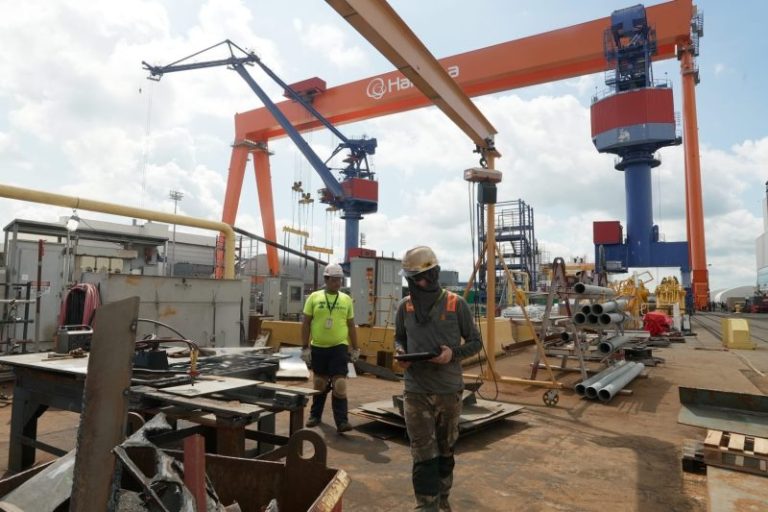
    The U.S. shipbuilding industry is looking for help. A South Korean company is answering the call.

    Hanwha Philly Shipyard CEO David Kim, nodding to the gargantuan vessels under construction just off the Delaware River, on Wednesday offered the kind of vision that has brought some optimism back to the U.S. shipbuilding community.

    “You take that level of experience, the technology that we have, the know-how, the process expertise, and so clearly, we believe we have a lot to bring to the Philly Shipyard, as well as to the U.S. maritime industrial base, in terms of modernization capacity,” he said on a walkthrough of the shipyard.

    Hanwha Philly Shipyard CEO David Kim.Obtained by NBC News

    Hanwha Group bought the Philly Shipyard in December for $100 million and plans to invest multiple times that amount in the yard, training over a thousand new workers and bringing in new high-tech equipment. The company hopes to build naval ships and become the first U.S. builder of specialized liquefied natural gas tankers.

    Shipbuilding in the United States has been all but dormant. China, South Korea, Japan and Europe all produce far more ships than the United States, with the few shipyards still operating in the country concentrating on military ships.

    Revitalizing shipbuilding has been one of the areas President Donald Trump has pointed to as part of a broader effort to bring manufacturing back to the United States — a move some see as shortsighted considering the costs associated with building the kind of gigantic modern ships that remain a core part of how goods and commodities move around the planet.

    This post appeared first on NBC NEWS

    Join Tom as he covers key inflation data, earnings season highlights, and sector rotation trends. He breaks down recent price action in major indexes like the S&P 500 and Nasdaq, with a close look at the 20-day moving average as a support gauge. Tom spotlights standout industry groups such as gambling, semiconductors, software, and aerospace, and shares charts of top-performing stocks like Goldman Sachs, Johnson & Johnson, and PNC. Tom highlights under-performing areas like insurance brokers and home improvement, then reviews several strong earnings reactions, including Monarch Casino’s 15% after-hours gain.

    This video was published on July 17, 2025. Click this link to watch on Tom’s dedicated page.

    Missed a session? Archived videos from Tom are available at this link

    There is no denying that the broad markets remain in a resilient uptrend off the April 2025 low.  But if there’s one thing I’ve learned from many years of analyzing charts, it’s to remain vigilant during bullish phases.  Even though I’ll assume the uptrend is still intact, that doesn’t mean I can stop looking for signs of potential weakness!

    With that in mind, here are three bearish candle patterns that often pop up during bullish market phases.  By looking for these patterns in the stocks and ETFs that you own, you can hopefully get ahead of any corrective moves and take profits before it’s too late!

    The Shooting Star Pattern

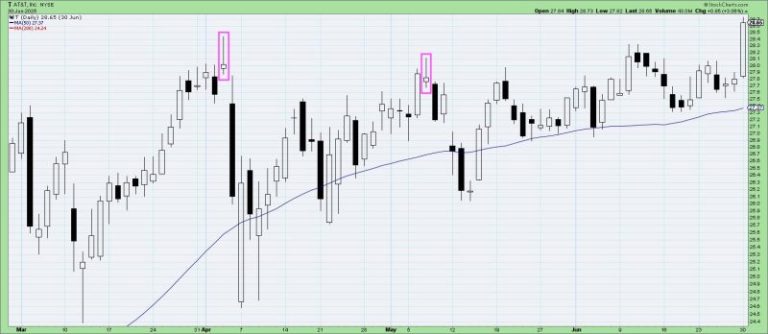
    If you see a long upper shadow, little to no lower shadow, and the open and close are close together near the bottom of the day’s range, then you have identified a shooting star candle pattern.  If you’re familiar with the hammer candle pattern, then you can think of this as a hammer candle but basically everything is upside down!

    The chart of AT&T (T) has featured a number of shooting star candles so far in 2025.  Just before the selloff in early April, there was a clear shooting star candle after the March rally.  Then during the rally off the April low, a shooting star pattern in early May suggested that the uptrend phase was nearing an exhaustion point.

    The Bearish Engulfing Pattern

    One of the most recognizable patterns in the candlestick library, the bearish engulfing pattern represents a short-term rotation from accumulation to distribution.  Basically, a large up candle is followed by a large down candle, and the second day’s “real body” (the open-to-close range) engulfs the range of the first day’s real body.  

    Look at the strength in the uptrend for Paramount Global (PARA) going into early June.  Then just before the 4th of July weekend, a bearish engulfing pattern suggests a change of character as the bears take control.  It’s worth noting that these candle patterns are not long-term signals, but rather indicate short-term dynamics.  So a bearish engulfing pattern suggests weakness for the next one to three bars.

    The Evening Star Pattern

    If you took the bearish engulfing pattern, and then added another small candle in the middle of those two days, then you’d have an evening star pattern.  Now most candlestick textbooks will tell you that the “star” day in the middle should include a gap, so there’s no overlap between that day’s range and the other two candles.  In practice, I’ve found most people ignore this detail and rather look for patterns with enough similarities to this basic structure.

    Going back to the AT&T chart we used earlier, we can see an evening star pattern at the end of June.  A big day is followed soon after by a big down day, with a small candle in the middle.  This is a great example of where additional weakness led the price below the 50-day moving average, serving to confirm the bearish outlook as represented by the evening star pattern.

    It’s so easy to become complacent during an extended bull market rally.  Investors that regularly scan for bearish candle patterns have an edge, as they can anticipate potential turning points before the uptrend changes in dramatic fashion to a new downtrend phase!

    RR#6,

    Dave

    PS- Ready to upgrade your investment process?  Check out my free behavioral investing course!

    David Keller, CMT

    President and Chief Strategist

    Sierra Alpha Research LLC

    marketmisbehavior.com

    https://www.youtube.com/c/MarketMisbehavior

    Disclaimer: This blog is for educational purposes only and should not be construed as financial advice.  The ideas and strategies should never be used without first assessing your own personal and financial situation, or without consulting a financial professional.  

    The author does not have a position in mentioned securities at the time of publication.    Any opinions expressed herein are solely those of the author and do not in any way represent the views or opinions of any other person or entity.

    One great habit to develop as an investor is regularly scanning the stock market. Whether you’re checking for stocks that are outperforming a benchmark, gapping up, reversing, or breaking out of a trading range, scanning keeps you in the loop and, importantly, helps you stay sharp and spot potential opportunities early on. 

    During one of our routine scans, one stock stood out: Rigetti Computing, Inc. (RGTI), a company in a fast-moving quantum computing space. On Wednesday, RGTI closed the day up 30%, which turned some heads. What’s behind the move? Rigetti announced significant improvements in its platform, better performance metrics, and the 36-qubit system, a technical milestone in the quantum world.  

    Should You Invest in RGTI?

    If you ran any of the bullish predefined scans on StockCharts, you may have noticed RGTI popping up. That alone is a good reason to take a closer look at RGTI stock’s price action.

    Looking at the daily chart of RGTI, the stock had a nice ride in late 2024. However, things cooled off in early January 2025 and, since then, the stock has been trading sideways until this week. On Wednesday, RGTI gapped up with strong volume, breaking out of that sideways range.

    FIGURE 1. DAILY CHART OF RGTI STOCK. Since its rise in late 2024, the stock has been trading sideways until Wednesday, when it broke out of that range. Chart source: StockCharts.com. For educational purposes.

    Back in June, RGTI bounced off its 50-day simple moving average (SMA), which is starting to slope upward—a healthy technical signal. With Wednesday’s price move, RGTI is above its May 27 and July 8 highs.

    RGTI’s price isn’t too far from its all-time high, set in January. If the stock breaks above that level and has strong momentum, we could see it push to new highs. The Relative Strength Index (RSI) and Percentage Price Oscillator (PPO) are showing early signs of positive momentum.

    On the other hand, if the stock pulls back and Wednesday’s gap up doesn’t get filled, RGTI could reverse either at the May 27 or July 8 high. A reversal with a rise in momentum would confirm an upside continuation. If RGTI falls below these levels, fills Wednesday’s gap up, and finds support at the 50-day SMA, it could go back to trading sideways, waiting for the next catalyst. A decline below the 50-day SMA would invalidate the uptrend.

    A Rising Tide in Quantum Stocks?

    Other stocks in the Quantum Computing space, like IonQ, Inc. (IONQ) and D-Wave Quantum, Inc. (QBTS), also saw gains on Wednesday.

    Quantum computing stocks can be a bit of a roller coaster; they rallied at the end of 2024, dipped earlier this year, and are now gaining ground, thanks to encouraging news on quantum computing developments. The technology is in its early stages and could take years before it’s truly mainstream. So while these stocks are gaining attention now, the momentum may not be consistent.

    If you’re a long-term investor with patience and curiosity, it may be worth adding RGTI, QBTS, ION, and others to your ChartLists. Track them regularly and watch for continued technical strength or signs of trend reversals. 


    Disclaimer: This blog is for educational purposes only and should not be construed as financial advice. The ideas and strategies should never be used without first assessing your own personal and financial situation, or without consulting a financial professional.