Author

admin

Browsing

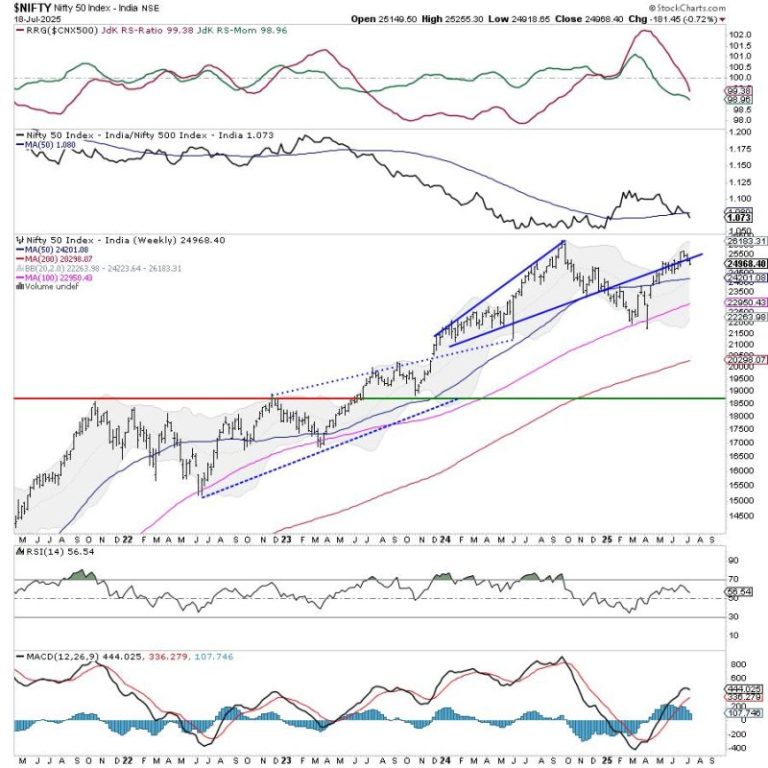
The Nifty traded in a broadly sideways and range-bound manner throughout the previous week and ended the week with a modest decline. The Index oscillated within a narrow 276-point range, between 25144.60 on the higher end and 24918.65 on the lower end, before settling mildly lower. The India VIX declined by 3.60% over the week to 11.39, suggesting continued complacency in the markets. On a weekly basis, Nifty ended with a net loss of 181.45 points or (-0.72%).

The Nifty is presently consolidating just below a key resistance zone after attempting a breakout above a rising channel. This zone, between 25100 and 25350, has proven to be a supply area where profit-taking has emerged. While the broader trend remains intact and the Nifty is above key moving averages, it is still within a complex zone of consolidation. This pause in momentum comes after a sharp up move from the lows near 21743 in April. A strong breakout above the 25265 –25350 zone, with a closing confirmation, may resume the uptrend. Conversely, a sustained move below 24750 could trigger incremental weakness and drag the Nifty towards lower supports.

 As we head into the new week, the markets may see a cautious start amid the current range-bound setup. The immediate resistance is at 25150, followed by 25400. On the lower side, the key support zones are placed at 24750 and further near 24380.

The weekly RSI stands at 56.54 and remains neutral without showing any divergence against price. It has made a fresh 14-period low, which is bearish. The MACD remains above its signal line on the weekly chart, continuing to indicate a positive crossover. No significant candlestick formation was observed for the week.

From a pattern analysis perspective, Nifty is trading just below the upper bound of a rising channel that it had briefly broken out of. With the Index slipping below the support levels of 25000-25150, it faces resistance at this zone again, failing to follow through on the breakout. Price action is still above the 20-week and 50-week moving averages, maintaining a bullish undertone from a medium-term perspective. However, the ongoing sideways action indicates a lack of fresh directional conviction.

Given the current technical structure, it would be prudent for traders to remain selective and protect profits at higher levels. The markets are not displaying signs of aggressive strength, and unless there is a convincing move above 25350, a stock-specific approach with tight risk management is advised. Traders may avoid aggressive fresh buying until a directional move is clearly established. Cautious optimism, with a focus on stocks exhibiting stronger relative strength, is the ideal approach for the coming week.


Sector Analysis for the coming week

In our look at Relative Rotation Graphs®, we compared various sectors against the CNX500 (NIFTY 500 Index), representing over 95% of the free-float market cap of all the listed stocks. 

Relative Rotation Graphs (RRG) show that the Nifty Media and the Metal Index have rolled inside the leading quadrant. The Midcap 100, Realty, and PSU Bank Index are also inside the leading quadrant. These groups are likely to relatively outperform the broader Nifty 500 Index.

The Nifty Bank, PSE, and the Financial Services Index are inside the weakening quadrant. They may experience a decline in relative performance compared to the broader markets.

The Nifty Services Sector Index, Pharma, Consumption, and the FMCG Index continue to languish inside the lagging quadrant. Among these groups, the Pharma Index shows improvement in its relative momentum against the broader markets.

The IT Index is inside the improving quadrant; it continues to improve its relative momentum against the benchmark. The Auto Index, which is also inside the improving quadrant, is seen deteriorating in relative momentum.


Important Note: RRG charts show the relative strength and momentum of a group of stocks. In the above Chart, they show relative performance against NIFTY500 Index (Broader Markets) and should not be used directly as buy or sell signals.  


Milan Vaishnav, CMT, MSTA

Consulting Technical Analyst

www.EquityResearch.asia | www.ChartWizard.ae

Investors honed in on tech stocks again as Q2 earnings season kicked off on Monday (July 14).

Some experts believe the rallying market is showing signs of frothiness.

Apollo Global Management (NYSE:APO) Chief Economist Torsten Sløk highlighted concerns about overvaluation mid-week, comparing the current tech craze to the dotcom bubble of the 1990s.

“The difference between the IT bubble in the 1990s and the AI bubble today is that the top 10 companies in the S&P 500 today are more overvalued than they were in the 1990s,” he wrote in a note on Wednesday (July 16).

Similar thoughts were expressed by Moor Insights & Strategy founder Patrick Moorhead last week.

However, Sanctuary Wealth’s chief investment strategist, Mary Ann Bartels, told CNBC’s Power Lunch team that valuations are justified by the technology that’s being unleashed. Major financial firms like Citigroup (NYSE:C), Bank of America (NYSE:BAC) and Morgan Stanley (NYSE:MS) also said they are increasingly exploring digital asset offerings, signaling traditional finance’s growing involvement in crypto and the broader adoption of innovative technologies.

These announcements came alongside positive earnings reports and mixed inflation data that helped lift markets to renewed highs, culminating in global manufacturer 3M (NYSE:MMM) raising its full-year profit forecast on Friday.

The company is projecting a smaller tariff-related hit to its 2025 earnings.

1. TSCM, ASML release latest quarterly results

This week saw semiconductor giants Taiwan Semiconductor Manufacturing Company (NYSE:TSM) and ASML Holding (NASDAQ:ASML) report their latest quarterly earnings.

The companies received vastly different reactions from the market. Contract chipmaker TSMC saw its valuation soar on Thursday (July 17) morning after it posted record profits that exceeded expectations and raised its full-year revenue forecast by 30 percent due to demand for artificial intelligence (AI) chips.

While the chipmaker addressed minor concerns about US tariffs and inventory, AI-driven growth dominated investor sentiment. Shares of TSMC opened 4.51 percent higher from Wednesday’s (July 16) closing price.

Positive sentiment spilled over into other chip stocks, with NVIDIA (NASDAQ:NVDA) and Broadcom (NASDAQ:AVGO) also seeing gains. TSMC maintained its position to close up 5.87 percent for the week.

TSMC and ASML performance, July 15 to 18, 2025.

Chart via Google Finance.

Conversely, ASML, a lithography systems monopolist, saw its share price plunge more than 8 percent ahead of Wednesday’s open, despite solid Q2 numbers, due to a cautious outlook for late 2025 and 2026.

In a statement, the company said it cannot confirm growth in 2026 due to current macroeconomic and geopolitical developments. ASML closed the week 7.39 percent below its Monday opening price.

The divergence highlights their supply chain positions: TSMC directly benefits from the immediate AI boom, while the prospects for ASML, a step removed, remain uncertain.

2. US announces major investments in Pennsylvania

US President Donald Trump joined Pennsylvania Senator Dave McCormick (R) at the inaugural Energy and Innovation Summit at Carnegie Mellon University in Pittsburgh on Tuesday (July 15).

He announced an investment amounting to over US$90 billion in AI and energy infrastructure in the state.

The announcement from Trump covers several multibillion-dollar spending plans from the likes of Google (NASDAQ:GOOGL), Blackstone (NYSE:BX), Anthropic, GE Verona (NYSE:GEV) and others for power generation and grid modernization. It also includes natural gas production to help power data centers.

Additionally, the preview mentions AI training programs and apprenticeships for businesses.

“These commitments will create tens of thousands of construction jobs and thousands of permanent jobs, signaling Pennsylvania’s readiness to power the AI and energy revolution, further strengthening America’s resilience and independence,” McCormick’s office wrote in a press release.

Separately, Google and Brookfield Asset Management (NYSE:BAM) announced on Tuesday that they have entered into a framework agreement to provide up to 3,000 MW megawatts of domestically produced hydropower from Brookfield’s Holtwood and Safe Harbor hydroelectric facilities in Pennsylvania. The agreement allows for future expansion, with an initial focus on the mid-Atlantic and mid-continent electricity markets.

3. NVIDIA resumes chip sales to China

On Monday, NVIDIA CEO Jensen Huang said his company will resume H20 GPUs sales to China after productive meetings with government officials from the US and Beijing earlier this month.

In a press release, the company said it has been assured by the US government that licenses will be granted.

NVIDIA performance, July 15 to 18, 2025.

Chart via Google Finance.

Shares of the chipmaker opened 4.27 percent higher on Tuesday and closed the week up 4.25 percent.

4. Apple to invest in US rare earths miner

On Tuesday, Apple (NASDAQ:AAPL) said it will invest US$500 million in rare earths miner MP Materials (NYSE:MP) as part of an effort to strengthen the American rare earths supply chain.

MP is the only fully integrated rare earths miner operating in the US. Last week, the US Department of Defense said it would buy a direct equity stake in the company, becoming its largest shareholder.

The company’s Apple collaboration also includes plans to build out MP’s neodymium magnet manufacturing lines at its Texas factory specifically for Apple products. This expansion is slated to boost production and create jobs in advanced manufacturing and research and development, helping to meet global demand.

Apple and MP will also collaborate to establish a rare earths recycling line in Mountain Pass, California, and will develop new magnet materials and processing technologies to improve magnet performance.

“American innovation drives everything we do at Apple, and we’re proud to deepen our investment in the U.S. economy,” said Tim Cook, Apple’s CEO.

5. OpenAI and AWS launch new AI agent features

Open AI has launched a powerful new Agent mode in ChatGPT for pro, plus and team users.

It can autonomously complete tasks across the web, and also includes productivity tools.

The new feature enables AI agents that can help automate workflow by creating and editing spreadsheets and presentations, generating reports, analyzing data and managing calendars on users’ desktops; agents can also browse websites and fill out forms with user approval. The company has plans to add e-commerce checkouts.

Aside from that, the Financial Times reported this week that OpenAI plans to take a cut of online shopping purchases made within its chatbot as a way to generate revenue from people using AI for shopping inspiration.

Amazon (NASDAQ:AMZN) also made major announcements around AI agents this week. At its Amazon Web Services (AWS) Summit in New York, the company launched Bedrock AgentCore, a suite of enterprise-grade services that will allow developers to build, deploy and run scalable agents. AWS also introduced AI Agents & Tools, a new category on AWS Marketplace. It features pre-built agents from partners like Anthropic, IBM (NYSE:IBM) and Stripe.

Securities Disclosure: I, Meagen Seatter, hold no direct investment interest in any company mentioned in this article.

This post appeared first on investingnews.com

Democrats have railed against potential Medicaid cuts since President Donald Trump won the 2024 presidential election. Now that his ‘big, beautiful bill’ has passed through Congress, they are making Medicaid a top talking point ahead of competitive midterm elections expected in 2026. 

Republicans, meanwhile, are doubling down on Medicaid reform included in Trump’s megabill, which also includes sweeping legislation on taxes, immigration and energy. 

‘My policy is if you’re an able-bodied worker, get a damn job,’ Rep. Nancy Mace, R-S.C., told Fox News Digital. ‘If you want government benefits, go to work and get a job.’

A provision in the megabill requires able-bodied, childless adults between the ages of 18 and 64 to work at least 80 hours a month to be eligible to receive Medicaid benefits. Individuals can also meet the requirement by ​​participating in community service, going to school or engaging in a work program.

Fox News Digital asked lawmakers on Capitol Hill if taxpayers should have to pay for Medicaid bills for able-bodied workers who are under 65 and unemployed. 

Sen. Angus King, an independent from Maine, said in both Arkansas and Georgia, where work requirements have already been imposed, it ended up costing taxpayers more money to administer the work requirements. 

‘We’re talking about a very small population, and in the two cases where they tried it, it ended up, number one, disqualifying people who met all the requirements but gave up on the paperwork. These aren’t people that are used to filling out a lot of paperwork every month. And it also cost the state a lot to administer,’ King said. 

The New England Journal of Medicine found that Arkansas’ Medicaid work requirement from 2018 to 2019 ‘found no evidence of increased employment … and a significant loss of Medicaid coverage among low-income adults.’

Similarly, the Georgia Budget & Policy Institute (GBPI) reported that 80% of the $58 million spent in the first year of Georgia’s Pathways to Coverage program went toward administrative costs. 

But Sen. Katie Britt, R-Ala., emphasized that Republicans ‘want these programs to be around for the people who need them.’ She said Medicaid reform is about ‘strengthening and preserving these programs at the rate that they’re growing.’

‘These programs were intended to be safety nets, not hammocks that people stay in, and the success of these programs should be measured by how many people we get off of them,’ Britt said. 

Sen. Bill Cassidy, R-La., agreed, telling Fox News Digital, ‘What you don’t want is for somebody to become dependent. I’d tell people: safety nets should bounce you to your feet. They shouldn’t be like flypaper in which you stick and can never get off.’

‘We’re not saying, ‘Hey, we’re not throwing you out.’ All right, but you gotta go get a job. You either get a job, or actually you can even volunteer, all right? And that will satisfy the requirements for work,’ Rep. Carlos Gimenez, R-Fla., explained. 

But Democrats who spoke to Fox News Digital continued to push back against the work requirements included in the ‘big, beautiful bill.’ 

‘I think people [who] are able to work, trust me, they’d rather work than to get the piddling dollars that they get from Medicaid. It’s insulting to suggest that a person would rather sit at home rather than work and get this meager amount of money. All of this has just been totally expanded to fit a narrative that allows them to cut into those people who really deserve Medicaid,’ Rep. Troy Carter, D-La., said. 

And Rep. Lateefah Simon, D-Calif., said, ‘We need to be able to have an infrastructure in this country that supports the elderly and the sick and the widows and the child. This bill, it violates all those basic principles.’

Fox News’ Peter Pinedo contributed to this report. 

This post appeared first on FOX NEWS

Elon Musk’s health tech company Neuralink labeled itself a “small disadvantaged business” in a federal filing with the U.S. Small Business Administration, shortly before a financing round valued the company at $9 billion.

Neuralink is developing a brain-computer interface (BCI) system, with an initial aim to help people with severe paralysis regain some independence. BCI technology broadly can translate a person’s brain signals into commands that allow them to manipulate external technologies just by thinking.

Neuralink’s filing, dated April 24, would have reached the SBA at a time when Musk was leading the Trump administration’s Department of Government Efficiency. At DOGE, Musk worked to slash the size of federal agencies.

MuskWatch first reported on the details of Neuralink’s April filing.

According to the SBA’s website, a designation of SDB means a company is at least 51% owned and controlled by one or more “disadvantaged” persons who must be “socially disadvantaged and economically disadvantaged.” An SDB designation can also help a business “gain preferential access to federal procurement opportunities,” the SBA website says.

The Department of Justice has previously fined companies for making false claims about their SDB status.

Musk, the world’s wealthiest person, is CEO of Tesla and SpaceX, in addition to his other businesses like artificial intelligence startup xAI and tunneling venture The Boring Company. In 2022, Musk led the $44 billion purchase of Twitter, which he later named X before merging it with xAI.

Jared Birchall, a Neuralink executive, was listed as the contact person on the filing from April. Birchall, who also manages Musk’s money as head of his family office, didn’t immediately respond to a request for comment.

Neuralink, which incorporated in Nevada, closed a $650 million funding round in early June at a $9 billion valuation. ARK Invest, Peter Thiel’s Founders Fund, Sequoia Capital and Thrive Capital were among the investors. Neuralink said the fresh capital would help the company bring its technology to more patients and develop new devices that “deepen the connection between biological and artificial intelligence.”

Under Musk’s leadership at DOGE, the initiative took aim at government agencies that emphasized diversity, equity and inclusion (DEI). In February, for example, DOGE and Musk boasted of nixing hundreds of millions of dollars worth of funding for the Department of Education that would have gone towards DEI-related training grants.

This post appeared first on NBC NEWS

Even with a few short-lived roller coaster rides, the stock market had a strong week. Though there was some selling on Friday, the S&P 500 ($SPX) and Nasdaq Composite ($COMPQ) closed up over the week as a whole, while the Dow Jones Industrial Average ($INDU) closed lower by 0.07%.

Earnings season has started on a positive note, with big banks and Netflix, Inc. (NFLX) reporting better-than-expected earnings. Inflation remains relatively tame and the labor market remains resilient. This has helped fuel the stock market’s higher trajectory, with sectors such as Technology, Industrials, and Financials showing strong upward moves.  Even small-caps are hanging in there, although they have pulled back a bit.

This price action supports broad participation in the market. The S&P 500 Equal-Weighted Index ($SPXEW) is also holding strong, trading above its 20-day exponential moving average. This tells us that participation isn’t limited to a handful of giants.

A Look Under the Hood

Overall growth still takes center stage and, so far, July is following its seasonality pattern. The seasonality chart below shows that in the last 10 years, the return in July was positive every year, with an average gain of 3.30%.

FIGURE 1. SEASONALITY CHART OF THE S&P 500. July is a strong month for the index, but August, September, and October paint a different picture.Image source: StockCharts.com. For educational purposes.

Switching to a same-scale line chart (with a few years removed for clarity) you can see that even in 2020 and 2022, when the S&P 500 was in negative territory, July was still a strong month.

FIGURE 2. SAME-SCALE SEASONALITY CHART FOR S&P 500 FROM 2016 TO 2025. July is a strong month for stocks, although some years the latter part of the month has seen a decline.Image source: StockCharts.com. For educational purposes.

Seasonality shifts notably as we move into late summer and early fall. That doesn’t guarantee a weak August, but it does argue for staying alert. It’s like driving into a stretch of winding road. You don’t slam the brakes, you just keep both hands on the wheel.

How to Track the Overall Market’s Performance

For a bird’s-eye view, the StockCharts Market Summary is your go-to page, but, after drilling down, one chart I often visit in my Market Analysis ChartList is the 3-year weekly chart of the S&P 500, with its Bullish Percent Index (BPI) and the percentage of S&P 500 stocks trading above their 200-day moving average.

FIGURE 3. WEEKLY CHART OF S&P  500 WITH MARKET BREADTH INDICATORS. From a weekly perspective, the S&P 500 is still trending higher. Breadth indicators support the bullish move.Chart source: StockCharts.com. For educational purposes.

The trend is still higher, although the range between the open and close is relatively narrow. The BPI is above 50 but is flattening out, and the percentage of stocks trading above their 200-day moving average is also declining. Neither breadth indicator suggests we’ll see a massive selloff in the coming days.

The Cboe Volatility Index ($VIX) is low, and investor sentiment leans bullish (you can confirm this in the Sentiment panel of the Market Summary page).

Will Growth Lead For the Rest of the Year?

There are lots of variables that can change from now to the end of the year, from government policy to geopolitical tensions. These changes will be reflected in the market breadth and sentiment charts.

Tip: StockCharts members can download the Market Summary ChartPack to include the charts from the page in their ChartLists. You need to keep an eye on these charts for leading signals of change in the market’s price action.


End-of-Week Wrap-Up

Stock Market Weekly Performance

  • Dow Jones Industrial Average: 44,342.19 (-0.07%)
  • S&P 500: 6,296.79 (+0.59%)
  • Nasdaq Composite: 20,895 (+1.51%)
  • $VIX: 16.41 (+0.06%)
  • Best performing sector for the week: Technology
  • Worst performing sector for the week: Energy
  • Top 5 Large Cap SCTR stocks:  AST Spacemobile, Inc.(ASTS); Nuscale Power Corp. (SMR); Robinhood Markets Inc. (HOOD); Avis Budget Group (CAR); Symbiotic, Inc. (SYM)

On the Radar Next Week

  • June Home Sales
  • June Durable Goods Orders
  • Several Fed speeches
  • Earnings from Alphabet, Inc. (GOOGL), Tesla, Inc. (TSLA), AT&T Inc. (T), Intel Corp. (INTC), International Business Machines (IBM), and many more.

Disclaimer: This blog is for educational purposes only and should not be construed as financial advice. The ideas and strategies should never be used without first assessing your own personal and financial situation, or without consulting a financial professional.

This week, let’s dive into three interesting stocks: a well-known Dow stalwart, a tech giant in a tug of war, and a former Dow member showing signs of revival. Whether you’re looking for opportunity, caution, or something worth watching, there’s a little something here for every thoughtful investor.

Sherwin-Williams (SHW): Painting a Better Picture?

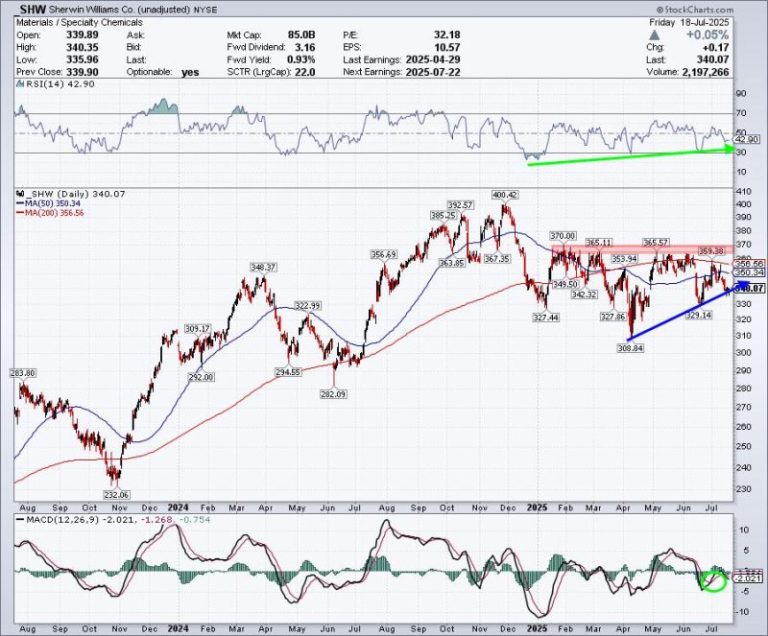
Sherwin-Williams, Co. (SHW) comes into earnings flat year-to-date, and is hoping that a solid quarterly result can turn the price around. This Dow stock, and the second biggest member of the Materials Select Sector SPDR ETF (XLB), has traded higher after three of its last four results and has an average expected move of +/- 3.6% when it reports.

FIGURE 1. DAILY CHART OF SHERWIN-WILLIAMS. The uptrend needs to hold to maintain the uptrend.Chart source: StockCharts.com. For educational purposes.

From a technical perspective, there are some bright spots. The reality, however, is that the stock has a lot of work to do to be considered healthy again. And from a risk/reward metric, this recent uptrend from the lows needs to hold. Otherwise, look for a retest of the $310 level on a dip.

The good, the bad, and the ugly:

Shares continue to make higher lows, which is a bullish sign

There’s bullish divergence in its Relative Strength Index (RSI) — it’s going higher while the stock stalls

The MACD gave us a short-lived buy signal and has now turned negative

Trading below both key moving averages

There’s major resistance at the $360 level

This is one to put on your watchlist, with definitive risk/reward levels to monitor. To jump in ahead of earnings seems more of a crapshoot, so reacting to price action may be the best play. Patience may be your best friend.

Alphabet (GOOGL): A Mag Stock or Just Mag History?

Alphabet, one of the “Magnificent 7” stocks, has had a rough ride lately. The company has been facing continual headwinds due to antitrust and litigation risk, AI competition disrupting search, and a massive CapEx spend.

Shares have been stuck in neutral for the last year. They are lower by -2.5% year-to-date and 11% off all-time highs. If the company can address these concerns and focus on the positives of its YouTube and Waymo divisions, it could be back on the upswing.

FIGURE 2. DAILY CHART OF GOOGL STOCK. It’s in the middle of a rebound and could be at an interesting pivot point.Chart source: StockCharts.com. For educational purposes.

Technically, I will keep this five-year daily chart as simple as possible. It’s intriguing, to say the least.

GOOGL was dangerously close to breaking down in early April, but quickly regained its key support level. Now it finds itself in the middle of a nice rebound and at an interesting pivot point. The bull case is more concrete at these levels, but I’m sure the bears are looking at a potential head-and-shoulders topping formation in the works as well.

As we examine, watch the 50 and 200-day moving averages closely. They are at a key consolidation area and need to act as support in a small downturn. If not, then back to the major support area we go, and a potential head-and-shoulders top is in play. 

The good news is that overall momentum continues to favor the upside. We have a good support area at the averages (your risk) and then a potential run to $200 easily if we get a nice pop on earnings. If so, this could be the fourth of the “Magnificent 7” stocks trading at all-time highs.

Intel (INTC): A Blast From the Past, Showing Signs of Life?

Remember Intel? It once dominated the landscape during the dot-com era, was a proud member of the Dow, and now is just a struggling former tech giant trying to stay relevant in a challenging environment. We are not claiming they are back by any stretch, but maybe the worst is over for now, as new management and constructive price action have set up a “deja vu” trade that hearkens back to early 2023.

FIGURE 3. WEEKLY CHART OF INTC STOCK. The stock is above its 50-week moving average, there’s a bullish divergence in the RSI and MACD, and the bottom base was tested several times.

Chart source: StockCharts.com. For educational purposes.

Technically, we highlight price action daily over a five-year weekly period. The risk/reward set-up seems quite favorable at current levels and also looks eerily similar to its last rebound.

Here’s the current scenario that also occurred in 2022/2023.

Bottom/base that was tested multiple times and held

Bullish divergence in both key momentum indicators – RSI and MACD

Price followed and broke above the 50-week moving average

Price was over 40% below its 200-week moving average — something to reverse

In 2023, shares rallied back. Will this situation resolve similarly?

The risk to the downside seems worth the possible reward up to the moving average. Whether or not the stock has turned it around completely is a different story, but for now, the tide seems to be shifting. 

The Bottom Line

These three stocks offer a mix of opportunity and caution. Be sure to add these stock to your ChartLists and watch the action unfold as the companies report earnings.


Trading resumes in:


Company:  Prismo Metals Inc.  


CSE Symbol: PRIZ  


All Issues: Yes  


Resumption (ET):   8:00 AM   7/21/2025   


CIRO can make a decision to impose a temporary suspension (halt) of trading in a security of a publicly-listed company. Trading halts are implemented to ensure a fair and orderly market. CIRO is the national self-regulatory organization which oversees all investment dealers and trading activity on debt and equity marketplaces in Canada .


SOURCE Canadian Investment Regulatory Organization (CIRO) – Halts/Resumptions


  View original content: http://www.newswire.ca/en/releases/archive/July2025/18/c4294.html  


News Provided by Canada Newswire via QuoteMedia

This post appeared first on investingnews.com

The gold price saw both peaks and troughs this week, reacting to the release of June consumer and producer price index data out of the US, as well as renewed discussions about whether President Donald Trump may fire Federal Reserve Chair Jerome Powell.

Silver was the real precious metals star, pushing past the US$39 per ounce level once again.

What’s happened is we broke through that US$37 to US$37.30 resistance level — after failing there, by the way — which is also a technical bullish sign. And then we rallied all the way to the US$39s, but we hit resistance between US$39 and US$40, which is not really unexpected, because it was a really quick move from US$37 to US$39.

I think US$40 is a big, round number that doesn’t have a lot of resistance on the long-term chart, but it’s still there in people’s minds.

It’s going to take a little bit to get through US$40. But once you’re by US$40, then it’s absolutely go time if you don’t think it is already.

Take a watch for more on silver, as well as the gold, platinum and copper markets.

Bullet briefing — MP shares rise, Barrick and Discovery talk Hemlo

MP Materials signs deal with Apple

MP Materials (NYSE:MP) was in the headlines after announcing a US$500 million partnership with Apple (NASDAQ:AAPL). The companies said on Tuesday (July 15) that they have entered into a definitive long-term agreement through which MP will supply Apple with rare earth magnets.

The magnets will be made in the US, and will use 100 percent recycled materials.

The news follows last week’s new partnership between MP and the US Department of Defense. A key component is a 10 year deal that sets up a price floor commitment of US$110 per kilogram for MP’s neodymium-praeseodymium products, a move geared at creating supply chain stability.

The defense department will also become MP’s largest shareholder, buying US$400 million worth of preferred stock and receiving warrants to purchase additional common stock.

Shares of MP spiked on the news and have stayed high since then.

MP describes itself as the only fully integrated rare earths producer in the US, and the moves from Apple and the defense department reflect a growing push to diversify away from China.

Investors are taking note of the rare earths opportunity too. Here’s how Rick Rule of Rule Investment Media described the sector’s potential in a recent interview:

If you want a gamier suggestion, I really like the high-quality rare earths space. Nobody understands it, nobody cares. There are probably 50 pretenders in rare earths, but there are two or three speculations that, while you could easily lose 30 percent of your money, you could also easily enjoy 20 baggers.

Watch the interview for more, including Rule’s favorite ASX-listed mining stocks.

Barrick, Discovery Silver in Hemlo talks

Major miner Barrick Mining (TSX:ABX,NYSE:B) is reportedly looking to sell Hemlo, its last remaining Canadian gold mine, to Discovery Silver (TSX:DSV,OTCQX:DSVSF).

According to Bloomberg, the companies are in ‘advanced talks’ about a deal.

Located in Ontario, Hemlo’s 2025 output is forecast at 140,000 to 160,000 ounces of gold at an all-in sustaining cost of US$1,600 to US$1,700 per ounce.

The move to sell Hemlo comes as Barrick hones in on tier-one assets and broadens its focus. It changed its name from Barrick Gold to Barrick Mining earlier this year, with its latest divestment being the sale of its 50 percent stake in the Alaska-based Donlin gold project for US$1 billion in cash.

For its part, Discovery Silver has been on an expansion path, closing its acquisition of Newmont’s (TSX:NGT,NYSE:NEM) Porcupine complex this past April.

In addition to Porcupine, Discovery holds the Cordero silver project in Mexico.

Securities Disclosure: I, Charlotte McLeod, hold no direct investment interest in any company mentioned in this article.

This post appeared first on investingnews.com

In this video, Mary Ellen spotlights the areas driving market momentum following Taiwan Semiconductor’s record-breaking earnings report. She analyzes continued strength in semiconductors, utilities, industrials, and AI-driven sectors, plus highlights new leadership in robotics and innovation-focused ETFs like ARK. From there, Mary Ellen breaks down weakness in health care and housing stocks, shows how to refine trade entries using hourly charts, and compares today’s rally to past market surges. Watch as she explores setups in silver and examines individual stocks like Nvidia, BlackRock, and State Street.

This video originally premiered on July 18, 2025. You can watch it on our dedicated page for Mary Ellen’s videos.

New videos from Mary Ellen premiere weekly on Fridays. You can view all previously recorded episodes at this link.

If you’re looking for stocks to invest in, be sure to check out the MEM Edge Report! This report gives you detailed information on the top sectors, industries and stocks so you can make informed investment decisions.

This opinion piece was submitted to the Investing News Network (INN) by Darren Brady Nelson, who is an external contributor. INN believes it may be of interest to readers and has copy edited the material to ensure adherence to the company’s style guide; however, INN does not guarantee the accuracy or thoroughness of the information reported by external contributors. The opinions expressed by external contributors do not reflect the opinions of INN and do not constitute investment advice. All readers are encouraged to perform their own due diligence.

By Darren Brady Nelson

As an economist, I, perhaps somewhat sadly, have many economist friends. One of them recently alerted me to a post on X that was even a shock to me in the toxic 2020s. That being: “Almost all political donations by Fed employees go to one party. The Fed is already politicized.”

The post had a link to the data supporting this assertion, which was published at OpenSecrets. They are a “501(c)3” devoted to: “tracking money in US politics and its effect on elections and public policy.” Their theme is appropriately “Follow the Money,” as it is for this story.

Political money contributions, since 2016, from those at the Fed, range between 92 to 93 percent for Democrats and 8 to 9 percent for Republicans. As Public Choice economics teaches, it is crucial to “Follow the Money” in politics. Austrian and Chicago schools of economics teach the same for gold.

Gold pricing 101

Gold pricing is often characterized as being driven by “fear and uncertainty,” at least in the short run, including geopolitical fears like war and economic uncertainties such as recession. It is also typically recognized to be an “inflation hedge,” in the long run anyway.

Gold is an asset with a price determined in a 24/7/365 global auction, most often quoted per troy ounce, in the world’s reserve currency of US dollars. New supply plays an unusually small role compared to almost all other commodities, goods or services. Thus, highest bid wins.

Perhaps none of these things about gold, and its price, are new nor surprising. But what might be, despite the end of the gold standard in 1971 and legalization of gold investment in 1974, is that gold is still a shadow currency to fiat ones, especially US dollar, in the ‘always run.’

The annual gold price from 1960 to 2024 is displayed below, as sourced from the World Bank. Rises include: late 1970s; late 2000s; and mid 2020s. Slides include: early 1980s; late 1990s; and early 2010s. Overall growth was: Sum 555 percent; Ave 8.7 percent; Max 98 percent; Min 24 percent; and CAGR 6.8 percent.

Gold yearly growth ($).

Source: World Bank.

Money supply 101

Gold is the inflation hedge, precisely because it is shadow currency. Money supply is the inflation source, precisely because it is fiat currency. As Chicago economist Milton Friedman wrote in Money Mischief (1994): “In the modern world, inflation is a printing-press phenomenon.”

There are multiple money supply measures, such as M0, M1, M2 and M3. M1 includes paper and coin currency held by the general public as well as liquid bank deposits (e.g. checking accounts). M3 includes M1, plus less liquid bank deposits (e.g. savings accounts) as well as “repos.”

Austrian economist Robert Murphy details in Understanding Money Mechanics (2021) just how the Fed’s printing, Treasury bonds and bank loans create US money supply, through open market operations. Since 2008 and 2020, the Fed has expanded to buying and selling just about anything.

Speaking on behalf of the Fed, and all major central banks, the Bank of England wrote in Money Creation in the Modern Economy (2014): “(B)ank lending creates deposits. At that moment, new money is created. (This is) ‘fountain pen money,’ created at the stroke of bankers’ pens(.)”

Annual M1 and M3 money supply from 1960 to 2024 are displayed below, as sourced from the OECD. M3 starts to take off from the mid 1990s. Both blast off in the early 2020s, M1 in part due to redefinition. Combined growth was: Sum 533 percent; Ave 8.3 percent; Max 126 percent; Min 6.4 percent; and CAGR 7.4 percent.

Money yearly growth ($).

Source: OECD.

Gold inflation 101

Christian economist Gary North points out in Honest Money (2011) that businesses have three choices in the face of money inflation: A) profit deflation; B) price inflation; C) quality shrinkflation. Investors have a fourth: D) gold inflation. A, B, and C are all bad options. D is good.

The chart below shows cumulative annual growth of gold versus M1 and M3. Gold performs and protects against both M1 and M3 from 1974 to 2019, even in 2001, but not against M1 from 2020 to 2024. In 2019, gold had a 150 percent lead on M1 and 92 percent on M3. By 2022, it shrunk to 110 percent and 80 percent.

Cumulative yearly growth (percent).

Sources: OECD and World Bank.

A 2020 regression study found: “When the Federal Reserve increases money supply by 1%, gold prices increase by 0.94%.” A 2023 academic paper: “Confirms a long-term relationship between gold price and US M2.” Note that M1’s 2021 redefinition has now made it nearly identical to M1.

Period yearly change (percent).

Sources: OECD and World Bank.

However, the authors of Austrian School for Investors (2015) wrote: “Gold does not correlate with the rate of inflation as such, but with the rate of change of the inflation rate. In order to buttress this hypothesis, we calculated the regression depicted in (the chart below).”

Source: Austrian School for Investors: Austrian Investing between Inflation and Deflation.

In conclusion, as per my Wokenomics 101 (2023) ghost blog, money inflation by: “increasing demand puts upward pressure on price and quantity and downward pressure on quality.” That puts upward pressure on: nominal CPI and GDP statistics; as well as real gold investment and price.

Inflation doesn’t harm all. It helps some. They are the “Bootleggers and Baptists,” as Public Choice economist Bruce Yandle dubbed them in 1983. Bootleggers are crony capitalists, politicians and bureaucrats whose inflated revenue outpaces costs. Baptists are the “useful idiots.”

Thus, “Follow the Money” back to the “inflationistas” of: Big Business; Big Government; and Big Banks. All gain supernormal profits from easy money: one, making more money; two, collecting more money; and three, creating more money. Also, “Follow the Money” when it comes to gold.

And, sadly, there is one policy that is always bipartisan; print more money. But, gladly, gold will always win.

About Darren Brady Nelson

Darren Brady Nelson is chief economist with Fisher Liberty Gold and policy advisor to The Heartland Institute. He previously was economic advisor to Australian Senator Malcolm Roberts. He authored the Ten Principles of Regulation and Reform, and the CPI-X approach to budget cuts.

This post appeared first on investingnews.com