Author

admin

Browsing

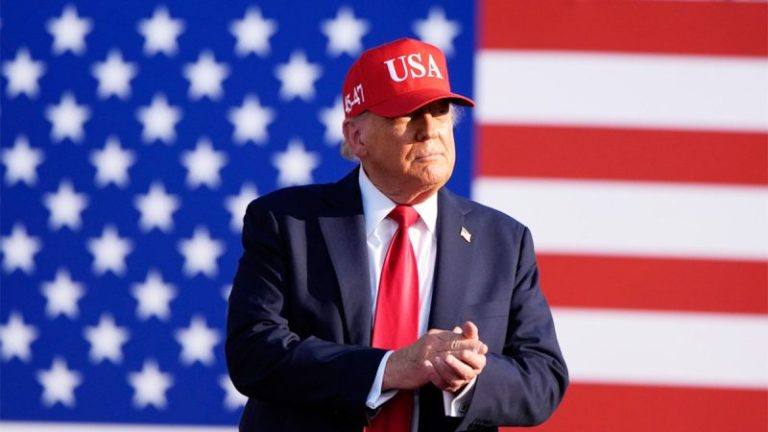
President Donald Trump declared that the United States will do ‘whatever it takes’ to win the global race to artificial intelligence dominance, during an address at a summit held in the nation’s capital Wednesday.

‘From this day forward, it’ll be a policy of the United States to do whatever it takes to lead the world in artificial intelligence,’ Trump said during his address shortly ahead of signing three new executive orders that are aimed at boosting the country’s artificial intelligence capabilities. 

Meanwhile, Trump also slammed the former Biden administration for ‘weaponizing’ and restricting AI innovation and advancements.

‘If you regulate [AI] too much, you kill the source of American genius and technological power,’ Trump said. ‘I believe that Joe Biden had a plan to lose the AI race. I think he wanted to lose it.’

Administration leaders, including White House Office of Science and Technology policy director Michael Kratsios and AI and crypto czar David Sacks, held a background call with the media Wednesday morning and outlined a three-pillar plan of action for artificial intelligence focused on American workers, free speech and protecting U.S.-built technologies. 

‘We want to center America’s workers, and make sure they benefit from AI,’ Sacks said on the call while describing the three pillars. 

‘The second is that we believe that AI systems should be free of ideological bias and not be designed to pursue socially engineered agendas,’ Sacks said. ‘And so we have a number of proposals there on how to make sure that AI remains truth-seeking and trustworthy. And then the third principle that cuts across the pillars is that we believe we have to prevent our advanced technologies from being misused or stolen by malicious actors. And we also have to monitor for emerging and unforeseen risks from AI.’

Ending red tape and restrictions on the technology is also a key component of the new AI initiative, administration officials said, noting it will usher in the next ‘industrial revolution.’

Trump ordered his administration in January to develop a plan of action for artificial intelligence in order to ‘solidify our position as the global leader in AI and secure a brighter future for all Americans.’ 

The presidential action ordered administration leaders to craft a plan ‘to sustain and enhance America’s global AI dominance in order to promote human flourishing, economic competitiveness, and national security’ within 180 days, which was Tuesday. 

Kratsios stressed on the Wednesday press call that by cutting federal red tape surrounding AI, American workers will benefit while the U.S. will avoid going down the same AI path as Europe, which is mired in tech regulations, Kratsios said on the call. ‘The action plan calls for freeing American AI innovation from unnecessary bureaucratic red tape, ensuring all Americans reap the benefits of AI technologies and leveraging AI to drive new scientific breakthroughs.’

‘On deregulation, we cannot afford to go down Europe’s innovation-killing regulatory path. Federal agencies will now review their rules on the books and repeal those that hinder AI development and deployment across industries, from financial services and agriculture to health and transportation.’ 

‘At the same time, we’re asking the private sector to recommend regulatory barriers that they face for the administration to consider removing,’ he added. ‘Instead of cultivating skepticism, our policy is to encourage and enable AI adoption across government and the private sector through regulatory sandboxes and sector-specific partnerships.’ 

Trump rescinded a Biden-era executive order hours after taking office in January that put restrictions on artificial intelligence technologies, including requiring tech companies to keep the federal government appraised of the most powerful technology they were building before the programs are made available to the public. 

Trump’s signature rescinded the Biden order, with a White House fact sheet at the time arguing the Biden executive order ‘hinders AI innovation and imposes onerous and unnecessary government control over the development of AI.’

‘American development of AI systems must be free from ideological bias or engineered social agendas,’ the White House said. ‘With the right government policies, the United States can solidify its position as the leader in AI and secure a brighter future for all Americans.’ 

‘The order directs the development of an AI Action Plan to sustain and enhance America’s AI dominance, led by the Assistant to the President for Science & Technology, the White House AI & Crypto Czar, and the National Security Advisor,’ the White House said. 

The Trump administration has notched massive wins in the artificial intelligence race, which has pitted the U.S. against China to develop the most high-tech artificial intelligence systems, including Oracle and OpenAI announcing Tuesday the companies will further develop the Stargate project, which is an effort to launch large data centers in the U.S. The two companies’ most recent announcement promises an additional 4.5 gigawatts of Stargate data center capacity, a move expected to create more than 100,000 jobs across operations, construction, and indirect roles such as manufacturing and local services.

The Stargate project includes a commitment from OpenAI, Oracle, SoftBank and MGX to invest $500 billion in U.S.-based artificial intelligence infrastructure throughout the next four years.

Creating the data centers is key to the U.S. artificial intelligence race, according to admin officials who spoke on the background call Wednesday. Sacks explained that the administration wants to see U.S. artificial intelligence infrastructure grow by leaps and bounds in order for the country to ‘lead in data centers and in the energy that powers those data centers.’ 

Earlier in July, Trump traveled to Pittsburgh for an artificial intelligence summit at Carnegie Mellon University while touting the $90 billion in private-sector investments intended to create the Keystone State into an energy and artificial intelligence hub for the country 

Trump also has signed other executive orders focused on artificial intelligence as it relates to increasing America’s energy grid capacity, and an April executive order aimed at preparing America’s next generation to employ artificial intelligence through educational programs. 

Kratsios said during the call Wednesday that the U.S. winning the artificial intelligence race is ‘non-negotiable,’ citing not only economic and geopolitical considerations. 

‘We’re not alone in recognizing the economic, geopolitical, and national security importance of AI, which is why winning the AI race is non-negotiable,’ he said. ‘The plan presents over 90 federal policy actions across three pillars. As David (Sacks) discussed, those are accelerating innovation, building American AI infrastructure, and leading international AI diplomacy and security. The action plan was crafted with overwhelming input from industry, academia and civil society, informed by over 10,000 responses to the White Houses request for information.’ 

The plan delivered to Trump could be executed in the next six months to a year, according to the background call.

The Trump administration has repeatedly rallied around how artificial intelligence will be crucial at catapulting America into the next ‘industrial revolution,’ which administration officials say will lead to job creation and a strong tech industry that can trounce other nations in the race. 

Vice President JD Vance has been one of the most vocal admin leaders touting the U.S. strength on artificial intelligence as it cut red tape surrounding the industry.

‘The Trump administration is troubled by reports that some foreign governments are considering tightening screws on U.S. tech companies with international footprints,’ Vance said in a fiery February speech from Paris. ‘America cannot and will not accept that, and we think it’s a terrible mistake.’

‘At this moment, we face the extraordinary prospect of a new industrial revolution… But it will never come to pass if over-regulation deters innovators from taking the risks necessary to advance the ball,’ he said. ‘Nor will it occur if we allow AI to become dominated by massive players looking to use the tech to censor or control users’ thoughts.’
This post appeared first on FOX NEWS

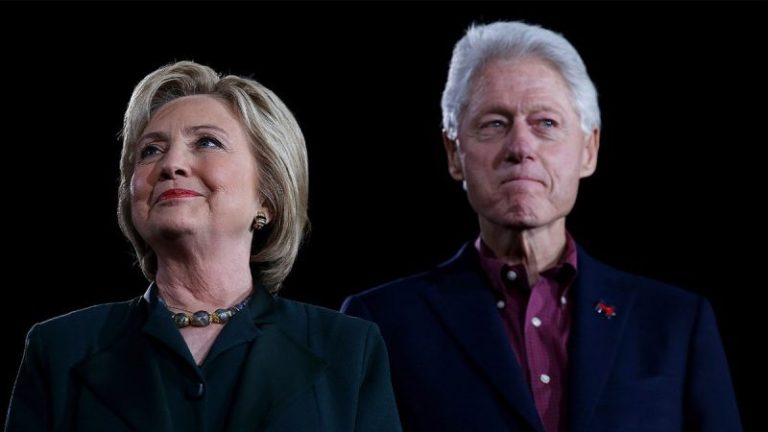
A House panel Wednesday voted in favor of subpoenaing former President Bill Clinton and former Secretary of State Hillary Clinton.

Rep. Scott Perry, R-Pa., offered a motion during a House Oversight Committee subcommittee hearing to call on Committee Chairman James Comer, R-Ky., to subpoena people with possible links to Ghislaine Maxwell, the imprisoned former associate of late pedophile Jeffrey Epstein.

‘I have a motion to subpoena the following individuals to expand the full committees investigation into Miss Maxwell – and the list reads as follows: William Jefferson Clinton, Hillary Diane Rodham Clinton, James Brian Comey, Loretta Elizabeth Lynch, Eric Hampton Holder, Jr., Merrick Brian Garland, Robert Swan Mueller III, William Pelham Barr, Jefferson Beauregard Sessions the third, and Alberto Gonzales. That’s the full list, Mr. Chairman. And that’s the motion,’ Perry said.

The motion passed by voice vote, meaning there was not an individual roll call.

The subpoenas would actually need to be issued by Comer to be active.

A House Oversight Committee aide told Fox News Digital, ‘The subpoenas will be issued in the near future.’

It comes after Rep. Summer Lee, D-Pa., a member of the progressive ‘Squad,’ pushed for a vote on her own motion to subpoena any files related to Epstein.

That motion passed in an 8-to-2 vote, also directing Comer to issue that subpoena.

Republican lawmakers have dealt with a barrage of media scrutiny on Epstein’s case over the last two weeks. It’s a side effect of the fallout over a recent Department of Justice (DOJ) memo effectively declaring the matter closed.

Figures on the far-right have hammered Trump officials like Attorney General Pam Bondi, accusing them of going back on earlier vows of transparency.

At Trump’s direction, the DOJ is moving to have grand jury files related to Epstein’s case unsealed. Bondi is looking into whether imprisoned former Epstein associate Ghislaine Maxwell will speak with federal authorities as well.

A House GOP-led motion directing Comer to subpoena Maxwell passed the House Oversight Committee unanimously on Tuesday, and Comer issued the subpoena the following day.

But Democrats have nonetheless seized on the Republican discord with newfound calls of their own for transparency in Epstein’s case. 

Wednesday’s hearing by the Oversight Committee’s subcommittee on federal law enforcement was unrelated to Epstein — but it’s part of a pattern of Democratic lawmakers in the House using any opportunity to force Republicans into an uncomfortable political position on the issue.

Rep. Andy Biggs, R-Ariz., another member of the subcommittee, successfully got Lee’s amendment altered to also call for the release of Biden administration communications related to Epstein.

Fox News Digital reached out to the Clinton Foundation for comment but did not immediately hear back.

This post appeared first on FOX NEWS

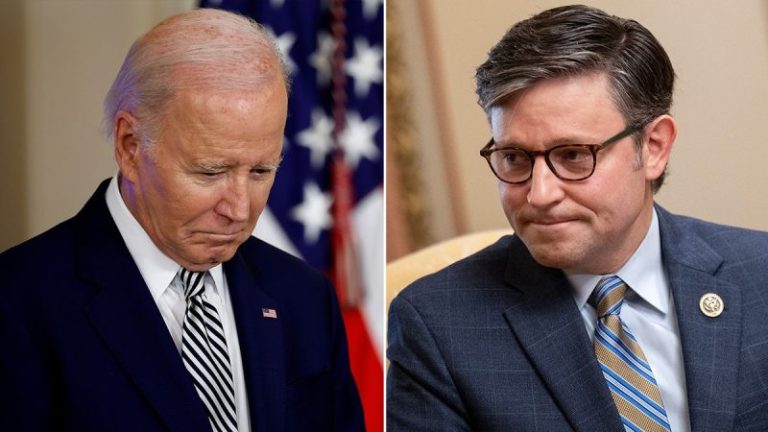
Speaker Mike Johnson, R-La., accused Democrats of orchestrating a ‘cover-up’ of President Joe Biden’s signs of mental decline in a set of remarks to reporters on Wednesday.

The leader of the House of Representatives criticized left-wing lawmakers for their public pressure campaign regarding Jeffrey Epstein’s case, dismissing their calls for transparency as a hypocritical political ploy.

‘We will not be lectured on transparency by the same party that orchestrated one of the most shameless, dangerous political cover-ups in the history of the United States – and that was President Biden’s obvious mental decline,’ Johnson told reporters.

‘House Republicans stand for maximum transparency and truth. We always have, and we always will.’

It comes as the House Oversight Committee continues to investigate allegations that the former president’s top White House aides obscured signs of mental and physical decline in the octogenarian leader from the public and others in the administration.

Biden told The New York Times earlier this month that he was fully aware of every decision he made in a story regarding his use of autopen for clemency orders.

Johnson and other Republican lawmakers have dealt with a barrage of media scrutiny on Epstein’s case over the last two weeks. It’s a side effect of the fallout over a recent Department of Justice (DOJ) memo effectively declaring the matter closed.

Figures on the far-right have hammered Trump officials like Attorney General Pam Bondi, accusing them of going back on earlier vows of transparency.

At Trump’s direction, the DOJ is moving to have grand jury files related to Epstein’s case unsealed. Bondi is looking into whether imprisoned former Epstein associate Ghislaine Maxwell will speak with federal authorities as well.

Democrats seized on the discord by forcing Republicans on a key panel – the House Rules Committee – to take multiple votes on whether to make files related to Epstein’s case public.

GOP lawmakers’ frustration at being put into a tough political situation forced House Republicans’ agenda to partially grind to a halt this week, forcing leaders to send the House into August recess a day earlier than initially planned.

Some Republicans are frustrated with the Trump administration’s handling of the issue, while others are angry at fellow GOP lawmakers joining Democrats in public calls for transparency.

Many, like Johnson, have accused Democrats of operating on a double-standard. 

‘The way Democrats have tried to weaponize this issue is absolutely shameless. And I just want to say this – Democrats said nothing and did nothing, absolutely nothing, about bringing transparency for the entire four years of the Biden presidency,’ the speaker said. But now, all of a sudden, they want the American people to believe that they actually care.’

When reached for comment, a spokesperson for House Minority Leader Hakeem Jeffries, D-N.Y., pointed Fox News Digital to his remarks on Epstein earlier this week, questioning what Republicans were ‘hiding.’

‘Jeffrey Epstein committed suicide during the Trump administration. Trump administration officials have said, prior to arriving in Washington in positions of prominence, including at the FBI and the Department of Justice, that they were going to release the Epstein files. Trump administration officials are now in a position to release the Epstein files,’ Jeffries said. 

‘Does any of that, in your view, have anything to do with President Joe Biden? Why do we think President Joe Biden or President Barack Obama’s names are being invoked?’

Fox News Digital also reached out to the office of former President Joe Biden for comment but did not immediately hear back.

This post appeared first on FOX NEWS

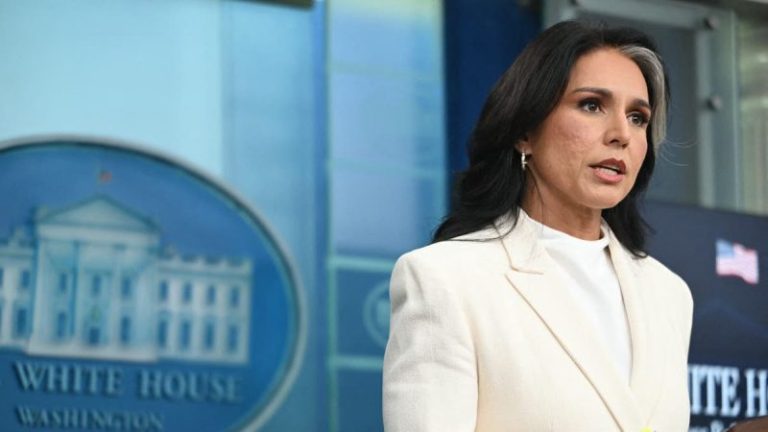
Director of National Intelligence Tulsi Gabbard doubled down at a White House press briefing Wednesday, alleging the Obama administration promoted a ‘contrived narrative’ that Russia interfered in the 2016 election. 

‘There is irrefutable evidence that details how President Obama and his national security team directed the creation of an intelligence community assessment that they knew was false,’ Gabbard said. ‘They knew it would promote this contrived narrative that Russia interfered in the 2016 election to help President Trump win, selling it to the American people as though it were true. It wasn’t.’ 

Gabbard’s comments come amid the declassification of a trove of documents from the U.S. intelligence community that allege the Obama administration politicized intelligence, and that U.S. intelligence organizations did not have direct information that Russian President Vladimir Putin sought to support Trump’s election in 2016. 


‘All come back to and confirm the same report: There was a gross politicization and manipulation of intelligence by the Obama administration intended to delegitimize President Trump even before he was inaugurated, ultimately usurping the will of the American people,’ Gabbard said. 

Gabbard also said that the declassified documents have been shared with the Department of Justice and the FBI so those agencies can evaluate if any criminal implications stemming from the materials are warranted. 

‘We have referred and will continue to refer all of these documents to the Department of Justice and the FBI, to investigate the criminal implications of this for the evidence,’ Gabbard said. ‘Correct. The evidence that we have found, and that we have released, directly point to President Obama leading the manufacturing of this intelligence assessment. There are multiple pieces of evidence and intelligence that confirm that fact.’

On Tuesday, President Donald Trump accused former President Barack Obama of being the ‘ringleader’ of investigations into whether his campaign colluded with Russia in the 2016 election. 

In response, a spokesperson for Obama labeled the accusations ‘bizarre’ and said the new documents do not alter the conclusions of previous intelligence assessments, including a 2020 report from the Senate Intelligence Committee that was chaired by now-Secretary of State Marco Rubio. 

‘Out of respect for the office of the presidency, our office does not normally dignify the constant nonsense and misinformation flowing out of this White House with a response,’ Obama spokesman Patrick Rodenbush said in a statement. ‘But these claims are outrageous enough to merit one.’ 

‘These bizarre allegations are ridiculous and a weak attempt at distraction,’ Rodenbush said. ‘Nothing in the document issued last week undercuts the widely accepted conclusion that Russia worked to influence the 2016 presidential election but did not successfully manipulate any votes.’ 

A spokesperson for Obama did not immediately respond to a request for comment from Fox News Digital Wednesday. 

The newly declassified documents name Obama, in addition to other administration officials, including Director of National Intelligence James Clapper, CIA Director John Brennan, National Security Advisor Susan Rice, Secretary of State John Kerry, Attorney General Loretta Lynch and Deputy FBI Director Andrew McCabe. 

Fox News Digital previously reported that Gabbard sent a criminal referral to the Justice Department pertaining to the newly declassified material, but the agency did not disclose specifics regarding whom the criminal referral targeted. 

The Justice Department did not immediately respond to a request for comment from Fox News Digital on Wednesday. 

Gabbard’s appearance before reporters at the White House came just hours after she released a 2020 report from the House Permanent Select Committee on Intelligence, which said the intelligence community published ‘potentially biased’ or ‘implausible’ intelligence suggesting Putin sought to help Trump win the election, per the ‘unusual’ orders of Obama. 

Fox News’ Brooke Singman and Mike Emanuel contributed to this report. 

This post appeared first on FOX NEWS

Corporations are continuing to spend on business travel, but are being strategic about how they allocate those dollars amid ongoing trade uncertainties, according to new reports from the travel and expense platform Navan and the Global Business Travel Association.

Corporate travel spending activity increased 15% year over year in the second quarter of 2025, according to a business travel index published Tuesday from Navan.

Navan’s index, backed by Nasdaq, is derived from millions of corporate business transactions on its platform. It examines the amount spent and number of transactions relating to airline travel, hotel reservations and expense transactions from corporate cards.

Amy Butte, Navan’s CFO, said during an interview that from talking with other chief financial officers over the past few months, she never got the sense that corporate leaders would stop spending on business travel altogether. Instead, they are in “wait and see” mode.

“If you’re making choices about where you’re being cautious, we’re not seeing people be cautious in the area of relationship building, either with their customers or with their teammates. We’re still seeing the spend allocated towards travel as a key component of any business strategy,” Butte said.

But while global business travel is expected to reach a new high of $1.57 trillion in 2025, according to a Monday report by the Global Business Travel Association, that total represents 6.6% year-over-year growth, which is less than the 10.4% increase that was previously predicted. GBTA cited trade tensions, policy uncertainty and economic pressures as the reasons for the more moderate growth.

A string of sentiment polls by GBTA also shows that corporate travel optimism for the rest of 2025 appears muted. The percentage of respondents who said they were optimistic about the overall outlook for the business travel industry in 2025 dropped sharply from 67% in November 2024 to 31% in April and declined slightly again this month to 28%.

The findings from both reports, grouped together with commentary from airline CEOs last week, show C-suite leaders are still largely left in wait-and-see mode amid President Donald Trump’s fluid tariff policies, but companies appear now to have a better read on how they will manage the uncertainty.

“Historically, corporate travel has been the first thing, one of the easiest things, to minimize if you’re a company,” Delta Air Lines CEO Ed Bastian said during the company’s earnings call this month, adding that corporate travel on the airline has been flat on a year-over-year basis.

But Butte said that Navan has not seen a drop-off in business travel. Instead, businesses are shifting how they are spending.

For example, Butte said businesses are continuing to commit to individual, face-to-face meetings, rather than spending on large group outings. The Navan index shows that spending on personal meals, meaning one-on-one meetings held over a meal, was up 9.8% from last year, while spending on team events and meals was the only category in the report that declined.

Navan did see some compression earlier in the year in the share of higher-priced airline tickets purchased that were first class or business class, Butte said, but she added that the platform has since seen an acceleration as uncertainty has lessened.

Airfare prices have also declined so far this year, which means business and consumers alike are spending less on plane tickets. Airfare fell 3.5% in June from a year earlier while inflation overall rose, according to the Bureau of Labor Statistics.

GBTA CEO Suzanne Neufang said during an interview that CFOs have not cut travel spending off entirely, but are looking for efficient ways to get employees on the road. This may look like booking multicity trips, scheduling multiple meetings per trip or booking fewer trips per month, she said.

Neufang said the business travel industry has been focused over the past five years on making sure every trip has a purpose and delivers a return on investment.

“Gone are the days when there’s really frivolous business traveling,” Neufang said.

The new findings on business travel spending also come as airlines are reporting their quarterly earnings.

When Delta reported earnings on July 10, Bastian said he expects both consumer and corporate confidence to improve in the second half of the year, creating an environment for travel demand to accelerate.

Delta and other airlines saw travel demand come in weaker than expected at the beginning of the year, especially from price-sensitive customers traveling domestically. Bastian said back in April that Trump’s trade policies were hurting bookings.

Bastian took a more positive tone this month, telling CNBC that corporate travel has stabilized as businesses have more clarity and confidence than they did earlier this year. But he said corporate travel is in line with last year, not the 5% to 10% growth Delta expected at the start of the year.

Meanwhile, Delta President Glen Hauenstein said on an earnings call this month that corporate travel trends are “choppy” and overall corporate volumes are expected to be “flattish” over last year.

United Airlines reported earnings last week. CEO Scott Kirby said during the company’s call with analysts that so far this month, the airline has seen a double-digit acceleration in business demand as uncertainty has declined.

Andrew Nocella, United’s executive vice president and chief commercial officer, added that the business traffic growth is “across the board” and not restricted to any singular hub or vertical, which he said reflects lessening macroeconomic uncertainty.

Southwest Airlines, Alaska Airlines and American Airlines are scheduled to report their quarterly results this week.

This post appeared first on NBC NEWS

There’s a new player making waves in an industry dominated by big banks.

Imprint, the 5-year-old credit card startup, beat out banks in a competitive bidding process for a new co-branded card from online shopping platform Rakuten, CNBC has learned.

The deal is the most recent sign that Imprint is gaining traction in the co-branded credit card industry.

The New York-based startup also just raised $70 million in additional capital, boosting its valuation by 50% to $900 million less than a year from its previous round, according to Imprint CEO Daragh Murphy.

Credit card partnerships with retailers, airlines and hotels are some of the most hotly contested deals in finance. Brands often go through extensive bidding processes to select a card company, while the companies compete for the right to issue cards to millions of loyal customers. The industry’s largest players include JPMorgan Chase, Capital One, Citigroup and Synchrony.

“We’re talking to Fortune 500 companies about being their partner and them choosing us over Synchrony, over Barclays, over U.S. Bank,” Murphy said in an interview. “We have to kind of walk and talk like we’re a big, important company, even though we still have a startup ethos.”

That’s why the company recently raised capital, bringing its total to $330 million, most of which is held on the firm’s balance sheet, according to Murphy. Those funds help show potential partners that Imprint has staying power, he said.

Imprint also has about $1.5 billion in credit lines from banks including Citigroup, Truist and Mizuho, which it uses to extend loans to card customers, Murphy said. The startup is behind the cards from brands including Eddie Bauer, Brooks Brothers and Turkish Airlines.

To offer its credit cards, Imprint usually partners with one of two small banks, First Electronic Bank or First Bank and Trust. Imprint handles the customer experience, including the technology and credit decisions, while using the credit card rails of regulated banks.

In the case of the Rakuten card, Imprint is relying on the American Express network, which allows users to get Amex purchase protections and other perks. It is using First Electronic Bank to help issue the cards.

“Though we’re not a regulated bank, we’re effectively building a bank,” Murphy said. “We have to do all the same things as a bank. We’re a capital markets company; we’re a compliance company; we’re a risk and credit and fraud company; we’re a technology company.”

To gain a toehold in the market for co-branded cards, which can be used anywhere credit cards are accepted, Imprint decided it would focus on a seamless digital experience for customers, Murphy said. That requires technology integration that is difficult for established players who rely on third-party companies including Fiserv to complete transactions, he said.

“The banks are in trouble because they don’t own the technology that the credit card runs on,” Murphy said. “Every credit card in your wallet, whether it’s Chase … or from Citi or Synchrony, they rely on two or three different third parties to power the technology.”

Imprint also decided to set itself apart by making it easy for customers to pay off their loans, Murphy said. Card companies including Bread Financial and Synchrony make a far larger percentage of revenue from late fees than Imprint does, he said.

“You shouldn’t have all these regressive late fees, and you shouldn’t make it hard to pay,” Murphy said. “The easier we make it to pay, the more likely you are to use the card, and the more likely you are to use the card, the better it is for everybody.”

Finally, Murphy said the company’s low customer acquisition costs allow it to fund more rewards for card users.

The new Rakuten card, for instance, offers users an extra 4% in cash back in addition to what customers earn through shopping on the online portal, capped at $7,000 in spending per year.

Users also earn 10% in cash back while dining at Rakuten’s partner restaurants, and 2% cash back on groceries and non-partner restaurants.

The previous Rakuten credit card was issued by Synchrony and discontinued in 2022.

This post appeared first on NBC NEWS

WASHINGTON — Bleach maker Clorox said Tuesday that it has sued information technology provider Cognizant over a devastating 2023 cyberattack, alleging that the hackers pulled off the intrusion simply by asking the tech company’s staff for employees’ passwords.

Clorox was one of several major companies hit in August 2023 by the hacking group dubbed Scattered Spider, which specializes in tricking IT help desks into handing over credentials and then using that access to lock them up for ransom. The group is often described as unusually sophisticated and persistent, but in a case filed in California state court on Tuesday, Clorox said one of Scattered Spider’s hackers was able to repeatedly steal employees’ passwords simply by asking for them.

“Cognizant was not duped by any elaborate ploy or sophisticated hacking techniques,” according to a copy of the lawsuit reviewed by Reuters. “The cybercriminal just called the Cognizant Service Desk, asked for credentials to access Clorox’s network, and Cognizant handed the credentials right over.”

Cognizant did not immediately return a message seeking comment on the suit, which was not immediately visible on the public docket of the Superior Court of Alameda County. Clorox provided Reuters with a receipt for the lawsuit from the court.

Three partial transcripts included in the lawsuit allegedly show conversations between the hacker and Cognizant support staff in which the intruder asks to have passwords reset and the support staff complies without verifying who they are talking to, for example by quizzing them on their employee identification number or their manager’s name.

“I don’t have a password, so I can’t connect,” the hacker says in one call. The agent replies, “Oh, ok. Ok. So let me provide the password to you ok?”

The 2023 hack caused $380 million in damages, Clorox said in the suit, about $50 million of which were tied to remedial costs and the rest of which were attributable to Clorox’s inability to ship products to retailers in the wake of the hack.

Clorox said the clean-up was hampered by other failures by Cognizant’s staff, including failure to de-activate certain accounts or properly restore data.

This post appeared first on NBC NEWS

The stock market feels like it’s holding its breath ahead of Big Tech earnings. The first two days of the trading week were mostly quiet, but Tuesday gave us a few nuggets worth chewing on.

The S&P 500 ($SPX) squeaked out another record close, up by a modest +0.06%. It’s barely a blip, but it keeps the uptrend intact.

Tech momentum slowed down a tad, but we didn’t see a wave of selling. It was more like a little profit-taking after a strong run. No reason to hit the panic button just yet.


StockCharts Tip: Head to the Market Summary page and take a glance at the Market Factors panel. On Tuesday, Large-Cap Growth and Large-Cap Momentum were the only factors in the red (see image below).


FIGURE 1. MARKET FACTORS PANEL IN THE MARKET SUMMARY PAGE. Here you see the one-day performance metrics of the factors. You can change the timeframe using the dropdown menu at the top of the page. Image source: StockCharts.com. For educational purposes.

In the US Sectors panel in the Market Summary page, Technology was the lone S&P 500 sector that finished lower. Tuesday’s action can be seen in the StockCharts MarketCarpet of the S&P 500, based on a one-day performance.

FIGURE 2. MARKETCARPET FOR THE S&P 500. The Technology sector took a bit of a hit on Tuesday, but other sectors saw gains. Image source: StockCharts.com. For educational purposes.

The big names — NVIDIA (NVDA), Microsoft Corp. (MSFT), Amazon.com (AMZN), Meta Platforms (META), and Broadcom (AVGO) — were all in the laggard camp. This pause in tech stocks comes right before a wave of Big Tech earnings.

Some of the big tech companies reporting earnings this week are Alphabet, Inc. (GOOGL), Tesla, Inc. (TSLA), and International Business Machines (IBM). All three report on Wednesday after the close. If GOOGL and TSLA come in hot with solid numbers and upbeat guidance, the S&P 500 and Nasdaq Composite ($COMPQ) could catch a tailwind. (Fun fact: both stocks closed higher on Tuesday.)

Despite Tuesday’s tech wobble, major support levels are holding. The Nasdaq Composite remains comfortably above its 20-day exponential moving average (EMA), and breadth is improving (see chart below).

FIGURE 3. DAILY CHART OF THE NASDAQ COMPOSITE. The index is above its 20-day exponential moving average, and market breadth is improving. Chart source: StockCharts.com. For educational purposes.

Small Caps Still in the Game

We’re also seeing small-cap stocks rising. When small-caps participate in the market’s upside move, it’s an indication of a healthy stock market. Healthcare stocks represent a significant portion of the small-cap indexes, which explains why Health Care was the top-performing sector on Tuesday. 

Another area that stole the spotlight was homebuilders. The SPDR S&P Homebuilders ETF (XHB) broke above its 200-day simple moving average (SMA), a positive sign for the struggling industry group (see chart below). Its Relative Strength Index (RSI) indicates that momentum is relatively strong.

FIGURE 4. SPDR S&P HOMEBUILDERS ETF (XHB). The ETF broke above its 200-day simple moving average, and momentum is relatively strong. XHB has underperformed SPY over the last year. Chart source: StockCharts.com. For educational purposes.

Over the last year, XHB has lagged the SPDR S&P 500 ETF (SPY) by roughly 18%. Strong earnings from DR Horton, Inc. (DHI) and PulteGroup, Inc. (PHM), however, have given the group a welcome boost, even with a soft housing backdrop. We’ll get the June Existing Home Sales data on Wednesday. A stronger-than-expected report could add fuel to XHB’s rally.


StockCharts Tip: The XHB chart above is part of the  Market Summary ChartPack, which is free for StockCharts subscribers. Install it, and you’ll have a ready-to-use list of charts for days like this.


Also worth a peek is the U.S. Dow Jones Home Construction Index ($DJUSHB), which topped the Dow Industries list (check the US Industries panel in Market Summary and hit the Dow Industries tab).

Gold and Silver Nudge Higher

While tech cooled and home builders heated up, precious metals prices climbed higher. Gold ($GOLD) rose 0.92% and silver ($SILVER) gained 0.94%. Gold sits just under its all-time high, and silver is back to levels we haven’t seen since 2011.

The Big Picture: Still a Healthy Market Environment

None of Tuesday’s actions suggests a crack in the market’s growth story. We are in the thick of earnings season, and that always brings uncertainty and volatility. Expectations are high for Big Tech, especially in light of a weaker dollar. Stay patient, watch the price action, and let the charts guide your next move.


Disclaimer: This blog is for educational purposes only and should not be construed as financial advice. The ideas and strategies should never be used without first assessing your own personal and financial situation, or without consulting a financial professional.


(TheNewswire)


July 22, 2025 TheNewswire – Vancouver, British Columbia, Canada JZR Gold Inc. (TSXV:  JZR) (the ‘ Company ‘ or ‘ JZR ‘) is pleased to announce that it has completed its previously announced non-brokered private placement (the ‘ Offering ‘) of units (each, a ‘ Unit ‘) at a price of $0.30 per Unit. Pursuant to the Offering, which was announced on July 11, 2025, the Company has issued 6,000,000 Units for aggregate gross proceeds of CAD$1,800,000. The Company also wishes to announce that, due to investor interest, the Offering was increased from $1,500,000 to $1,800,000.


  Each Unit consists of one common share in the capital of the Company (each, a ‘S   hare   ‘) and one common share purchase warrant (each, a ‘   Warrant   ‘). Each Warrant is exercisable into one additional Share (each, a ‘   Warrant Share   ‘) at a price of $0.40 per Warrant Share for a period of two (2) years from the date of issuance, subject to acceleration. The Warrants are subject to an acceleration provision whereby, in the event that the volume weighted average trading price of the Company’s common shares traded on TSX Venture Exchange (the ‘   Exchange   ‘), or any other stock exchange on which the Company’s common shares are then listed, is equal to or greater than $0.75 for a period of 10 consecutive trading days, the Company shall have the right to accelerate the expiry date of the Warrants by giving written notice to the holders of the Warrants that the Warrants will expire on the date that is not less than 30 days from the date that notice is provided by the Company to the Warrant holders. The Company did not pay any finder’s fees in closing this Offering.  


  The Units, Shares, Warrants, and Warrant Shares are collectively referred to as the ‘   Securities   ‘. The Securities are subject to a hold period of four months and one day from the date of Closing.  


  The Company intends to use the net proceeds from the Offering to fund operations of the fully constructed 800 tonne-per-day gravimetric mill, as well as future exploration work on the Vila Nova Gold project located in Amapa State, Brazil, and for general working capital purposes. JZR has been advised by its Joint Venture Royalty Agreement partner, ECO Mining Oil & Gaz Drilling and Exploration Ltda. (EIRELI) (‘ECO’), that the Mill is fully operational, but ECO is completing a few minor improvements to the Mill to improve operational efficiency. There will be further updates regarding operations in the immediate future.  


For further information, please contact:


Robert Klenk


Chief Executive Officer


  rob@jzrgold.com  


Forward-Looking Information


  This press release contains certain ‘forward-looking information’ within the meaning of applicable Canadian securities legislation. Forward-looking information in this press release includes all statements that are not historical facts, including, without limitation, statements with respect to the details of the Offering, including the proposed size, timing and the expected use of proceeds and the receipt of regulatory approval for the Offering; the testing and anticipated commencement of operation of the Mill. Forward-looking information reflects the expectations or beliefs of management of the Company based on information currently available to it. Forward-looking information is subject to known and unknown risks, uncertainties and other factors that may cause the actual results, level of activity, performance or achievements of the Company to be materially different from those expressed or implied by such forward-looking information. These factors include, but are not limited to:   the Company may not complete the Offering; the Offering may not be approved by the TSX Venture Exchange;   risks associated with the business of the Company; the Mill may not commence operating once testing has been completed, or at all; business and economic conditions in the mineral exploration industry generally; the supply and demand for labour and other project inputs; changes in commodity prices; changes in interest and currency exchange rates; risks related to inaccurate geological and engineering assumptions; risks relating to unanticipated operational difficulties (including failure of equipment or processes to operate in accordance with the specifications or expectations, cost escalation, unavailability of materials and equipment, government action or delays in the receipt of government approvals, industrial disturbances or other job action and unanticipated events related to health, safety and environmental matters); risks related to adverse weather conditions; political risk and social unrest; changes in general economic conditions or conditions in the financial markets; and   other risk factors as detailed from time to time in the Company’s continuous disclosure documents filed with the Canadian securities regulators.  The forward-looking information contained in this press release is expressly qualified in its entirety by this cautionary statement.  The Company does not undertake to update any forward-looking information, except as required by applicable securities laws.  


  Neither the TSX Venture Exchange nor its regulation services provider (as that term is defined in the policies of the TSX Venture Exchange) accepts responsibility for the adequacy or accuracy of this press release.  


  None of the securities of JZR have been registered under the U.S. Securities Act of 1933, as amended (the ‘U.S. Securities Act’), or any state securities law, and may not be offered or sold in the United States or to, or for the account or benefit of, persons in the United States or ‘U.S. persons’ (as such term is defined in Regulation S under the U.S. Securities Act) absent registration or an exemption from such registration requirements. This press release shall not constitute an offer to sell or the solicitation of an offer to buy in the United States nor shall there be any sale of the securities in any State in which such offer, solicitation or sale would be unlawful.  


NOT FOR DISTRIBUTION TO U.S. NEWSWIRE SERVICES OR FOR RELEASE, PUBLICATION, DISTRIBUTION OR DISSEMINATION, DIRECTLY OR INDIRECTLY, IN WHOLE OR IN PART, IN OR INTO THE UNITED STATES.


Copyright (c) 2025 TheNewswire – All rights reserved.


News Provided by TheNewsWire via QuoteMedia

This post appeared first on investingnews.com

The cannabis market has faced unexpected challenges in 2025, despite initial optimism for rescheduling in the US. 

While US federal regulatory uncertainty and banking remain persistent, companies are shifting focus to match changes in consumer behavior. The growing popularity of edibles and rising interest in cannabis-infused beverages reflect evolving demand in a persevering industry.

Cannabis companies in the sector continue to move forward and develop their offerings, and with potential catalysts ahead, some investors are interested in getting involved. Looking at the key players is often a good place to get started, so this list of US and Canadian cannabis stocks covers the companies with the largest presence in two major cannabis ETFs.

This list of the biggest publicly traded cannabis companies was put together based on the top-weighted cannabis stocks included in the AdvisorShares Pure US Cannabis ETF (ARCA:MSOS) and the Horizons Marijuana Life Sciences Index ETF (TSX:HMMJ) as of July 16, 2025. Share price information for the companies was accurate as of that time.

US cannabis market

Cannabis is federally illegal in the US, but state market openings have allowed some operators to thrive. Typically these firms set up vertically integrated businesses with a focus on branded products, retail networks and licenses.

While these companies have adapted to regulatory challenges, they have much to gain from country-level reform in the US, and are eager to see more welcoming federal laws that will allow their businesses to develop further.

Top cannabis stocks in the AdvisorShares Pure US Cannabis ETF

The AdvisorShares Pure US Cannabis ETF provides exposure to public companies exclusively operating within the US cannabis industry. By investing in companies that are working in states with clear guidelines, MSOS gives investors a way to be more selective about the types of cannabis companies they’re investing in.

1. Green Thumb Industries (CSE:GTII,OTCQX:GTBIF)

ETF weight: 32.06 percent
Market cap: US$1.36 billion
Share price: US$5.72

Green Thumb Industries is a multi-state operator (MSO) with headquarters in Chicago, Illinois.

The company is involved in the entire process of the industry, from cultivating and producing cannabis products to selling them in its own retail stores, of which there are many across the United States. Green Thumb Industries owns a portfolio of well-known cannabis brands like Rythm, Beboe, Dogwalkers, Incredibles and Doctor Solomon’s.

2. Trulieve Cannabis (CSE:TRUL,OTCQX:TCNNF)

ETF weight: 22.59 percent
Market cap: US$781.51 million
Share price: US$4.09

Trulieve is another major player in the cannabis industry, with a strong focus on medical cannabis. The company offers a diverse selection of cannabis products, including flower, pre-rolls, concentrates, edibles, topicals and more.

Vertically integrated, Trulieve Cannabis has a dominant market share in its home state of Florida, as well as in Arizona and Pennsylvania. In June 2024, the company opened its 200th dispensary in the United States.

3. Curaleaf Holdings (TSX:CURA,OTCQX:CURLF)

ETF weight: 15.37 percent
Market cap: US$764.16 million
Share price: US$1.00

Curaleaf Holdings has a significant presence in the US cannabis market, with around 150 dispensaries and several cultivation centers across 17 states. The company is also continuing its expansion into the European cannabis sector, where it already has a strong presence. Curaleaf has a wide range of brands covering a variety of cannabis product types, including flower, vapes, edibles and hemp-derived THC beverages.

4. Glass House Brands (CBOE:GLAS.A.U,OTC Pink:GHBWF)

ETF weight: 7.32 percent
Market cap: US$269.57 million
Share price: US$5.40

Glass House Brands is a vertically integrated cannabis company with a focus on the California market. The company is has placed an emphasis on sustainable practices at its large-scale cultivation facility in Camarillo, California. Glass House Brands is also a major producer and wholesaler of cannabis biomass and cannabis oil to other manufacturers and extractors in the industry.

Glass House offers a diverse range of cannabis products through its various brands and retail operations, including edibles and wellness products under its Mama Sue Wellness brand.

5. Cresco Labs (CSE:CL,OTCQX:CRLBF)

ETF weight: 5.53 percent
Market cap: US$235.9 million
Share price: US$0.53

Cresco Labs is a vertically integrated multi-state cannabis operator in the United States. A leading US cannabis company, it is known for its strong brands like Cresco, High Supply and Good News.

Cresco Labs controls its supply chain from cultivation to retail, offering a wide range of products. While it has its own stores, it focuses heavily on wholesale, getting its products into dispensaries across the country.

Canadian cannabis market

In 2018, Canada became the first G7 nation to legalize adult-use cannabis and create its own streamlined program regulated by both federal and provincial powers. Since then, companies working in the country have faced ups and downs in dealing with tight marketing rules, high tax rates and ongoing competition with the unregulated market.

Top cannabis stocks in the Global X Marijuana Life Sciences Index ETF

The Global X Marijuana Life Sciences Index ETF was the first cannabis ETF available in Canada, and it holds a variety of publicly traded companies involved in cannabis, along with several non-flower companies.

While HMMJ does not invest in US-based multi-state operators, it does have exposure to the US market through Canadian companies that have interests in the US cannabis industry. Overall, HMMJ is designed to give investors broad exposure to the cannabis industry, with a particular focus on North American companies.

1. Jazz Pharmaceuticals (NASDAQ:JAZZ)

ETF weight: 16.47 percent
Market cap: US$7.02 billion
Share price: US$116.08

Jazz Pharmaceuticals is a global biopharmaceutical company focused on developing and commercializing medicines for people with serious diseases, often with limited or no other options. They have a diverse portfolio of products in areas like sleep disorders, cancer and epilepsy.

Jazz Pharmaceuticals’ cannabis business stems from their 2021 acquisition of GW Pharmaceuticals and its epilepsy medicine Epidiolex for a whopping US$7.2 billion. This made big waves as it was one of the largest moves by a traditional pharmaceutical company into the cannabis space.

2. Cronos Group (NASDAQ:CRON,TSX:CRON)

ETF weight: 13.14 percent
Market cap: US$774.69 million
Share price: US$2.01

Cronos Group is the Canada-based company behind the Spinach, Peace Naturals and Lord Jones cannabis brands. In Canada, Cronos’ Spinach brand is in the top three for retail sales in the flower and edible categories.

The company also has a presence in Israel and Germany with its brand Peace Naturals. In late 2023, the company re-entered the German medical cannabis market through its partnership with a German medical cannabis company called Cansativa Group. Cronos serves the Israeli market through its subsidiary Cronos Israel.

3. Innovative Industrial Properties (NYSE:IIPR)

ETF weight: 11.28 percent
Market cap: US$1.51 billion
Share price: US$53.99

Innovative Industrial Properties is a real estate investment trust that provides specialized real estate opportunities for cannabis companies in 19 states. Its properties mostly consist of processing plants, greenhouses and warehouses, with retail spaces making up a small percentage of its portfolio.

The firm has provided long-term absolute net lease agreements to some of the cannabis industry’s biggest names, including Green Thumb, TILT Holdings (NEO:TILT,OTCQB:TLLTF), Ascend Wellness (CSE:AAWH.U,OTCQX:AAWH) and Curaleaf. The company’s sale-leaseback program has helped cannabis companies access a source of capital, a much-needed workaround in the US where there are fewer traditional financing options.

4. Scotts Miracle-Gro Co (NYSE:SMG)

ETF weight: 10.74 percent
Market cap: US$3.92 billion
Share price: US$67.92

Scotts Miracle-Gro is a leader in lawn and garden products, but its involvement in the cannabis industry comes through its Hawthorne Gardening Company subsidiary. Hawthorne is an ancillary provider, supplying essential hydroponic and indoor growing equipment, nutrients, lighting and environmental control systems for large-scale cannabis production.

5. SNDL (NASDAQ:SNDL)

ETF weight: 7.8 percent
Market cap: US$383.4 million
Share price: US$1.49

SNDL, formerly known as Sundial Growers, is the largest private-sector liquor and cannabis retailer on the Canadian market. They cultivate and sell cannabis products under various brands, including Top Leaf, Sundial Cannabis, Palmetto and more. They focus on premium indoor cultivation and have a strong presence in the Canadian market.

SNDL has faced financial challenges in the past, but in Q1 2025 the company’s cannabis business revenue grew year-over-year for the 13th consecutive quarter. The company has continued to make strategic investments in 2025.

FAQs for investing in cannabis

Are cannabis stocks worth investing in?

Each investor will have to think and act for themselves to manage their own risk exposure, but it’s no secret that cannabis stocks have taken a beating for some time now. While financial experts point to the long-term upside of US operators as more state markets expand, the stock market has not been kind to these names lately.

Are cannabis stocks considered a high- or low-risk investment?

Cannabis investments are extremely young in the grand scheme of the investment universe. There is an exciting and refreshing element to these stocks, but the market has always been characterized by volatility and unpredictability.

While wild, spontaneous swings in the open market have become less common, cannabis stocks are often moved — both positively and negatively — by big pieces of market news or legalization updates.

Why do people buy cannabis stocks?

Investors may choose to get exposure to the cannabis market as a way to participate in the development of a new drug market with consumer packaged goods capabilities. Some participants are bullish on the industry’s long-term outlook and expect more welcoming laws in the US and across the world to provide upward momentum.

Securities Disclosure: I, Meagen Seatter, hold no direct investment interest in any company mentioned in this article.

This post appeared first on investingnews.com